With casual warehouse wages in Australia now reaching A$33.85 per hour and prime Sydney warehouse rents climbing as high as A$500 per square metre, the DIY model is becoming increasingly expensive to maintain. This guide will show you how to identify the exact tipping point where your DIY logistics start holding you back. You’ll learn how to reclaim your time and scale your brand using a model that runs on autopilot. We will break down the true costs of Australian labor, the benefits of carrier volume discounts, and how real-time inventory visibility can provide the operational freedom you need to focus on marketing and growth.
Key Takeaways
- Understand the fundamental differences between in-house fulfillment vs 3pl to decide which model best supports your brand’s 2026 growth targets.
- Identify the “garage ceiling” and learn why reaching 500 to 1,500 monthly orders is the critical moment to transition away from DIY packing.
- Discover how cloud-based WMS and API connectors for Shopify and eBay provide more precise inventory control than manual in-house systems.
- Follow a streamlined two-step process to audit your inventory and sync your tech stack for an effortless move to professional logistics.
- Shift your focus from operational friction to strategic marketing by delegating pick, pack, and ship tasks to a scalable partner.
In-House vs 3PL: Defining the Choice in 2026
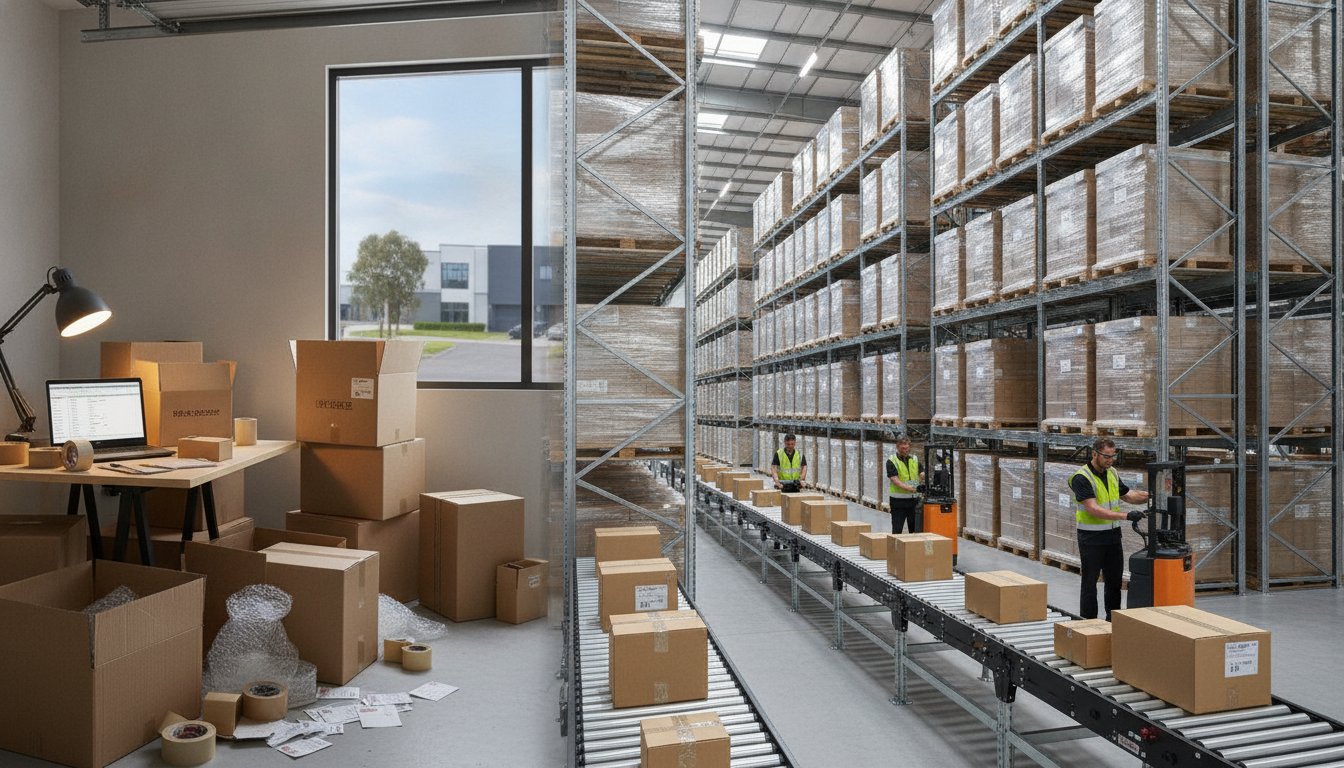
Choosing between in-house fulfillment vs 3pl is one of the most significant decisions an Australian eCommerce founder will make. It’s the difference between managing a warehouse and managing a brand. In-house fulfillment means you own the entire process. You lease the physical space, hire the staff, and buy the bubble wrap. It feels safe because you can see every parcel, but it’s a model built on rigid, fixed costs. Whether you ship ten orders or a thousand, your rent and warehouse worker wages remain a constant weight on your cash flow. Under current Australian awards, a full-time warehouse worker costs at least A$27.08 per hour, a cost you pay even during quiet sales periods.
A third-party logistics (3PL) provider, such as Pik Pak, takes over the physical heavy lifting. This includes inventory storage, pick, pack, and ship services, and returns management. You trade fixed overheads for a variable, pay-per-use model. In 2026, the definition of fulfillment has shifted. It’s no longer just about moving boxes; it’s about plugging your store into a high-performance engine that automates the logistics chain. The core differences include:
- Cost Structure: In-house involves fixed rent and salaries. 3PL uses variable costs that scale with your order volume.
- Workflow: In-house often relies on manual spreadsheets. 3PL uses automated, tech-driven workflows.
- Scalability: In-house is limited by your physical square meterage. 3PL offers virtually unlimited room to grow.
The 3PL Evolution: From Dusty Shelves to Strategic Tech
Modern logistics has moved past dusty shelves and manual clipboards. A 3PL now acts as the digital “back-end” of your business. With a cloud-based Warehouse Management System (WMS), you get real-time visibility into your stock levels across the country. Data is the new currency. If you can’t see your inventory levels on your phone while you’re at a meeting, your logistics model is outdated. You can learn more about how this works in our Complete Guide to 3PL. Modern providers act as the “back-end engine” that ensures your Shopify or eBay store remains synced and accurate 24/7.
The Self-Fulfillment Trap for Growing Brands
Many founders fall into the “Self-Fulfillment Trap.” They believe packing orders themselves is “free” because they aren’t paying a service fee. In reality, every hour spent taping boxes is an hour not spent on marketing or product strategy. This is the founder bottleneck. With casual warehouse rates at A$33.85 per hour and Sydney prime rents hitting A$500 per square metre, the “free” garage is actually a high-interest loan against your business growth. Shifting to a 3PL isn’t just an operational move; it’s a psychological one. It’s about deciding to be a CEO instead of a packer. Reclaiming your time allows you to refocus on the core objectives that actually drive revenue.
The Tipping Point: When to Move from DIY to 3PL
The “Garage Ceiling” isn’t just a physical limit; it’s a growth barrier. You know you’ve reached it when your living room is filled with bubble wrap and your shipping times start to slip. While packing 10 orders a day is a manageable morning task, scaling to 50 or 100 orders daily turns your business into a full-time logistics operation. This is where the in-house fulfillment vs 3pl debate moves from theoretical to financial. Manual packing is prone to errors. A single wrong item sent to a customer in Perth can cost you the profit from three other sales once you factor in return shipping and replacement costs. Precision is the antidote to this operational friction.
Most Australian brands reach a critical crossroad when they hit 500 to 1,000 monthly orders. At this volume, the complexity of managing inventory visibility and courier pickups begins to outweigh the perceived savings of DIY packing. If you’re spending more time solving delivery queries than creating new products, you’ve passed the tipping point. Transitioning to a professional partner allows you to delegate these burdens and refocus on your core business objectives.
Analyzing Your True Fulfillment Costs
Fixed costs are the silent killers of eCommerce margins. Leasing even a small industrial space in Sydney can cost between A$210 and A$500 per square metre. You pay that rent whether your shelves are full or empty. In contrast, a 3PL model is variable. You only pay for the storage space you actually occupy. There’s also the hidden cost of shipping. As of July 1, 2026, Australia Post increased domestic parcel rates by up to 5%, with a medium parcel now costing A$16.00 via Parcel Post. Because 3PLs ship thousands of items daily, they often access carrier volume discounts that individual brands simply can’t reach. If you want to see how these numbers stack up for your brand, you can explore our pick and pack service models.
Scalability and Seasonal Peaks
Black Friday and Christmas shouldn’t be periods of dread. If you’re fulfilling in-house, these peaks require hiring casual staff at A$33.85 per hour, including the 25% casual loading. Managing temporary workers adds another layer of stress to an already busy season. A 3PL absorbs these spikes through shared labor pools and automated systems, ensuring your shipping times remain consistent even during the November rush. Are you ready? 5 Signs You Need a 3PL to see if your current setup can handle the next big sales event.
Operational Realities: Control, Technology, and Brand Experience
Many business owners hesitate to outsource because they fear losing control over their orders. In reality, the in-house fulfillment vs 3pl comparison often reveals that “hands-on” control is actually a lack of visibility. If your inventory is tracked on a spreadsheet that requires manual updates, you aren’t in control; you’re just reacting to the latest error. A professional logistics partner replaces guesswork with precision. We use automated systems to track every SKU from the moment it arrives at the warehouse to the second it reaches the customer’s door. This level of detail provides a clearer picture of your business than a crowded garage ever could.
Technology is the bridge between your online store and the physical product. Connecting your Shopify, WooCommerce, or eBay store directly to a Warehouse Management System (WMS) eliminates the need for manual data entry. These pre-built API connectors ensure that when a customer buys your last item on eBay, your Shopify store updates instantly to prevent an oversell. This multi-channel synchronization is nearly impossible to maintain in-house without dedicated IT staff or expensive software subscriptions. It turns a complex logistical challenge into a simple, automated task.
The WMS: Your Single Source of Truth
A cloud-based WMS acts as the single source of truth for your entire operation. You can monitor stock levels, track order statuses, and view shipping performance in real-time from any device. This prevents the “Out of Stock” nightmare where customers purchase items you don’t actually have. By automating the order flow, your parcels move from the digital cart to the warehouse floor in seconds. This ensures faster dispatch times and higher customer satisfaction. Explore our Technology Support to see how these integrations simplify your daily operations.
Kitting, Assembly, and Returns
Maintaining your brand identity doesn’t stop when you outsource. Through custom kitting and assembly, you can still offer curated subscription boxes or promotional bundles that look exactly as you intended. Kitting allows you to bundle multiple products under a single SKU for promotional offers or subscription models. Professional 3PLs also manage reverse logistics, which is the process of handling returns. When a customer sends an item back, it’s inspected, processed, and restocked according to your specific guidelines. This keeps your inventory accurate and your customers happy without you ever having to touch a return label. Our Warehousing and Fulfilment services are designed to handle these complex tasks with ease.
The Seamless Transition: Moving from In-House to 3PL
Transitioning from in-house fulfillment vs 3pl is a strategic evolution that requires a clear roadmap. It isn’t just about moving boxes from one warehouse to another; it’s about migrating your entire operational heartbeat to a more scalable environment. A successful move starts with a rigorous inventory audit. This is your opportunity to purge slow-moving stock or dead inventory that has been taking up space in your garage or office. Sending only your “hero” products and active SKUs to the 3PL ensures you aren’t paying for storage on items that don’t sell. It keeps your capital working for you rather than sitting on a shelf.
Once your inventory is lean, the focus shifts to the technical sync. We test the API connection between your eCommerce platform and the WMS to ensure every order flows through without manual intervention. This technical bridge is what allows your business to scale without adding more staff. After the sync is verified, you organize the physical transfer of freight. The final step is receiving and slotting, where the warehouse team organizes your stock for rapid picking. This structure ensures that your first day with a 3PL is as smooth as your last day in-house. You can explore our transition support to see how we handle this heavy lifting for you.
Receiving Guidelines to Avoid Delays
Efficiency starts at the loading dock. To ensure your stock is available for sale the moment it arrives, you must follow strict Warehouse Receiving Guidelines. The most critical tool here is the Advanced Shipping Notice (ASN). This digital document tells the warehouse exactly what is arriving, how many units are in each box, and when to expect the truck. Accurate labelling is equally vital. If the warehouse team can identify your stock instantly, they can slot it into the picking face faster. This eliminates the “black hole” period where stock is in the building but not yet available for purchase online.
Managing the First 30 Days
The “Go-Live” phase is about building confidence in your new automated system. During the first 30 days, monitor your dispatch times and order accuracy closely through the WMS dashboard. This is also the time to train your customer service team to use the dashboard for tracking enquiries. Instead of walking into a back room to check a shelf, they can now give customers real-time updates with a few clicks. Setting reorder points within the WMS is another priority. These automated alerts tell you exactly when to restock, preventing the loss of sales on top-selling SKUs. This proactive approach turns logistics into a competitive advantage.
Why Pik Pak Logistics is the Pragmatic Choice for Australian Brands
Choosing between in-house fulfillment vs 3pl is ultimately a decision about where your energy belongs. We believe that logistics shouldn’t be a source of friction; it should be an invisible engine that powers your growth. The Pik Pak philosophy is built on simplifying complex backend processes so you can return to your core objective of building a brand. We don’t just provide shelf space. We provide a scalable infrastructure that adapts to your sales volume, whether you are navigating a quiet July or the intense pressure of a November peak. This isn’t just outsourcing. It’s a strategic pivot from being an operator to being a CEO.
Our strategic Melbourne hub is positioned to optimize national delivery times across Australia. From this central location, we leverage high-volume carrier relationships to ensure your parcels reach customers in Sydney, Brisbane, and Perth with maximum efficiency. This geographical advantage, combined with our transparent pricing model, ensures your margins remain protected. You won’t find hidden fees or complex surcharges here. Instead, you get a predictable cost structure that turns the fixed overhead of a warehouse into a flexible variable expense. It’s what we call “Freedom-as-a-Service,” allowing you to reclaim your time and focus on what actually drives revenue.
Tailored Support for Local eCommerce
We understand the unique challenges of the Australian market because we live in it. From managing the latest Australia Post rate updates to navigating local labor regulations, we handle the details that cause founder burnout. Every brand we partner with benefits from a professional approach that treats your inventory with the same precision you would. You aren’t just another account number; you’re a growing business that requires a reliable partner to maintain your reputation for fast, accurate shipping. Discover why we are the Ideal Partner for brands ready to step up their operational game.
Ready to Stop Packing and Start Scaling?
2026 is the year to stop letting cardboard boxes dictate your schedule. The transition from your current setup to our automated facility is designed to be effortless. Our team guides you through a simple process of auditing your stock, syncing your digital store, and receiving your inventory into our WMS. This move eliminates the manual errors and physical limitations that hold back your sales potential. If you’re ready to automate your operational friction and see what your brand can achieve with professional backing, it’s time to take the next step. Get Your Tailored 3PL Quote Today and start scaling with confidence.
Scale Your Australian Brand with Operational Freedom
Scaling a business shouldn’t mean spending more time in a warehouse. By recognizing the tipping point where manual packing hinders your growth, you can shift from a model of high fixed overheads to one of flexible, variable costs. The transition between in-house fulfillment vs 3pl is your opportunity to trade the stress of managing a physical space for the precision of automated systems. You gain real-time WMS visibility and seamless API integrations with platforms like Shopify and WooCommerce without the burden of a long-term commercial lease.
Delegating your logistics allows you to refocus on the strategic marketing and product development that built your brand in the first place. It’s time to stop being a packer and start being a CEO. We’re here to ensure your transition is effortless and your operations are secure. If you’re ready to reclaim your time and professionalize your delivery experience, request a tailored 3PL quote from Pik Pak Logistics. Your business has no limits when your logistics run on autopilot.
Frequently Asked Questions
What is the main difference between in-house fulfillment and a 3PL?
The main difference lies in who manages the physical operations and overheads. With in-house fulfillment, you are responsible for leasing warehouse space, hiring staff, and managing every step of the packing process. A 3PL provider takes over these tasks, converting your fixed costs into a variable model where you only pay for the storage and services you actually use.
How much does it typically cost to move from self-fulfillment to a 3PL?
Moving to a 3PL typically involves an initial setup fee and the cost of transporting your inventory to the new facility. For businesses operating in international hubs like Dubai, professional relocation experts like MIC Movers and Packers specialize in these types of commercial inventory transfers, ensuring that stock is moved safely and efficiently. These costs vary based on the complexity of your SKUs and the volume of stock being transferred. While there is an upfront investment, most brands find they recoup this quickly through lower courier rates and reduced operational overheads.
Will I lose control over how my packages are wrapped if I use a 3PL?
You don’t have to sacrifice your brand identity when outsourcing. Modern 3PLs offer kitting and assembly services that follow your specific brand guidelines, including custom tissue paper, stickers, or thank-you cards. You maintain control over the unboxing experience while delegating the repetitive task of packing to a professional team that ensures every order looks exactly as intended.
How long does the technical integration with my Shopify store take?
Technical integration with Shopify, WooCommerce, or eBay is often a matter of days rather than weeks. Most established 3PLs use pre-built API connectors that allow for a seamless sync between your store and the Warehouse Management System. This ensures your orders begin flowing to the warehouse floor almost immediately after the initial technical setup is complete.
Do 3PL companies handle customer returns and exchanges?
Yes, professional 3PLs manage the entire reverse logistics process. When a customer initiates a return, the items are sent back to the warehouse where they are inspected, processed, and either restocked or disposed of based on your instructions. This keeps your inventory levels accurate and removes the administrative burden of managing exchanges from your daily task list, keeping your customers happy.
Is there a minimum order volume required to work with a 3PL in Australia?
While some providers have strict minimums, the decision to use in-house fulfillment vs 3pl usually becomes most viable once you reach 500 to 1,000 orders per month. Below this volume, the per-order fees might be higher, but many growing Australian brands choose to switch earlier to reclaim their time for marketing and strategic business development.
What happens if the 3PL warehouse loses or damages my inventory?
Reputable 3PLs have strict receiving and storage protocols to minimize risk. In the rare event that inventory is lost or damaged within the warehouse, standard operating procedures and service level agreements (SLAs) typically outline the compensation or insurance coverage provided. Real-time WMS visibility allows you to monitor stock levels constantly, providing a clear audit trail for every SKU in the building.
Can a 3PL help me get better shipping rates with Australia Post or couriers?
Yes, a major benefit of using a 3PL is access to aggregated shipping rates. Because providers ship thousands of parcels daily, they can negotiate much lower rates with Australia Post and national couriers than an individual brand can. These savings often offset a significant portion of the pick and pack fees, making the 3PL model a highly cost-effective choice for growing businesses.