

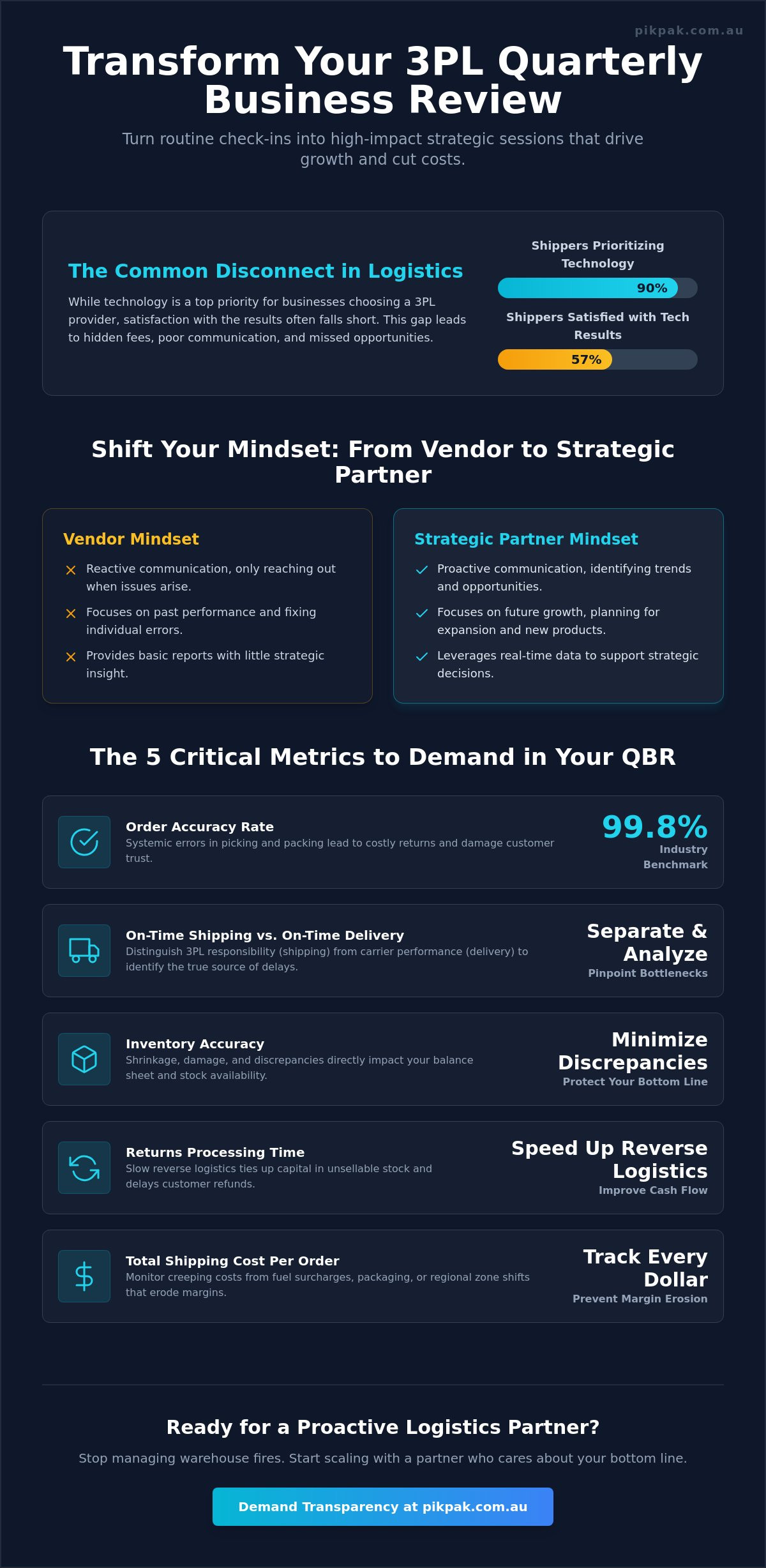
Is your quarterly business review with your 3pl just an hour of nodding at slide decks while your shipping costs continue to climb? It’s frustrating to feel like a small fish in a big pond, especially when you’re dealing with recurring inventory discrepancies and a warehouse that only reaches out when something goes wrong. You’re not alone in this struggle. While 90% of shippers prioritize technology when choosing a provider, only 57% are actually satisfied with the results they see. This gap often leads to unexplained fees and a total lack of proactive communication that holds your business back.
We’re going to change that. This guide shows you how to reclaim control and transform your QBR into a high-impact strategic session. You’ll learn how to leverage 2026’s tech-driven transparency to lower your cost per order and drive higher customer satisfaction scores. We’ll break down the exact metrics you need to demand and the communication habits that turn a simple vendor into a seasoned logistics partner. It’s time to stop managing warehouse fires and start scaling your business with a partner who cares about your bottom line as much as you do.
Key Takeaways
- Shift your logistics mindset from simple vendor management to a strategic partnership to unlock hidden growth opportunities.
- Master the five critical metrics, including the 99.8% order accuracy benchmark, that separate high-performing warehouses from the rest.
- Audit your tech stack to ensure seamless Shopify or WooCommerce integrations are reducing manual errors in your pick and pack process.
- Prepare for a successful quarterly business review with your 3pl by reconciling your store sales reports against actual billing data.
- Use your review session to set concrete 90-day goals for regional expansion or new product launches supported by real-time WMS data.
What is a 3PL QBR and Why is it Vital for Your eCommerce Growth?
A quarterly business review with your 3pl is a dedicated strategic alignment meeting where you and your logistics provider step away from daily warehouse fires to focus on the big picture. While many merchants treat their logistics provider as a simple vendor, a QBR shifts that relationship into a true strategic partnership. Understanding What is a 3PL is essential for any business owner, but the real value lies in how that provider supports your specific growth trajectory. In 2026, the global 3PL market is nearing $1.4 trillion. This scale means your logistics strategy is now a core competitive advantage rather than just a back-office expense.
Skipping these sessions creates significant operational risks. You might face ballooning shipping costs or stagnant technology integrations that can’t keep up with your competitors. Unaddressed service level agreement (SLA) breaches can quietly erode your customer trust. In Australia’s current market, speed and data accuracy are the primary ways to differentiate your brand. A structured review ensures you aren’t just reacting to problems but are actively planning for long-term efficiency.
The Difference Between a Monthly Report and a QBR
Think of your monthly report as a tactical fix for yesterday. It identifies which orders were late or which boxes were damaged. A QBR is different because it is strategic. Instead of obsessing over a single order error, you analyze long-term performance trends. It’s a time to evaluate if your 3PL services are evolving as your SKU count grows. If your provider isn’t discussing how to handle your next expansion or a new product line, they aren’t acting as a partner. Use this time to move beyond the “what” and focus on the “how” of your logistics performance.
Top 3 Benefits of a Structured Review
- Cost optimization: Identify shipping inefficiencies that aren’t obvious in daily billing. This often involves adjusting packaging or carrier tiers to lower your total cost per order.
- Risk mitigation: Spot inventory trends early. You can identify slow-moving stock or high return rates before they impact your cash flow.
- Improved customer experience: Align your delivery speeds with your marketing promises. If your website promises fast shipping, the QBR is where you verify that your logistics partner is actually delivering on that promise.
The 5 Critical Metrics to Review During Your Quarterly Business Review
Your quarterly business review with your 3pl should be rooted in hard data. Without specific metrics, the meeting becomes a vague conversation about “how things are going” rather than a strategic audit. This data-driven approach is more urgent than ever. A recent Gartner supply chain readiness survey shows only 29 percent of supply chain organizations have built necessary capabilities to deliver on future performance. Your review is the time to ensure you aren’t part of that struggling majority. Focus on these five pillars to gauge your logistics health.
First, demand an order accuracy rate of at least 99.8%. Anything lower suggests systemic issues in the pick and pack process that lead to expensive returns and unhappy customers. Second, distinguish between on-time shipping and on-time delivery. Your 3PL is responsible for getting the box out the door; the carrier handles the rest. If shipping is on time but delivery is slow, it’s time to re-evaluate your carrier mix. Third, audit your inventory accuracy. Shrinkage and discrepancies directly hit your balance sheet. Fourth, track returns processing time. Slow reverse logistics tie up capital in unsellable stock. Finally, monitor your total shipping cost per order. Watch for creeping fuel surcharges or regional zone shifts that might be quietly eroding your margins. If your current provider can’t provide this level of detail, it might be time to explore a more transparent partnership.
Analysing SLA (Service Level Agreement) Compliance
When a 3PL misses a same-day dispatch window, it’s not just a delay; it’s a breach of trust. Use data from your WMS platform to verify every performance claim. Don’t rely on verbal assurances. If you see consistent failures, discuss service credits or specific remedies. A reliable partner will welcome this transparency because it identifies where automation or staffing needs to improve. It’s about fixing the system, not just pointing fingers.
Inventory Health and SKU Rationalisation
Dead stock is a silent budget killer. Use your review to identify items that haven’t moved in 90 days. High storage density and smart warehousing and fulfilment strategies can lower your overhead significantly. This is also the moment to plan for seasonal stock builds. Whether you’re preparing for EOFY or Black Friday, your 3PL needs to know your volume projections to ensure they have the space and hands ready to handle the surge.
Evaluating Strategic Alignment and Technology Integration
A successful quarterly business review with your 3pl must look forward, not just backward. While metrics tell you what happened, your technology integration tells you what can happen. You need to assess your tech stack health. Are your Shopify or WooCommerce integrations seamless, or are you still dealing with sync errors during regional shipping peaks? In Australia, where logistics distances are vast, a broken data link can mean a package sits in a warehouse for an extra day. You should also evaluate local carrier performance to ensure your regional customers aren’t being neglected. This level of strategic alignment is the hallmark of a high-value quarterly business review with your 3pl.
Strategic alignment means your partner’s roadmap matches your own growth plans. This is where you discuss the Harvard Business Review on supply chain strategy and how it emphasizes resilience through better visibility. If your 3PL isn’t expanding their customer delivery options to include eco-friendly or express carriers, you’re losing ground. Automation is another key pillar. It’s the primary way to reduce human error during the pick and pack process. When your 3PL uses automated scanning and sorting, your order accuracy goes up and your operational friction disappears. Precision in these backend processes frees you up to focus on your core business goals.
The Power of Real-Time Data
Manual reporting is a major red flag in 2026. If you’re waiting for weekly spreadsheets to see stock levels, you’re operating in the dark. API-first 3PLs like Pik Pak eliminate this information lag by providing real-time data syncs. This visibility allows you to predict warehouse labour needs before sales events. You can see exactly when stock arrives and how fast it leaves. This level of control is essential for managing cash flow and customer expectations.
Proactive Problem Solving
Your review is the perfect time to evaluate how your partner handled last quarter’s biggest bottlenecks. Did they react quickly to a carrier delay? Use this session to identify new opportunities like kitting or bundling to increase average order value. A proactive partner doesn’t just ship boxes; they suggest ways to make operations more profitable. They act as a seasoned expert who eliminates inefficiency before it hits your bottom line.
How to Prepare for a Successful Review Session
A successful quarterly business review with your 3pl doesn’t happen by accident. It requires diligent preparation to ensure the conversation remains focused on growth rather than just debating old invoices. You must start by gathering your own data. Don’t rely solely on the reports provided by your warehouse. Instead, export your eCommerce store sales reports and compare them directly against your 3PL’s billing. This reconciliation process often reveals hidden discrepancies in storage fees or shipping zones that you can address during the meeting. It turns a passive update into an active audit of your logistics spend.
You also need to look beyond the numbers. Survey your customer service team to identify the most common complaints regarding shipping. If customers are consistently reporting damaged packaging or slow dispatch times in specific regions, these are the “Top 5” errors you must bring to the table. Finally, set a clear agenda. Ensure stakeholders from operations and finance are present so that decisions regarding new product lines or regional expansions can be made on the spot. This collaborative approach ensures everyone is aligned on the next 90 days of growth.
Your QBR Prep Checklist
- Review last quarter’s action items: Check what was promised versus what was actually delivered. Hold your partner accountable for previous commitments.
- Identify root causes: Don’t just list errors; find out why they happened. Is it a staffing issue or a technology gap?
- Share your marketing calendar: Forecasting volume spikes for the upcoming quarter helps the warehouse manage labour effectively. This is vital for avoiding delays during major Australian sales events.
Questions You Must Ask Your 3PL
Use this session to dig into the operational mechanics. Ask your provider, “What is our current cost-to-serve, and how can we reduce it?” This question forces a discussion about efficiency rather than just pricing. You should also ask about any bottlenecks in the warehouse receiving process. If your stock takes too long to go from the dock to the shelf, it’s costing you sales. Finally, ask about their technology roadmap. Knowing what new shipping lanes or automation tools are coming helps you stay ahead of the competition. This proactive communication ensures your quarterly business review with your 3pl actually moves the needle for your brand.
Preparation turns a routine check-in into a powerful tool for scaling. If you’re ready to partner with a logistics provider that values transparency and strategic growth, learn more about how Pik Pak supports your business goals through data-driven fulfillment.
Pik Pak Logistics: Your Partner in Proactive Business Reviews
Pik Pak Logistics isn’t just a warehouse; we’re a seasoned expert in your corner. While many providers treat fulfillment as a series of isolated tasks, we view every interaction as an opportunity to sharpen your operations. A quarterly business review with your 3pl shouldn’t be a chore you dread. At Pik Pak, these sessions are the engine of your growth. We move beyond standard pick and pack services to provide strategic consulting that actually impacts your profit margins. Our team analyzes your specific shipping patterns and inventory cycles to find efficiencies you might have missed. We’re here to help you scale, not just store your stock.
For example, one of our long-term partners recently saw a 15% reduction in their total shipping spend. This wasn’t due to luck. It was the direct result of proactive reviews where we identified regional zone shifts and optimized their carrier selection. This is the power of having a partner who cares about your bottom line as much as you do. We provide the clarity you need to reclaim your time and refocus on your core business objectives. You don’t have to manage the chaos of logistics when you have a partner who eliminates it for you. We take pride in being a supportive force for your brand’s expansion.
Effortless Integration and Transparent Reporting
Transparency is built into our DNA through our cloud-based WMS. You get 24/7 access to real-time reporting, so you never have to wait for a weekly spreadsheet to know where your stock is. Our technology support includes seamless API connectors for Shopify, WooCommerce, and other major platforms. This automation reduces human error and ensures your data is always accurate. We handle the complex backend processes so you can stay focused on scaling your brand. To see how we hold ourselves accountable, you can learn more about our service priorities and our commitment to precision.
Ready for a 3PL That Actually Partners With You?
Choosing a logistics provider is one of the most significant decisions for your eCommerce business. As an Australian-owned and operated company, we understand the unique nuances of the local market, from regional shipping peaks to local carrier networks. We don’t just want to be a vendor; we want to be the enabling force that removes your operational hurdles. If you’re tired of feeling like a number and want a logistics partner that proactively drives your success, it’s time to make a change. Request a Quote from Pik Pak Logistics Today and discover the difference a strategic partnership makes for your business.
Take Control of Your Logistics Strategy in 2026
Transforming your logistics from an operational burden into a growth engine starts with a shift in perspective. You’ve seen how tracking 99.8% order accuracy and auditing tech integrations can uncover hidden efficiencies that directly impact your margins. A well-executed quarterly business review with your 3pl is the difference between a stagnant warehouse and a scaling brand. By focusing on real-time data and strategic alignment, you ensure your logistics partner is actively contributing to your bottom line rather than just processing boxes.
At Pik Pak Logistics, we provide the tools you need to succeed, including real-time WMS visibility and dedicated Australian-based expert support. We hold ourselves to 99.8%+ order accuracy benchmarks to ensure your customers stay happy and your costs stay low. It’s time to delegate the operational friction and reclaim your time for what matters most: growing your business. Partner with a 3PL that prioritises your growth, Contact Pik Pak today. Your path to a more efficient and profitable supply chain starts with a single conversation. We’re ready to help you reach your next milestone.
Frequently Asked Questions
How long should a 3PL quarterly business review take?
A standard review usually takes between 60 and 90 minutes. This timeframe allows enough room to audit the previous quarter’s data while leaving space for strategic planning. If the session is shorter, you’re likely just skimming the surface. Longer sessions often get bogged down in tactical details that should be handled in monthly reports. Keeping it focused ensures everyone stays engaged and actionable goals are set.
Who should attend the QBR from my company?
You should bring your operations manager, a finance representative, and the person who manages the 3PL relationship daily. Having finance present is essential for discussing billing reconciliations and cost-to-serve metrics. Operations leaders ensure that the warehouse workflow aligns with your internal fulfillment goals. This mix of stakeholders ensures every decision is backed by both budget and reality. It prevents the need for follow-up meetings to confirm decisions.
What is the most important KPI to track in a 3PL review?
Order Accuracy Rate is the most critical metric to track during a quarterly business review with your 3pl. We recommend a benchmark of 99.8% for pick and pack operations. High accuracy reduces the cost of reverse logistics and protects your brand reputation. While shipping speed is important, sending the wrong item is a guaranteed way to lose a customer and increase your operational overhead. It’s the foundation of customer trust.
What happens if my 3PL refuses to do a QBR?
A refusal to conduct a QBR is a significant red flag that suggests a lack of transparency or investment in your success. In 2026, 74% of shippers report they would switch providers for better AI and reporting capabilities. If your partner won’t sit down for a strategic review, they’re treating you as a vendor rather than a partner. It’s often a sign that you’ve outgrown their capabilities or that they’re hiding poor performance metrics.
How can a QBR help me reduce my shipping costs in Australia?
A QBR helps reduce Australian shipping costs by identifying inefficiencies in carrier selection and regional zone shifts. You can analyze if you’re overpaying for express services in areas where standard delivery is just as fast. Reviewing your packaging dimensions can also reveal opportunities to lower cubic weights. These small adjustments across thousands of orders lead to substantial savings on your monthly freight bill. It turns shipping from a fixed cost into a managed expense.
Should I include my marketing team in the 3PL review?
Yes, your marketing team should participate to share upcoming sales calendars and product launch dates. Logistics teams need at least 30 days of lead time to prepare for volume spikes like Black Friday or EOFY sales. When marketing communicates these peaks early, the warehouse can adjust labor levels. This alignment prevents the dispatch delays that often frustrate customers during high-traffic periods. It ensures your fulfillment capacity matches your promotional ambitions, especially when coordinated with search specialists like seosem.sg who can align campaign timing with inventory levels.
What is the difference between a KPI and an SLA in logistics?
An SLA is the contractual promise your provider makes, while a KPI is the specific measurement of how well they’re keeping that promise. For example, a same-day dispatch SLA might be part of your contract. The KPI is the actual percentage of orders that made it out the door on time. Tracking both during your quarterly business review with your 3pl ensures that your legal protections match your operational reality. It helps you hold your provider accountable to the fine print.
Can a QBR help with inventory management issues?
Strategic reviews are the best time to address inventory management issues like dead stock and shrinkage. You can identify SKUs that haven’t moved in 90 days and decide whether to liquidate them or bundle them into kits. This frees up valuable shelf space and lowers your monthly storage fees. Real-time WMS data makes these decisions easy and prevents your capital from being tied up in unsellable inventory. It’s about keeping your warehouse lean and profitable.