

Could your logistics partnership be the very thing holding your brand back from its next growth milestone? While you’re focused on scaling, hidden fees and shipping delays can quietly erode your margins and damage your reputation. It’s frustrating to watch customer complaints rise while your visibility into inventory levels remains clouded. You deserve a logistics partner that acts as an engine for growth, not a source of operational friction.
We understand that the complexities of fulfillment often feel overwhelming, but mastering your supply chain is simpler than you think. This guide teaches you exactly how to conduct a 3pl audit to recover costs, improve shipping accuracy, and build a truly scalable partnership. By following our pragmatic, step-by-step process, you’ll learn to identify billing errors that often impact costs by up to 4% and ensure your provider meets the 95% on-time delivery benchmark. We will walk you through verifying inventory records against ASC 330 standards and optimizing your carrier mix to navigate the 5.9% UPS rate increases with total confidence. It’s time to turn your logistics into a competitive advantage and reclaim your time to focus on what matters most.
Key Takeaways
- Identify and eliminate “zombie fees” by cross-referencing your original service contract against actual billing records.
- Master the systematic workflow of how to conduct a 3pl audit to ensure your logistics provider scales alongside your business.
- Measure the “Big Three” performance metrics—accuracy, speed, and returns—to maintain a high-quality customer experience.
- Gather 6 to 12 months of data to uncover long-term trends and identify recurring operational friction points.
- Transition from a basic vendor relationship to a strategic partnership built on transparency and real-time visibility.
What is a 3PL Audit and Why Does Your Business Need One?
A 3PL audit is a systematic review of your logistics provider’s operational, financial, and technological performance. It isn’t just a reactive measure to fix a failing relationship; it’s a strategic health check designed to ensure your partner can keep pace with your ambition. Many brands view an audit as a confrontation, but it’s actually a recalibration. It ensures that the Third-party logistics (3PL) services you pay for align perfectly with your current business reality.
If you’re wondering how to conduct a 3pl audit effectively, you must first understand the “Growth Trigger.” For scaling businesses, an audit should occur every 12 months. With U.S. retail eCommerce sales growing 5.2% year over year as of late 2025, your logistics needs can shift overnight. An annual review ensures your provider’s warehouse capacity and software are still the right fit for your increasing volume. This process moves beyond basic KPIs to find strategic inefficiencies, like poorly optimized shipping zones or outdated kitting processes that slow down your speed to market.
You’ll typically choose between two types of reviews. A “Desk Audit” is data-driven and focuses on analyzing invoices, shipping reports, and inventory accuracy from your own office. A “Site Audit” involves visiting the warehouse to observe workflows and physical inventory management firsthand. Combining both provides the most comprehensive view of your logistics service and its impact on your bottom line.
Signs it is Time for a Logistics Review
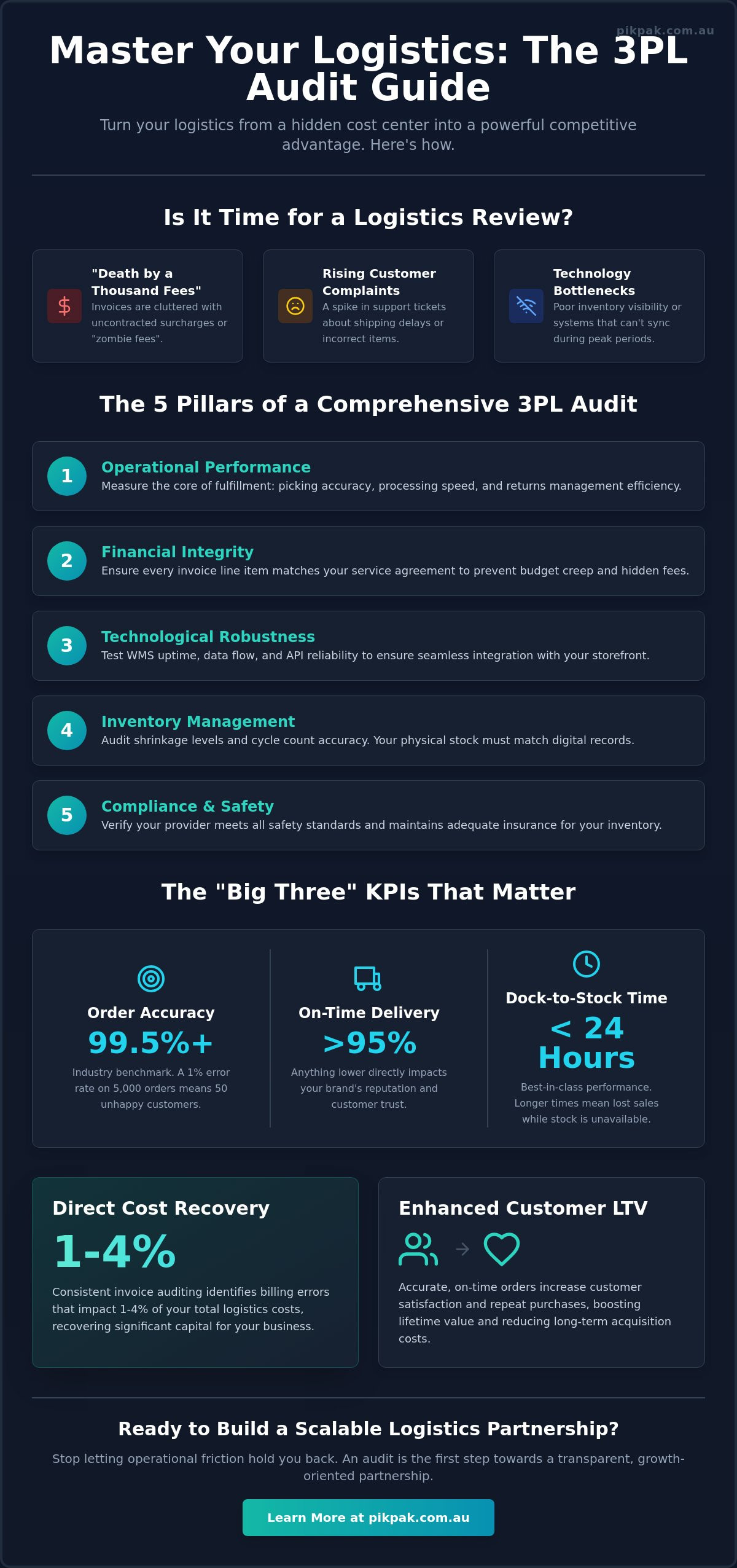
The most common sign is “Death by a Thousand Fees.” If your monthly invoices are suddenly cluttered with uncontracted surcharges or “zombie fees,” it’s time to dig deeper. You should also watch your customer support tickets. A spike in complaints about shipping delays or incorrect items is a clear indicator that warehouse precision is slipping. Finally, pay attention to your technology. If your 3PL’s system can’t provide real-time visibility into your inventory or struggles to sync with your storefront during peak periods, your growth is at risk.
The ROI of Auditing Your Provider
Auditing offers direct cost recovery. Research shows that consistent invoice auditing identifies errors that impact costs by 1% to 4%. Beyond immediate savings, a thorough review improves your customer lifetime value (LTV). When orders arrive on time and accurately, customers are far more likely to return, reducing your long-term acquisition costs. Understanding how to conduct a 3pl audit allows you to turn these operational wins into measurable financial gains. The ROI of a 3PL audit is defined as the total delta between recovered costs or saved expenses and the initial investment in the audit process.
The 5 Pillars of a Comprehensive 3PL Audit
To understand how to conduct a 3pl audit, you need a framework that looks past surface-level reports. A truly comprehensive review rests on five central pillars. These areas determine whether your logistics partner is a growth engine or a quiet bottleneck. When these pillars are aligned, your operations feel effortless; when they aren’t, your business carries unnecessary risk.
- Operational Performance: This is the heart of fulfillment. You’re measuring picking accuracy, processing speed, and the efficiency of your returns management.
- Financial Integrity: You must ensure every line item on your invoice matches your signed service agreement. This prevents budget creep from uncontracted surcharges.
- Technological Robustness: A modern 3PL is only as good as its software. Testing WMS uptime and API reliability ensures your data flows without interruption.
- Inventory Management: This involves auditing shrinkage levels and ensuring rigorous cycle counts. Your physical stock must match your digital records.
- Compliance and Safety: Verify that your provider meets all Australian safety standards and maintains adequate insurance coverage for your stock.
Operational KPIs That Actually Matter
Don’t settle for “good enough.” While many providers claim high standards, the industry benchmark for order accuracy is between 99.5% and 99.9%. If you’re shipping 5,000 orders a month, even a 1% error rate means 50 unhappy customers. You also need to track dock-to-stock time. Best-in-class performance is under 24 hours. If it takes 48 hours or more for your incoming stock to become available on your website, you’re losing sales. Finally, audit your carrier performance. If your on-time delivery rate is below 95%, your brand’s reputation is likely feeling the friction.
Auditing the Tech Stack
Your tech stack should be invisible and effortless. When learning how to conduct a 3pl audit, start by evaluating the technology support provided. Check for data silos. If your eCommerce platform shows one stock level and the warehousing and fulfilment system shows another, your inventory records are unreliable. You need real-time visibility. You shouldn’t have to email a representative to find out if a SKU is out of stock. A robust system provides a live window into your operations, allowing you to make fast, data-driven decisions. If your current setup feels like a black box, it might be time to reassess your service priorities to find a more transparent partner.
Financial Audit: Identifying Hidden Costs and Overbillings
Financial transparency is the bedrock of a healthy logistics partnership. When you learn how to conduct a 3pl audit, the financial phase is often where you see the most immediate return on your time. It’s about ensuring the price you agreed to is the price you’re actually paying. Many businesses find that small, undetected errors accumulate into substantial losses over a fiscal year, making this review a critical step for protecting your margins.
Start with a “Contract vs. Reality” check. Pull your original Service Level Agreement (SLA) and place it side-by-side with your last three months of invoices. Are the pick-and-pack rates identical? Is the storage rate what you signed for? You are looking for Zombie Fees, which are uncontracted surcharges that creep into invoices over time. These might appear as peak season surcharges that never ended or manual handling fees for tasks that should be covered under your standard rate. You should also verify your shipping rates by comparing the 3PL’s billed amounts against actual carrier manifest data to ensure you’re receiving the volume discounts you were promised.
Common Billing Discrepancies to Look For
One of the most frequent issues involves dimensional weight (DIM) calculations. If your provider isn’t right-sizing your packaging, DIM weight surcharges can impact your shipping costs by 3% to 15%. You should also watch for double-handling fees. This happens when a 3PL charges you once to move stock into a picking bin and again to pick the order. Kitting fees are often the most miscalculated line item because the labor required for assembly is frequently overestimated or miscategorized in automated billing systems.
The “Pallet Matching” Strategy
Storage costs have been rising by 6% to 11% annually since 2022. This makes auditing your storage utilization more important than ever. A common discrepancy is being billed for a full pallet position for a SKU that only occupies a fraction of that space. Compare your physical pallet counts or WMS reports against your monthly storage invoices to ensure you aren’t paying for air. When you pay for space you aren’t using, you’re essentially subsidizing the provider’s inefficiency.
To prevent these disputes before they start, ensure your suppliers follow strict warehouse receiving guidelines. When stock arrives correctly labeled and palletized, it reduces the likelihood of manual entry errors that lead to billing disputes. Establishing a recurring invoice validation workflow allows you to catch these issues early. By reviewing your data monthly rather than annually, you transform how to conduct a 3pl audit from a daunting task into a simple, manageable part of your financial routine.
Step-by-Step: How to Conduct the Audit Workflow
To master how to conduct a 3pl audit, you need a logical sequence of events. It isn’t enough to just look at a spreadsheet. You need to combine hard data with on-the-ground observations to get the full picture. In Australia, many brands find that the best time to start this process is leading up to the End of Financial Year (EOFY). This allows you to align your logistics performance with your annual financial reporting and tax obligations while preparing for the next peak season.
- Phase 1: Data Collection. Gather 6 to 12 months of invoices and reports. This long-term view helps you spot seasonal trends and recurring billing errors.
- Phase 2: Stakeholder Interviews. Talk to your customer service and warehouse teams. They are on the front lines of fulfillment friction and often see issues before they appear in reports.
- Phase 3: The Site Visit. Go to the warehouse. Seeing the process in person reveals things a digital report never will.
- Phase 4: Gap Analysis. Compare your findings against your Service Level Agreement (SLA). This is where you identify exactly where the provider is falling short of their promises.
- Phase 5: The Review Meeting. Present your findings to your 3PL partner. This should be a collaborative discussion about optimization, not a list of grievances.
Conducting an Effective Site Visit
A site visit is your chance to evaluate the physical reality of your 3PL warehousing. Look for cleanliness and organization. A cluttered warehouse often leads to picking errors and inventory shrinkage. Observe the staff morale; engaged teams are more precise and careful with your stock. Don’t forget to check how reverse logistics is handled. Returns should be processed with the same speed and care as outbound orders to protect your customer experience. Finally, perform a security check. Evaluate access controls and how your inventory is protected from damage or theft.
Closing the Audit Loop
The final step is turning your findings into action. Draft a Corrective Action Plan (CAP) with your provider. This document should outline specific steps to fix the gaps you found, along with clear deadlines for implementation. If you identified overcharges, this is the time to negotiate credits. Most providers are willing to make things right if you present clear, documented data. Set a date for a follow-up mini-audit in three to six months to ensure the changes are sticking and performance is improving. By mastering how to conduct a 3pl audit, you take back control of your operations. If your current provider isn’t meeting these standards, it is time to explore a more reliable logistics partnership today.
Beyond the Audit: Building a Scalable Logistics Partnership
Completing a review is only half the battle. The real value lies in what happens after the reports are filed. A successful audit should transform your logistics from a transactional cost center into a strategic advantage. This shift occurs when you move beyond viewing your provider as a mere vendor and start treating them as a scalable partner. Transparency is the bedrock of this transition. When you have a clear window into your logistics service at a granular level, you can make faster, more confident decisions that drive growth.
Choosing a partner that aligns with your specific service priorities is essential for long-term success. You need clear, automated reporting that removes the guesswork from your daily operations. Automation doesn’t just speed up shipping; it reduces the need for heavy, manual audits. When data flows effortlessly between systems, you can spot discrepancies in real-time rather than waiting for a quarterly review. By delegating these operational burdens to a partner that values precision, you reclaim the time needed to focus on your core business objectives.
The Power of Real-Time Visibility
Cloud-based WMS platforms have changed the landscape of fulfillment. They turn the task of how to conduct a 3pl audit into a continuous, effortless process rather than a stressful annual event. You gain the ability to monitor inventory levels, order statuses, and shipping speeds from any device at any time. This level of visibility ensures that benchmarks, such as the 99.5% order accuracy rate, are maintained without constant intervention. For brands looking to deepen their understanding of these systems, our resource on What is 3PL? Your Complete Guide provides the foundational context needed to evaluate provider technology effectively.
When to Stay vs. When to Switch
The ultimate test of an audit is your provider’s response to your findings. A strategic partner will welcome the data and work collaboratively to implement your Corrective Action Plan. If they become defensive or fail to address identified gaps within the agreed timeframe, it’s a major red flag. You should also consider if their infrastructure can truly scale with your volume. If your audit reveals that their manual processes are the primary cause of friction, even the best intentions won’t save the relationship as you grow.
Mastering how to conduct a 3pl audit gives you the clarity to decide your next move with total confidence. If your current provider isn’t meeting the benchmarks for speed, accuracy, and transparency, don’t let them hold your brand back. You deserve a partner that acts as an enabling force for your business. See how Pik Pak simplifies your fulfilment and provides the transparent, scalable support your eCommerce growth demands.
Secure Your Growth with a Strategic Logistics Partnership
A 3PL audit is the ultimate tool for reclaiming control over your supply chain and protecting your profit margins. By focusing on financial integrity and operational precision, you transform a simple vendor relationship into a powerful engine for growth. You now have the roadmap for how to conduct a 3pl audit by measuring the “Big Three” performance metrics and identifying hidden billing discrepancies that quietly erode your bottom line.
True scalability comes when you move past reactive fixes and embrace a partner that offers total transparency. You shouldn’t have to spend your days chasing reports or questioning invoices. Instead, look for a partner that provides specialized eCommerce fulfillment expertise and real-time WMS visibility to keep your business moving at peak efficiency. It is time to stop managing logistics friction and start focusing on your core objectives.
Reclaim your time and scale faster with Pik Pak’s transparent 3PL services. Our benefit-oriented pricing and tech-first approach ensure your fulfillment is simple, secure, and entirely automated. You have the tools to succeed; now take the next step toward a more efficient and profitable future.
Frequently Asked Questions
How often should I conduct a 3PL audit?
You should conduct a full audit at least once every 12 months to ensure your provider still aligns with your growth. High-volume brands or those experiencing rapid scaling often benefit from a “mini-audit” every six months. This frequency allows you to catch billing discrepancies before they compound into significant annual losses.
What are the most common “hidden fees” in 3PL contracts?
The most frequent hidden costs include fuel surcharges, peak season premiums that never expire, and manual handling fees for tasks that should be automated. You should also watch for “accessorial charges” for simple activities like label application or box resizing. These small line items can quickly erode your margins if left unchecked during your financial review.
Can I perform a 3PL audit remotely without visiting the warehouse?
Yes, you can perform a “desk audit” by analyzing digital reports, invoices, and carrier manifest data from your own office. This is a highly effective way to verify financial integrity and technological uptime. However, a remote review cannot replace the insights gained from a site visit, where you can observe physical security and staff workflows firsthand.
What should I do if my 3PL refuses to provide the data I need for an audit?
Refer to your original Service Level Agreement (SLA) to identify your “Right to Audit” clauses. A provider’s refusal to share performance data is a major red flag that suggests a lack of transparency. If your partner won’t provide basic visibility into your inventory or billing, it’s often a sign that you need to transition to a more accountable logistics partner.
How long does a typical 3PL audit take to complete?
A comprehensive audit usually takes between two and four weeks from start to finish. This timeframe includes the initial phase of data collection, the analysis of shipping reports, and the final review meeting with your provider. Setting a clear schedule ensures the process remains a manageable task rather than a lingering operational burden.
Is it worth auditing a 3PL if my business is still small?
It’s definitely worth it because small businesses have the least room for error in their margins. Identifying a 2% billing error early prevents it from becoming a massive financial drain as your order volume increases. Learning how to conduct a 3pl audit while your operations are still simple builds a foundation of transparency that supports effortless scaling later.
What is the difference between an operational audit and a financial audit?
An operational audit evaluates the physical performance of the warehouse, such as picking speed and order accuracy. A financial audit focuses exclusively on billing integrity and ensuring your invoices match your contracted rates. Both are essential pillars of a complete review, but they require different data sets and stakeholder involvement to execute properly.
How can I use audit findings to negotiate better rates?
Use documented performance gaps or recurring billing errors as objective leverage during your next contract review. When you show your partner how to conduct a 3pl audit using your own data, they are far more likely to offer credits or improved service terms. Clear evidence of inefficiency makes it much easier for a provider to justify lowering your rates to keep your business.