
How much potential revenue is evaporating while your latest shipment sits untouched on a wooden pallet? It’s a common frustration for eCommerce brand owners who see “Out of Stock” labels on their store even after the delivery truck has left the warehouse. You’ve done the hard work of sourcing and shipping, but if your inventory isn’t live, it isn’t making you money. This lag creates unnecessary stress and stalls your business growth.
We’ve created this guide to get your operations back on track with a clear dock to stock time explained breakdown. You’ll learn how to measure this metric accurately, compare your performance against 2026 industry benchmarks like the 24 hour average, and implement strategies to reduce receiving delays. We’ll also show you how to hold your warehouse team or 3PL accountable for faster results. We’re covering everything from basic receiving workflows to advanced automation tips so you can turn your inventory into cash faster than ever before.
Key Takeaways
- Understand how your dock to stock time explained impacts your cash flow and ability to prevent stockouts during peak sales periods.
- Compare your warehouse speed against 2026 industry benchmarks to see if you’re hitting world-class receiving targets of under six hours.
- Identify the specific bottlenecks in receiving and inspection that keep your products sitting idle on the loading dock.
- Learn how Advanced Shipping Notices (ASNs) and standardised vendor guidelines can drastically reduce manual receiving costs.
- Discover how real-time WMS technology provides the transparency needed to hold your fulfillment partner accountable for inventory speed.
What is Dock to Stock Time? Defining the Metric
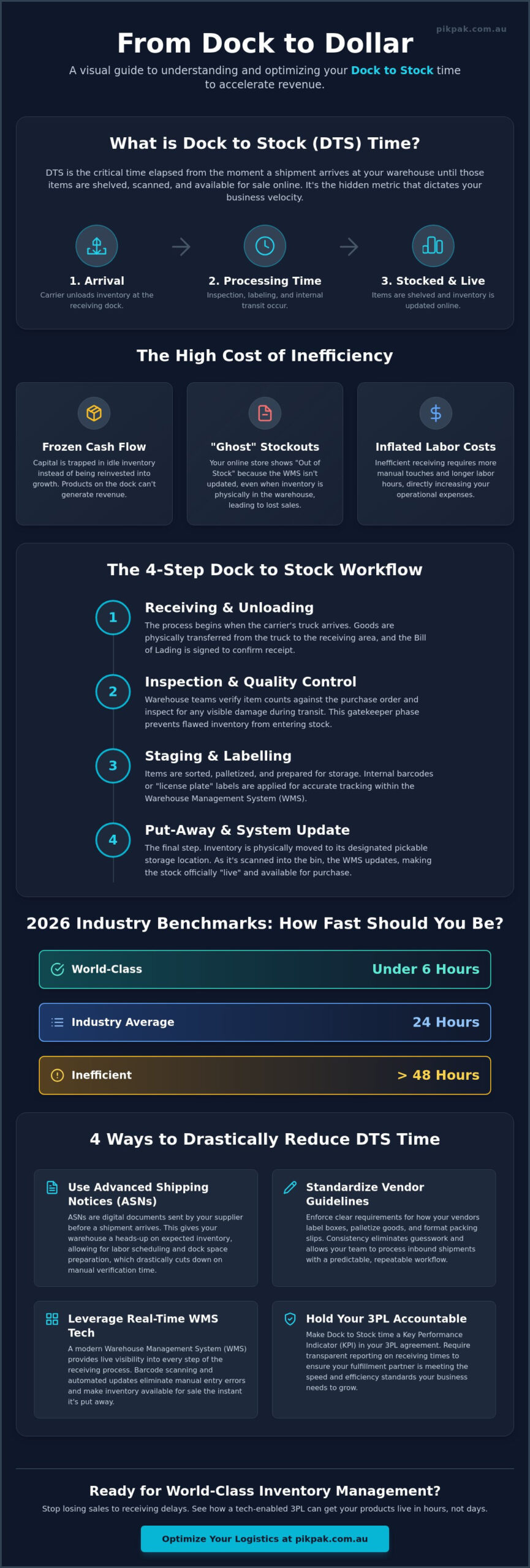
Dock to stock (DTS) is a specific measurement of the time elapsed from the moment a carrier arrives at your warehouse until those items are shelved and ready for order fulfillment. It is a vital KPI for maintaining a healthy supply chain and high inventory turnover rates. Essentially, dock to stock time is the bridge between physical arrival and digital availability. While many brands focus on shipping speed to the customer, they often overlook this “hidden” bottleneck. If your DTS is slow, your capital is tied up in boxes on a floor rather than moving through your checkout. To have dock to stock time explained simply: it is the countdown to revenue. Understanding the nuances of dock to stock time explained in the context of your specific industry helps you set realistic expectations for your logistics team.
For high-growth eCommerce brands, DTS represents the velocity of your business. When goods sit on a dock, they aren’t just taking up space; they’re preventing you from fulfilling orders and refreshing your cash flow. This metric measures the efficiency of your inbound logistics, reflecting how well your warehouse team handles the transition from a delivery truck to a pickable bin. If this process is sluggish, every other part of your operation suffers, from marketing campaigns that can’t launch to customer service teams dealing with backorder inquiries.
The Difference Between “Received” and “Live”
In modern eCommerce, there’s a massive difference between a shipment being “received” and being “live.” Your Warehouse Management System (WMS) might show that the pallets have arrived, but your “Available to Promise” (ATP) logic determines what customers actually see on your storefront. If your DTS lag is too high, you suffer from “ghost stockouts.” These occur when you technically own the inventory, but because it hasn’t been scanned into a pickable location, your website still shows “Out of Stock.” This lag kills customer trust and halts pre-order fulfillment, leading to lost sales even when the product is physically inside the building. Reducing this gap ensures your digital presence matches your physical reality.
Why DTS is the Pulse of Your 3PL Relationship
This metric is often the truest pulse of your third-party logistics provider relationship. A slow DTS usually points to deeper issues like poor labor scheduling or inefficient receiving workflows. There’s a direct correlation between high DTS and inflated warehouse labor costs; the longer it takes to process a shipment, the more manual touches are required. While speed is important, transparency is the real goal. You need to know exactly where your stock is in the receiving queue to make informed marketing decisions. A reliable partner ensures that receiving isn’t a black hole, but a streamlined process that fuels your growth. When you can see your stock moving through the stages of unloading, inspection, and put-away, you gain total control over your inventory cycle.
The 4-Step Dock to Stock Process
The journey from a delivery truck to a saleable SKU involves a series of coordinated movements. Having your dock to stock time explained as a four-step workflow allows you to see the process as a manageable system rather than a chaotic rush. According to the Supply Chain Management Review, a well-defined distribution strategy is what separates efficient warehouses from those struggling with backlog. By breaking down each phase, you can identify exactly where your inventory velocity is slowing down.
- Step 1: Receiving and Unloading. This is the initial handshake between the carrier and the warehouse. It involves the physical transfer of goods and the signing of the Bill of Lading.
- Step 2: Inspection and Quality Control. This is the gatekeeper phase. Teams verify piece counts and check for any visible damage before the stock moves further.
- Step 3: Staging and Labelling. Items are sorted and prepared for their specific warehouse homes. This often involves applying internal barcodes or “license plate” labels for tracking.
- Step 4: Put-away and System Update. The final move where stock is placed in a pickable bin. Once scanned into its location, the inventory becomes live on your sales channels.
A critical part of this process that many brands overlook is the reconciliation phase. This is where the physical units received are matched against the original purchase order. If your paperwork doesn’t match your physical reality, your inventory levels will be inaccurate from day one. If you’re ready to see how a tech-enabled partner handles these steps, our warehousing and fulfilment services are built for this level of precision.
Inspection and Quality Control (QC)
Quality control is about more than just looking for crushed boxes. It’s the process of verifying piece counts against the packing slip and handling “overages, shortages, and damages” (OS&D) immediately. If a discrepancy isn’t flagged at the dock, it becomes a nightmare to resolve once the stock is shelved. Performing rigorous QC prevents downstream errors in order fulfilment, ensuring customers receive the correct items without delay. Catching a SKU error now is significantly cheaper than processing a return later.
Systemic Integration and WMS Updates
Technology is the engine that drives a fast dock to stock time explained in modern logistics. Barcode scanning accelerates the transition from dock to shelf by eliminating the need for manual data entry, which is the primary cause of receiving delays. When your warehouse uses real-time inventory syncing, your eCommerce platform updates the moment a pallet is scanned into a bin. This automation removes the friction between your physical warehouse and your online store, allowing you to start selling new arrivals within minutes of their arrival. Supporting this digital evolution requires robust infrastructure, and Ethernetics is leading the way in making the data centres behind these technologies more energy-efficient.
Benchmarks: How Fast Should Your Warehouse Be?
How fast is “fast enough” when it comes to unloading a truck? If you don’t measure your operations against a standard, you’re flying blind. To have your dock to stock time explained through data, you must look at current 2026 industry standards. In a world where customer expectations are higher than ever, your warehouse speed is a competitive advantage. By comparing your performance to these Dock-to-Stock Time Benchmarks, you can identify if your 3PL is a partner in your growth or a roadblock to your success.
- World-Class/Best-in-Class: Under 2 to 4 hours. This is the gold standard for highly automated warehouses.
- Professional 3PL Benchmark: 2 to 6 hours. This is what you should expect from an efficient, tech-forward logistics partner.
- Industry Average: 24 hours. Most Australian SMBs operate within this window.
- The Danger Zone: 48 to 72+ hours. Anything in this range indicates a systemic failure in receiving that will eventually cripple your growth.
Your specific numbers will fluctuate based on SKU count and shipment type, but the goal remains the same: keep the inventory moving. If you’re consistently hitting the 48 hour mark, you’re already behind the curve. High-growth brands can’t afford to have capital sitting idle on a concrete floor while competitors are already shipping orders.
The Cost of Slow DTS
Slow receiving is an expensive habit. When your dock to stock time explained in financial terms, the most obvious cost is lost revenue from delayed availability. If a customer sees “Out of Stock” because your team hasn’t scanned the boxes yet, they’ll simply go elsewhere. Beyond lost sales, slow receiving leads to “dock congestion.” This creates a backlog that triggers higher carrier wait fees and detention charges. Most importantly, it creates a ripple effect that delays your customer delivery promises. You can’t ship what you haven’t officially “received,” and every hour of delay at the dock is an hour of delay for the end consumer.
Variables That Impact DTS Benchmarks
Not all shipments are created equal. Floor-loaded containers are notoriously slow because they require manual unloading piece-by-piece, whereas palletised shipments can be moved quickly with a forklift. If your products require kitting or assembly during the receiving phase, your DTS will naturally be higher. Seasonal peaks, like the lead-up to Black Friday, can also stretch standard times as warehouse volumes surge. To maintain efficiency, you must account for these variables in your planning. Pre-labelling items before they reach the warehouse is one of the most effective ways to bypass these bottlenecks and get your stock live faster.
5 Ways to Reduce Your Dock to Stock Time
Speed at the dock starts long before the delivery truck arrives at the warehouse. If you want your dock to stock time explained through the lens of peak efficiency, you have to look at the data you provide to your logistics team. A warehouse can only move as fast as the information it receives. By taking control of the inbound process, you remove the guesswork that leads to delays and “ghost stockouts.” Here are five actionable ways to slash your receiving times.
- Implement Advanced Shipping Notices (ASNs). Give your warehouse a digital “heads up” so they can prepare for your arrival.
- Standardise your vendor compliance. Ensure your suppliers follow strict warehouse receiving guidelines to avoid sorting chaos.
- Prioritise pre-labelled inventory. Eliminate the need for expensive and slow warehouse re-stickering by having labels applied at the factory.
- Utilise a cloud-based WMS. Real-time visibility and paperless receiving remove the friction of manual data entry.
- Schedule dock appointments. Avoid the “bottleneck” of multiple trucks arriving at once by coordinating delivery windows.
Reducing your dock to stock time explained in these steps isn’t just about warehouse speed; it’s about business discipline. When your vendors and your 3PL are in sync, your inventory velocity increases naturally. Ready to stop waiting and start selling? Partner with Pik Pak Logistics to streamline your inbound operations today.
The Power of ASNs and Pre-Advice
Sending a digital manifest 24 to 48 hours before a shipment arrives is a non-negotiable requirement for modern eCommerce. This pre-advice allows the warehouse manager to plan labour schedules and allocate specific bin space before the truck even backs into the dock. Without this data, your shipment is a surprise that disrupts the daily workflow. ASNs reduce the “mystery” of incoming freight by providing a digital blueprint of every SKU, quantity, and pallet on the vehicle. This preparation ensures that the moment the doors open, the team is ready to move.
Vendor Compliance: Helping Your 3PL Help You
Your manufacturers are the first link in your receiving chain. Create a “Cheat Sheet” for your suppliers, and to ensure these standards are followed at the source, you can partner with The Inspection Company for factory audits and inspections. While factory-level pre-labelling might carry a small upfront cost, the benefit of bypassing the warehouse labelling station is massive. Clear, consistent pallet markings can reduce manual inspection time by up to 50% because the receiving team doesn’t have to hunt for SKU details or count individual items by hand. When your stock arrives ready for the shelf, you eliminate the most time-consuming part of the dock-to-stock cycle.
Effortless Inventory Management with Pik Pak Logistics
Managing a warehouse shouldn’t be a constant source of stress for your business. We have had the dock to stock time explained in detail throughout this guide, but knowing the theory is only the first step. You need a partner that turns these benchmarks into a daily reality. At Pik Pak Logistics, we use advanced technology to simplify the receiving process for Australian brands. Our cloud-based WMS acts as a single source of truth for your inventory. You get total real-time visibility through our technology support, allowing you to see exactly when your stock moves from the dock to a pickable bin. Precision is our priority. By reducing errors during that critical receiving window, we ensure your digital storefront reflects your physical inventory without the lag that kills sales.
This is why Melbourne businesses trust us for scalable, tech-led warehousing and fulfilment. We act as a seasoned expert in a chaotic field, using precision to eliminate the inefficiencies that plague traditional logistics models. When you partner with us, you aren’t just outsourcing a task. You’re implementing a sales enablement strategy that keeps your business moving forward. We handle the backend complexity so you can focus on your core objectives.
Scalable Receiving for Growing Stores
Our systems are designed to grow with you. Whether you’re receiving small parcel shipments from local vendors or unloading full containers from overseas, our infrastructure adapts to your volume. The advantage of our integrated services is that we handle the complexity of SKU-heavy shipments so you don’t have to. You can reclaim your time and refocus on marketing and product development by delegating the dock-to-stock burden to us. We treat your inventory with the precision it deserves, ensuring every item is scanned, inspected, and shelved correctly the first time.
Get Your Stock Live Faster
Take a moment to audit your current operations. If your products take days to show up as “in stock” after they arrive at the warehouse, you’re leaving revenue on the table. We prioritise “Available to Promise” speed because we know that in eCommerce, every hour counts. Choosing a partner who understands the nuances of dock to stock time explained in this guide is the first step toward a more profitable business. Don’t let operational friction hold you back from reaching your next milestone. Request a quote from Pik Pak Logistics today and see how fast your inventory can move.
Take Control of Your Inventory Velocity
Your warehouse efficiency shouldn’t be a guessing game. Having your dock to stock time explained through clear benchmarks and structured processes is the first step toward reclaiming your time and accelerating your business growth. By implementing digital manifests and holding your logistics partners to the 2026 industry standard of under six hours, you ensure your capital never sits idle. Speed at the dock directly translates to sales at the checkout; this makes the metric the most important “hidden” driver of your eCommerce success.
We’re here to help you bridge the gap between delivery and availability. Our cloud-based WMS provides real-time tracking, while our specialised receiving protocols ensure every SKU is handled with precision. With an expert Australian-based support team by your side, you can delegate the operational friction and focus on scaling your brand. Ready to speed up your supply chain? Partner with Pik Pak Logistics today. We’re ready to help you turn your inventory into revenue faster than ever before.
Frequently Asked Questions
What is the ideal dock to stock time for a 3PL?
The ideal time for a professional 3PL is between 2 and 6 hours for standard palletised goods. World-class operations often hit targets under 4 hours by using advanced automation. If your shipments are consistently taking longer than 24 hours, you’re likely missing out on potential sales. Speed here is a major competitive advantage in modern eCommerce because it keeps your cash flowing.
How do I calculate my warehouse dock to stock time?
You calculate this metric by subtracting the carrier arrival timestamp from the moment the inventory becomes “Available to Promise” in your system. For a thorough dock to stock time explained calculation, you should track the time from the delivery truck’s arrival to the final put-away scan. This reveals exactly where your inbound bottlenecks are occurring so you can address them with your team.
Can a WMS really improve my receiving speed?
A WMS dramatically improves speed by replacing paper logs with digital barcode scanning. Instead of manually typing SKU numbers, staff scan items once to update your entire sales channel. This automation removes the risk of human error and ensures that your inventory levels are always accurate. It’s the most effective way to eliminate the “black hole” of manual receiving and data entry.
What happens if my shipment is damaged during receiving?
Damaged goods are identified during the initial Quality Control phase of the receiving process. The warehouse team will photograph the damage, note it on the Bill of Lading, and notify you immediately. These items are typically moved to a quarantine area so they don’t get mixed with saleable stock. This prevents you from accidentally shipping faulty products to your customers and protects your reputation.
Does pre-labelling inventory actually save money?
Pre-labelling at the factory level saves significant money by eliminating manual warehouse labour. When your stock arrives ready for the shelf, the receiving team can skip the staging station and move items directly to pickable bins. This reduces the number of touches per item, which lowers your receiving fees and gets your products live much faster than unlabelled freight that requires manual intervention.
Why is my stock showing as “received” but not “available” for sale?
Stock showing as “received” often means the pallets have been unloaded, but they haven’t passed through inspection or put-away yet. This is a common part of the dock to stock time explained in this guide. Your items only become “available” for sale once they are scanned into a specific pickable location within the warehouse. This ensures that pickers can actually find the items when an order arrives.
How does dock scheduling work for small eCommerce businesses?
Dock scheduling involves coordinating with your carriers to book specific arrival windows. Even for small brands, this prevents bottleneck arrivals where multiple trucks show up at the same time. By spacing out deliveries, your warehouse team can focus on one shipment at a time. This consistent flow keeps the receiving area clear and ensures that your staff aren’t overwhelmed by sudden surges of freight.
What is an ASN (Advanced Shipping Notice) in logistics?
An ASN is a digital manifest that your supplier sends to your warehouse before the shipment arrives. It provides a detailed breakdown of every SKU, quantity, and pallet on the incoming truck. This allows the warehouse manager to plan the day’s labour and allocate bin space in advance. It’s a critical tool for any brand looking to move away from reactive receiving to a proactive strategy.