

What happens to your brand reputation when a sudden flood in Queensland or a major carrier outage halts your deliveries for three days? You likely already feel the pressure of rising operational costs and the end of the Road User Charge suspension this July, which only makes shipping disruptions more expensive. Understanding how a 3pl improves business continuity is no longer just a technical exercise. It is a critical strategy to prevent revenue loss and avoid the anxiety of customer backlash during shipping downtime.
We know that the jargon around Business Continuity Plans and Disaster Recovery Plans can be confusing when you just want your orders to move. This article promises to cut through that noise and show you how to build a resilient supply chain for 2026. We will walk through the exact steps to create an actionable logistics DRP, showing you how a capable 3PL partner can handle the heavy lifting. By the end, you will have a clear roadmap to reduce operational risk and reclaim the time you need to focus on your core business goals.
Key Takeaways
- Identify the high-impact risks facing Australian eCommerce in 2026, from extreme weather events to cyber threats, and establish a clear hierarchy for emergency decision-making.
- Discover how a 3pl improves business continuity by setting precise Recovery Time Objectives (RTO) that keep your orders moving even during regional disruptions.
- Leverage cloud-based WMS technology to ensure your inventory data remains secure and accessible, preventing the “ghost inventory” issues that often occur during system outages.
- Master the art of operational redundancy by splitting your stock strategically and calculating safety levels to protect your brand from single points of failure.
- Access a resilient shipping strategy through multi-carrier networks that automatically bypass local bottlenecks and maintain your delivery promises to customers.
Evaluating Risks in the Australian Logistics Landscape
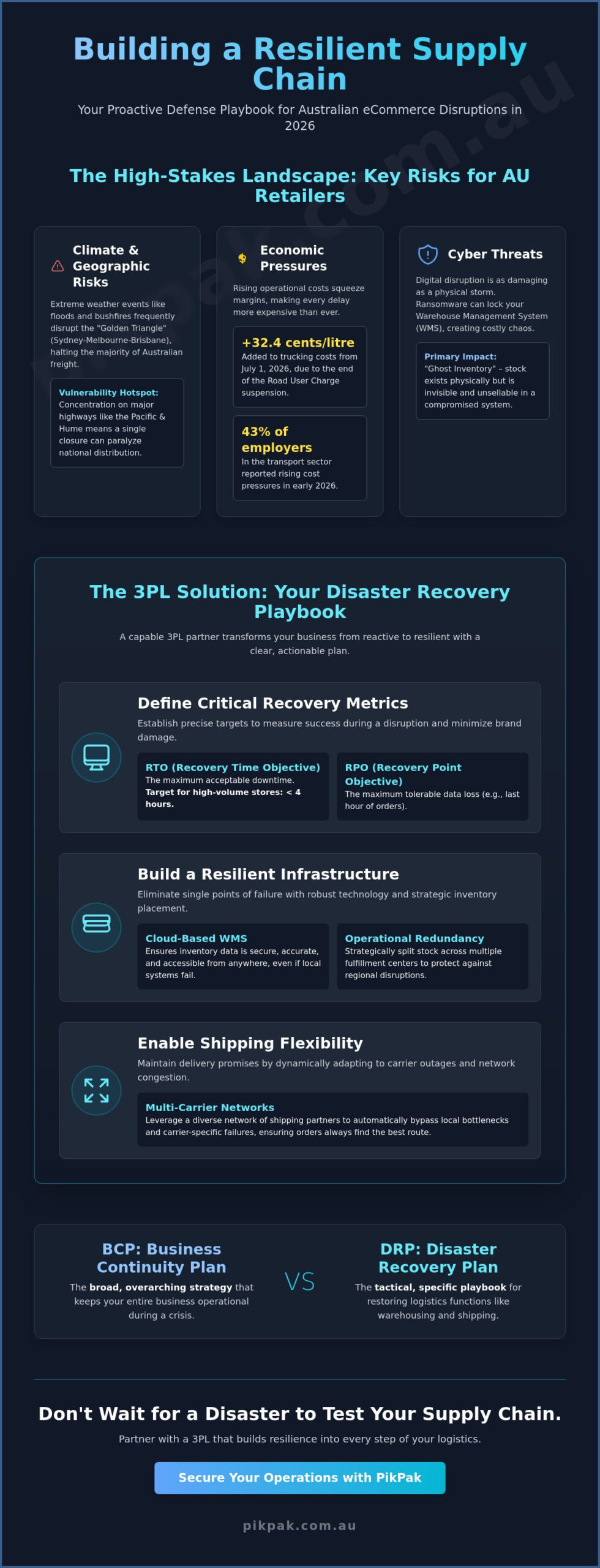
Australia’s geography presents a unique set of challenges that can turn a minor delay into a total supply chain collapse. By mid-2026, the stakes have never been higher for eCommerce brands. With the Road User Charge suspension ending on July 1, 2026, adding 32.4 cents per litre to trucking costs, every detour or delay caused by a disaster impacts your bottom line immediately. Effective business continuity planning is no longer a luxury for big corporations; it’s a survival requirement for every online store.
You need to distinguish between your Business Continuity Plan (BCP) and your Disaster Recovery Plan (DRP). Your BCP is the broad strategy that keeps the entire business operational. In contrast, the DRP is the tactical “playbook” for restoring specific logistics functions, like your order processing or warehouse access. Understanding how a 3pl improves business continuity begins with a Business Impact Analysis (BIA). This process identifies exactly how much revenue you lose for every hour your shipping remains frozen. It helps you set realistic targets for getting back on your feet.
Climate and Geographic Risks for AU Retailers
The Sydney-Melbourne-Brisbane “Golden Triangle” handles the vast majority of Australian freight. This concentration is a major vulnerability. If a flood closes the Pacific Highway or a bushfire cuts off the Hume, your entire national distribution can grind to a halt. In early 2026, cost pressures in the transport sector rose for 43% of employers, meaning you can’t afford the inefficiency of a blocked route. A resilient strategy involves identifying secondary shipping hubs and backup transport routes before the crisis hits. By spreading inventory across multiple locations, you ensure that a regional disaster in one state doesn’t paralyze your sales in another. To understand how advanced technology can help you manage these transport complexities, learn more.
The Growing Threat of Logistics Cyber-Attacks
Cyber-threats are now as disruptive as physical storms. Ransomware can lock your Warehouse Management System (WMS) overnight, leaving you with “ghost inventory” that you can’t see or sell. This is where secure, cloud-based inventory tracking becomes your strongest asset. If your data lives in a secure cloud environment rather than a local server, you can regain control of your operations from any location with an internet connection. Cyber-resilience in the context of 3PL data means your inventory records remain accessible and accurate even if your local hardware is compromised. Relying on a tech-forward partner ensures that your digital infrastructure is just as sturdy as your physical warehouse.
Creating a Robust Disaster Recovery Plan for Logistics
A disaster recovery plan for logistics shouldn’t sit in a digital folder gathering dust. It needs to be a practical roadmap that your team can execute when the pressure is on. Start by establishing a clear hierarchy of command. When a system failure or regional disruption occurs, everyone must know who has the authority to pause orders, divert stock, or switch carriers. This clarity prevents the hesitation that leads to shipping backlogs and lost revenue.
One of the primary ways how a 3pl improves business continuity is by helping you define your Recovery Time Objective (RTO) and Recovery Point Objectives (RPO). In logistics terms, your RTO is the maximum amount of time your store can stop shipping before the damage to your reputation becomes irreversible. Your RPO determines how much order data you can afford to lose during a system sync failure. For a high-volume eCommerce store in 2026, your RTO might be as short as four hours. Having these benchmarks in place allows you to measure the success of your recovery efforts in real time.
You also need to map out physical redundancy for your inventory. If your primary warehouse is inaccessible, you must have a plan to divert incoming stock. Reviewing our warehouse receiving guidelines ensures that your suppliers know exactly how to label and prep goods for an alternative facility. This prevents bottlenecks when you’re already operating under stress. If you’re unsure if your current setup is robust enough, you can review your logistics service requirements to see where you might need more redundancy.
Step 1: Communication Protocols
Silence is the quickest way to kill your brand reputation during a crisis. Your DRP should include pre-written, automated communication templates for your customers and stakeholders. Internal alerts should trigger immediately when a primary system goes down, informing the team of the next steps. Customer transparency is equally vital; telling your buyers that a delivery might be delayed by 48 hours is far better than leaving them wondering where their package is. Clear coordination with your carriers ensures they are ready to pivot as soon as you signal a shift in your logistics strategy.
Step 2: Alternative Routing & Carrier Redundancy
Relying on a single courier is a major fail-point in the 2026 Australian market. If one carrier experiences a network outage or a regional hub closure, your entire business stops. Leveraging multi-carrier networks allows you to bypass these regional bottlenecks automatically. By using direct freight options, you can maintain delivery speeds even when traditional networks are congested. This flexibility is a core component of a resilient supply chain, ensuring that your orders keep moving regardless of local disruptions.
The Role of Cloud-Based Technology in Business Continuity
Cloud technology is the invisible backbone of modern logistics. It transforms your operations from a fragile, location-dependent setup into a flexible, digital network. A Cloud Warehouse Management System (WMS) ensures that your inventory data survives even if a specific warehouse becomes physically inaccessible. If your records are stored on a local server in a flooded building, your business stops. With a cloud-native platform, you can manage your stock from any device, anywhere in Australia, ensuring your digital doors stay open when the physical ones cannot.
This is a primary example of how a 3pl improves business continuity. By hosting your data in a secure, off-site environment, a 3PL ensures that your order flow remains uninterrupted even during regional crises. API integrations are a necessity here. They create a seamless bridge between your eCommerce store and the warehouse floor, allowing for real-time data syncs. Without these automated links, you’re forced to rely on manual data entry, which is slow and prone to errors during a high-stress recovery period. Ensuring your partner provides robust technology support that includes off-site data replication is your best insurance policy against total data loss.
Real-Time Inventory Visibility During Disruptions
Manual spreadsheets fail the moment a disaster strikes. They are static, quickly become outdated, and are impossible to coordinate across a remote team. Cloud data allows you to see exactly what you have in real time, enabling you to pivot stock to a secondary fulfilment centre without missing a beat. This visibility prevents “ghost inventory”-selling items that aren’t actually on the shelf-which saves you from the nightmare of mass refunds and negative reviews. Real-time tracking reduces customer anxiety during delays by providing clear, honest updates on their order’s progress, which protects your brand reputation when you need it most.
Data Security & Cyber-Resilience in 3PL
Your logistics platform must be as secure as your bank account. In 2026, cyber-attacks are a constant threat to the Australian supply chain, making encryption and multi-factor authentication (MFA) essential features for any logistics platform. A “zero-trust” architecture is now the standard in modern warehousing; it assumes that every access request could be a threat until it is verified. Regular system audits are non-negotiable. Your 3PL’s IT health is effectively your business health. If their systems are vulnerable, your customer data and order history are at risk. Choosing a partner that prioritizes cyber-resilience means you don’t have to worry about your operations being held for ransom while you’re trying to grow your brand.
Operational Redundancy: Beyond the Warehouse Walls
Redundancy isn’t just a digital backup for your website; it’s a physical insurance policy for your inventory. If you store 100% of your stock in a single Sydney warehouse and a major storm shuts down the local power grid, your entire business goes offline. This is a fundamental way how a 3pl improves business continuity. By diversifying your storage locations, you ensure that a regional crisis doesn’t result in a total operational blackout. Decoupling your sales from a single physical point of failure is the most effective way to protect your revenue in a volatile climate.
Safety stock calculations also need to change when you’re planning for disasters. While traditional safety stock covers standard demand spikes, disaster-ready safety stock must account for lead time variability. If a major interstate freight corridor like the Hume Highway is closed, your replenishment times could double. You should calculate this buffer by multiplying your maximum daily sales by the potential lead time delay during a disruption. This ensures you can keep shipping while your main supply lines are rerouted. A resilient warehousing and fulfilment structure adapts to these surge volumes effortlessly, providing the elastic space you need without the overhead of managing your own facility.
The Strategy of Multi-Location Storage
Decentralize your risk. Using a 3PL with a nationwide network allows you to split your inventory across different states, balancing your storage costs against the catastrophic cost of a total failure. You don’t need to duplicate your entire range. Focus your redundancy on “A-class” SKUs, which are the top-selling products that drive the majority of your revenue. By keeping these high-priority items in multiple hubs, you can maintain your brand promise even when one region is struggling. This pragmatic approach keeps your costs manageable while providing maximum security for your core business.
Reverse Logistics in Crisis Mode
When transit routes are blocked, “Return to Sender” parcels can pile up quickly, creating a secondary logistics nightmare. Your disaster plan must include a strategy for managing these reverse flows to maintain customer trust. Setting up temporary return hubs or using a partner who can process returns at scale ensures that your customer service team isn’t overwhelmed by frustrated buyers. Integrating these processes into your broader logistics services allows you to reclaim your time and focus on recovery rather than manual parcel tracking. If your current returns process is a bottleneck, it’s time to delegate that burden to a partner who can handle the heavy lifting for you.
Partnering with a Resilient 3PL: The Pik Pak Approach
Building a custom disaster recovery plan for an in-house warehouse is a massive financial and operational undertaking. For most Australian eCommerce brands, outsourcing to a 3PL is the most cost-effective way to implement a bulletproof DRP without the heavy capital investment. It’s here that you truly see how a 3pl improves business continuity. By delegating your logistics to Pik Pak Logistics, you gain access to a resilient infrastructure that serves as your ultimate safety net. Our web-based platform acts as a digital mirror of your business, ensuring that your inventory and order data are always accessible, even if your own office systems fail.
Scalable storage is a core part of this partnership. When disasters cause emergency inventory shifts, you need a facility that can adapt to sudden surges in stock or rapid changes in shipping volume. We provide the elastic space required to keep your supply chain moving when others are forced to pause. This flexibility allows you to refocus on your core business goals while we manage the physical complexities of recovery.
Automated Systems and API Integrations
We take a “Plug and Play” approach to eCommerce connectivity. Our systems link directly to your store via robust API integrations, creating a seamless flow of information that doesn’t break under pressure. During operational chaos, our WMS remains your single source of truth, providing accurate data on every SKU and shipment. You don’t have to worry about technical downtime because our cloud infrastructure is built for high-level security and constant uptime. This digital resilience protects your business data and ensures that your orders are processed with precision, regardless of external disruptions.
Why Pik Pak Logistics is Your Best Fail-Safe
We are deeply committed to our service priorities, especially during high-stress periods. Our team has the expertise to handle special projects and massive surge volumes that would typically overwhelm an in-house team. In early 2026, when cost pressures rose for 43% of transport employers, our multi-carrier network became a vital advantage for our clients. We don’t rely on a single delivery partner; instead, we leverage a diverse network to ensure shipping never stops by bypassing local bottlenecks automatically. This is how a 3pl improves business continuity in the real world, turning complex logistical hurdles into simple, managed tasks.
Future-Proof Your Brand Against Logistics Disruptions
Success in the 2026 Australian eCommerce market requires more than just high sales; it demands operational resilience. You’ve seen how identifying geographic risks and implementing cloud-based technology can protect your revenue during a crisis. By diversifying your storage and using multi-carrier networks, you turn potential disasters into manageable tasks. Understanding how a 3pl improves business continuity is the first step toward reclaiming your time and focusing on your brand’s growth.
Don’t wait for the next flood or system outage to test your supply chain. Our team provides the real-time WMS visibility and multi-carrier shipping network you need to keep orders moving. With Australian-based expert support, we handle the heavy lifting so you can stay in control. It’s time to trade operational anxiety for a reliable partnership that scales with your needs.
Secure your eCommerce supply chain with Pik Pak Logistics today. You’ve built a great brand; let’s make sure it’s here to stay regardless of what the future holds.
Frequently Asked Questions
What is the most common cause of logistics failure in Australia?
Extreme weather events, such as floods and bushfires, are the leading causes of logistics failure in Australia. These events frequently close major freight corridors like the Hume Highway, causing immediate shipping delays. In early 2026, rising fuel costs and labor shortages have made the supply chain even more sensitive to these disruptions. Having a plan to reroute orders quickly is essential to avoid total operational downtime.
How often should we test our disaster recovery plan?
You should test your disaster recovery plan at least once every twelve months or whenever you make a major change to your supply chain. Regular testing ensures that your team knows exactly who to contact and what systems to activate during a crisis. It’s better to find a flaw in your plan during a drill than during a real-world emergency. This proactive approach keeps your business agile and ready for any scenario.
Is a 3PL responsible for my business continuity?
Your 3PL partner is responsible for the continuity of your logistics operations, but your overall business strategy remains your responsibility. A key part of how a 3pl improves business continuity is by providing the redundant infrastructure, multi-carrier networks, and cloud technology that most small businesses can’t build alone. They act as a fail-safe for your fulfillment, ensuring that orders keep moving even if your primary office or local area is impacted.
What is a Recovery Time Objective (RTO) in logistics?
Recovery Time Objective (RTO) is the maximum amount of time your logistics operations can be offline before your brand suffers significant damage. For most eCommerce stores in 2026, an RTO might be as short as four to eight hours. Setting a clear RTO helps you prioritize which tasks to restore first. It ensures your recovery efforts are focused on getting orders back into the hands of your customers as quickly as possible.
How does a cloud-based WMS help in a disaster?
A cloud-based Warehouse Management System (WMS) ensures your inventory data is stored in a secure, off-site location rather than on a local server. If a warehouse is physically damaged or inaccessible, your records remain safe and accessible from any internet connection. This prevents the loss of order history and inventory levels. It allows you to pivot your operations to an alternative facility without losing a single line of data.
Can I afford a disaster recovery plan as a small eCommerce business?
Yes, a disaster recovery plan is highly affordable when you leverage the existing infrastructure of a 3PL partner. Instead of building your own redundant warehouses, you can use a pay-as-you-go model to access professional-grade logistics security. This eliminates the need for massive upfront capital. Investing in a resilient partnership is far cheaper than the revenue loss and customer churn associated with a multi-day shipping blackout.
What should I tell my customers if a disaster delays their orders?
Be honest, proactive, and clear about the expected delay. Use automated templates to inform customers as soon as you identify a disruption in your shipping network. Provide a realistic timeline for when their order will move again. Most Australian shoppers are understanding of delays caused by extreme weather or major carrier outages, provided they aren’t left in the dark about their purchase status.
Does insurance cover logistics disruptions?
Most standard business insurance policies cover physical damage to stock, but they don’t always cover the lost revenue from shipping delays. You should check your policy for Business Interruption Insurance and see if it includes specific logistics failures or cyber-attacks. It’s important to understand your coverage limits before a crisis hits. Relying on a resilient 3PL partner reduces the likelihood of needing to make a claim in the first place.