

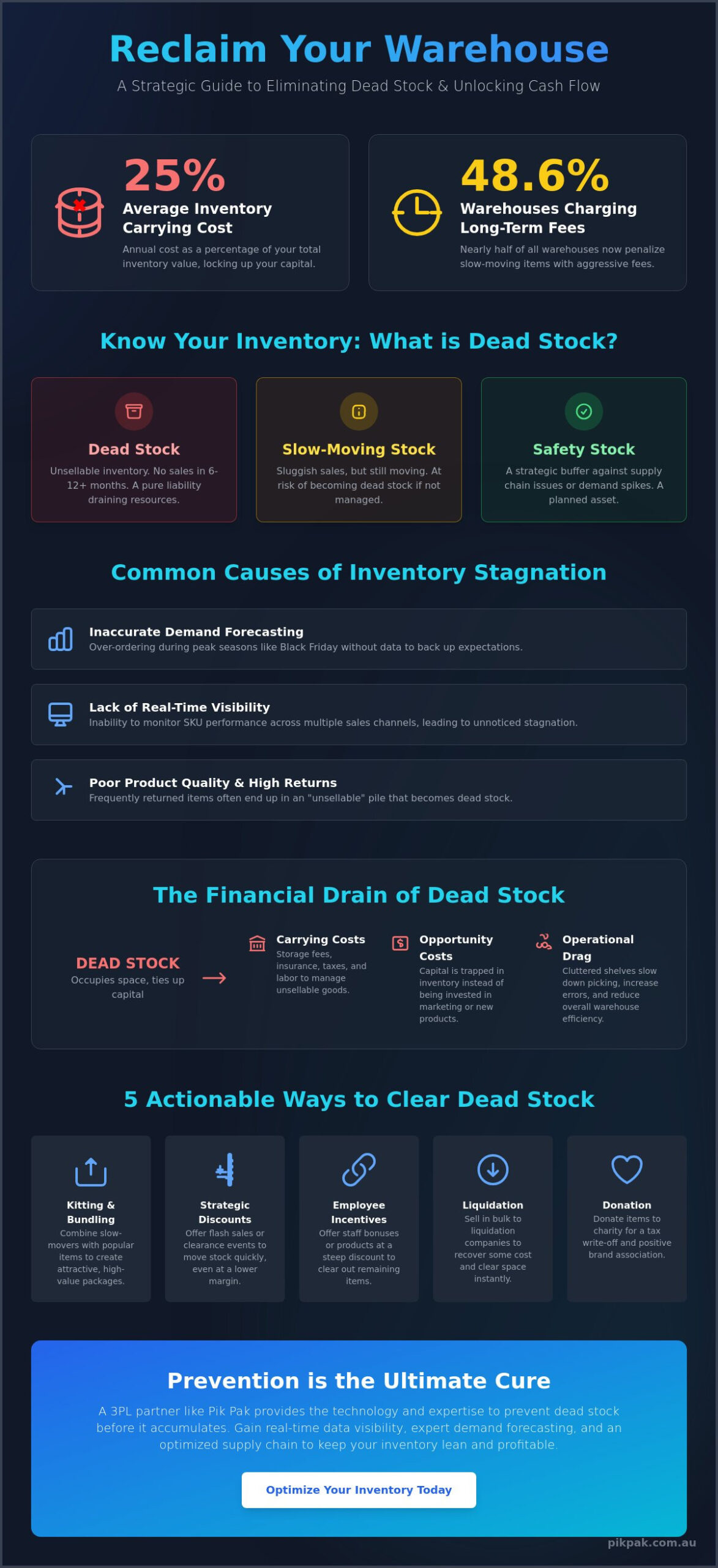
Did you know that the average inventory carrying cost in 2026 has climbed to 25% of your total inventory value? If you feel like your warehouse is getting crowded while your bank balance stays flat, you aren’t alone. It’s frustrating to watch capital sit idle in unsellable goods, especially when 48.6% of warehouses now charge aggressive long-term storage fees for slow-moving items. We understand that reducing dead stock in your warehouse can feel like a constant battle against your own growth, but it doesn’t have to be that way.
This guide provides a pragmatic roadmap to unlock cash flow and optimize your operations. You’ll learn how to identify obsolete inventory quickly, clear out the clutter, and use automated systems to flag slow-movers before they become a liability. We’ll show you how to turn visibility into a competitive advantage by leveraging data and efficient storage strategies. This article previews the exact steps needed to reclaim your space for high-margin winners and simplify your inventory management for good.
Key Takeaways
- Define the specific threshold between slow-moving items and truly obsolete inventory to prioritize your warehouse recovery efforts.
- Discover how reducing dead stock in your warehouse eliminates hidden carrying costs and frees up vital capital for high-margin products.
- Learn to use professional detection methods like ABC Analysis and Inventory Turnover Ratios to spot stagnant goods before they drain your profits.
- Master actionable clearance tactics, such as strategic kitting and assembly, to turn unsellable items into attractive customer bundles.
- Build a proactive prevention strategy using real-time data visibility to ensure your inventory stays lean and responsive to actual demand.
What is Dead Stock and Why Does it Accumulate?
Every warehouse has a forgotten corner. It’s usually filled with boxes that haven’t been touched in months, gathering dust while they occupy valuable rack space. In the logistics industry, we call this dead stock. Specifically, it’s inventory that has sat on your shelves for 6 to 12 months without a single sale. While it might seem harmless to let it sit there, it’s actually a silent drain on your resources. Understanding What is Dead Stock is the first step toward reclaiming your space and your profit margins.
Focusing on reducing dead stock in your warehouse is essential for maintaining a healthy balance sheet. It’s important to distinguish between slow-moving stock and truly obsolete inventory. Slow-moving items are just sluggish; they still sell, albeit at a lower frequency. Obsolete inventory, however, is “unsellable.” It has reached the end of its life cycle due to shifting market trends or newer product versions. For Australian eCommerce businesses, this often happens during periods of rapid scaling. When you grow too fast without the right data, it’s easy to over-order items that lose their appeal before they ever leave the warehouse.
Common Causes of Inventory Stagnation
Why does this happen? Often, it starts with inaccurate demand forecasting. During peak periods like Black Friday, it’s easy to get caught up in the excitement and over-order. If the actual demand doesn’t meet your expectations, you’re left with a surplus. Poor product quality or high return rates also play a role. If items are frequently returned, they often end up in an “unsellable” pile that eventually becomes dead stock. Finally, a lack of real-time visibility across multiple sales channels makes it impossible to see which SKUs are stagnating. Using the professional technology support provided by Pik Pak Logistics helps you monitor these levels through a centralized WMS platform before they become a problem.
Dead Stock vs. Safety Stock: Knowing the Difference
Don’t confuse dead stock with safety stock. Safety stock is a strategic buffer. It’s designed to protect you from supply chain disruptions or unexpected surges in demand. It’s a deliberate choice. Dead stock, however, is accidental overstock that no longer serves a purpose. You need to know when your buffer has crossed the line and become a liability. reducing dead stock in your warehouse requires a clear-eyed look at these numbers every month.
The tipping point occurs when the ongoing cost of storing an item exceeds the potential profit you could make from its eventual sale.
The Hidden Costs: Why Reducing Dead Stock is Critical for Cash Flow
Dead stock isn’t just taking up space; it’s actively draining your bank account. The average inventory carrying cost in 2026 has reached 25% of your total inventory value. This figure includes storage space costs, capital costs, and inventory risk like obsolescence. When you focus on reducing dead stock in your warehouse, you aren’t just tidying up. You’re reclaiming cash that’s currently locked in a depreciating asset rather than working for your business.
Carrying costs are the most obvious burden. You’re paying storage fees, insurance, and taxes on items that aren’t generating revenue. Beyond these bills, there’s the “opportunity cost.” Every dollar tied up in stagnant inventory is a dollar you can’t spend on marketing or new product lines. In fast-moving sectors like electronics or fashion, this is even more dangerous. Goods depreciate rapidly as newer models or styles emerge, meaning the longer you wait, the less value you recover. A strategic approach to reducing dead stock in your warehouse is essential for scaling without unnecessary debt.
The Drain on Warehouse Operations
Stagnant SKUs complicate the pick and pack warehouse process. When shelves are cluttered with unsellable items, staff have to navigate around them constantly. This extra movement slows down productivity and increases the risk of picking errors. Efficient distribution & warehousing requires high inventory turnover to keep the floor clear and the workflow logical. Removing the “noise” of dead stock allows your team to focus on the high-margin winners that actually drive growth.
Impact on Profit Margins and Scaling
Calculating the break-even point for long-term storage is vital. If an item hasn’t moved in six months, the storage fees might already be eating your entire profit margin. Implementing better Detection Strategies helps you identify these laggards before they become a permanent fixture. Clearing this stock provides the capital needed for new launches, allowing you to scale without needing external financing. There’s also a psychological benefit; a lean warehouse feels manageable and under control. If you’re ready to streamline, our team can help you manage your inventory storage more effectively.
Detection Strategies: Identifying Obsolete Items in Your Warehouse
You can’t fix what you can’t see. Identifying the items draining your cash flow requires more than a quick look at the shelves. In the Australian market, where shipping costs and local returns can fluctuate, having a precise detection strategy is vital for reducing dead stock in your warehouse. You need a mix of data-driven digital tracking and strategic categorisation to keep your inventory moving. Relying on guesswork leads to over-ordering; relying on data leads to growth.
The Inventory Turnover Ratio is your first line of defense. This metric measures how many times you sell and replace your stock over a specific period. A low ratio is a red flag. It suggests you’re overstocking or that market demand is falling. Complement this ratio with aged inventory reports. These digital snapshots flag SKUs that haven’t moved in 90, 180, or 365 days. While digital tracking is powerful, regular physical audits remain necessary. They ensure your WMS data matches the actual boxes on your racks, catching discrepancies before they impact your bottom line.
A proactive approach to reducing dead stock in your warehouse involves setting clear thresholds. If an item hasn’t moved in six months, it’s no longer just “slow.” It’s a candidate for clearance. By flagging these problem SKUs early, you can take action while the product still holds some market relevance. This prevents the 4% annual risk of obsolescence from turning into a total loss.
Using ABC Analysis to Prioritise Action
ABC Analysis helps you focus your energy where it matters most. Categorising your stock ensures you aren’t wasting time on items that don’t drive value. It breaks down your inventory into three distinct groups:
- Category A: High-value, high-turnover products. These are your “winners” that require tight control and frequent reordering.
- Category B: Moderate value and turnover. These items are stable but need regular monitoring to ensure they don’t stagnate.
- Category C: Low-value, slow-moving items. This is the dead stock danger zone where most of your warehouse clutter resides.
Leveraging WMS Data for Real-Time Audits
Modern technology support provides instant visibility into the age of every SKU you own. You can set up “low-turnover” alerts that notify you the moment an item hits a specific age threshold. This proactive approach allows you to act before storage fees escalate. Direct API integrations between your eCommerce store and your WMS prevent data silos by ensuring sales figures and inventory levels are always perfectly synced. This level of automation is key to maintaining a lean operation while you focus on high-level business strategy.
5 Actionable Ways to Clear Dead Stock and Recover Value
Once you’ve identified stagnant SKUs using the detection strategies discussed earlier, speed becomes your primary ally. The longer an item sits, the more its value erodes through storage fees and depreciation. reducing dead stock in your warehouse requires a decisive shift from storage to movement. You don’t always have to accept a total loss. With a pragmatic approach, you can recover a significant portion of your initial investment and clear the way for more profitable inventory.
There are several proven methods to shift obsolete goods quickly:
- Strategic Flash Sales: Run limited-time “everything must go” events or create “mystery boxes” where customers receive a surprise selection of items at a steep discount.
- Return to Vendor (RTV): Check your supplier contracts. Some vendors allow you to return slow-moving or defective goods for a credit, though you may need to pay a restocking fee.
- Tax-Deductible Donations: For items that simply won’t sell, donating to Australian charities can provide a helpful tax deduction while supporting a good cause.
- B2B Liquidation: Selling in bulk to “off-price” retailers or specialized liquidators is a fast way to clear entire pallets, even if the per-unit return is low.
- Kitting and Bundling: This is often the most effective way to recover near-full retail value by pairing slow items with your bestsellers.
The Power of Kitting and Bundling
Kitting allows you to pair a “Category C” slow-mover with a “Category A” bestseller. For example, if you have excess stock of phone cases but your chargers are flying off the shelves, bundle them together as a “Power Protection Kit.” This increases the Perceived Value (IPV) for the customer without requiring a deep discount on your top-selling item. Managing kitting & assembly is a core 3PL function that simplifies this process, allowing you to create new SKUs from existing stock without manual overhead. If you want to turn your stagnant stock into attractive bundles, explore our kitting services today.
Liquidation and Alternative Sales Channels
If your primary storefront isn’t moving the stock, look elsewhere. Social media “live sales” are highly effective for shifting oddments and end-of-line items to a dedicated audience in real-time. For larger volumes, bulk liquidators can take the entire burden off your hands at once. However, remember that high-volume clearance events often result in higher return rates. You must have a robust system for reverse logistics to handle these returns efficiently without re-cluttering your warehouse. reducing dead stock in your warehouse is only successful if you prevent those items from creeping back onto your shelves.
Preventing Dead Stock: How a 3PL Partner Keeps Your Inventory Lean
While previous sections focused on clearing existing clutter, the most sustainable path forward is preventing it from ever accumulating. Transitioning from reactive firefighting to proactive management ensures your eCommerce growth remains profitable and efficient. Partnering with Pik Pak Logistics allows you to move beyond manual spreadsheets and into a tech-driven ecosystem. By leveraging real-time visibility, you can make informed procurement decisions based on actual demand rather than optimistic guesses. reducing dead stock in your warehouse becomes an automated outcome of a smarter, more transparent supply chain.
Expert order fulfilment provides a critical feedback loop that minimizes the forecasting errors mentioned earlier. When your warehouse data is perfectly synchronized with your sales channels, you gain a clear view of SKU velocity. This transparency prevents the accidental over-ordering that often occurs during rapid scaling or seasonal transitions. By maintaining this lean approach, reducing dead stock in your warehouse is no longer a seasonal cleanup task but a constant operational standard that protects your margins.
Data-Driven Forecasting and Reordering
Sales data provides the roadmap for your next purchase. By analyzing historical trends through our platform, you can establish precise reorder points that trigger only when stock levels reach a specific threshold. This helps you avoid the “bulk discount trap” where the per-unit savings of a large order are quickly erased by long-term storage fees and eventual obsolescence. The platform at Pik Pak Logistics integrates directly with major storefronts like Shopify and WooCommerce. This ensures your inventory levels and sales figures are always aligned, eliminating the data silos that lead to costly ordering mistakes.
The Flexibility of Outsourced Warehousing
Outsourcing your logistics provides the agility needed to handle seasonal peaks without committing to permanent, underutilized space. You only pay for the storage you actually use, which prevents “dead space” costs from draining your capital during quieter months. This model allows you to focus on high-level strategy while Pik Pak Logistics manages the operational details, including strict warehouse receiving guidelines to ensure every item is accounted for and tracked from the moment it arrives. You don’t need to be a logistics expert to run a lean operation; you just need the right partner. Streamline your inventory with the expert fulfilment services at Pik Pak Logistics today.
Take Control of Your Inventory and Reclaim Your Profit
Managing a warehouse shouldn’t feel like an uphill battle against stagnant stock. By implementing detection strategies like ABC analysis and using actionable clearance tactics such as kitting and assembly, you’ve already started the journey of reducing dead stock in your warehouse. The real transformation happens when you move from manual tracking to an automated, data-driven system that prevents obsolescence before it impacts your bottom line.
You don’t have to manage these operational hurdles alone. Delegating your logistics to a partner with real-time WMS visibility and seamless eCommerce integrations allows you to refocus on what matters most: growing your business. Expert kitting and assembly services turn your inventory challenges into profitable bundles, ensuring every square metre of your storage works for you. Precision and automation are the keys to a modern, scalable supply chain.
Ready to clear the clutter? See how Pik Pak Logistics can optimise your warehouse.
Your business deserves a lean, efficient supply chain that fuels growth rather than draining it. Take the first step toward a more profitable future today.
Frequently Asked Questions
What is the difference between dead stock and slow-moving inventory?
Slow-moving inventory still has a sales velocity, even if it’s much lower than your bestsellers. It requires a minor marketing nudge or a small discount to shift. Dead stock, however, hasn’t moved for at least six months and is unlikely to sell at full retail price. Identifying the difference helps you decide whether to run a targeted promotion or clear the pallet entirely to stop the drain on your resources.
How much does dead stock actually cost my business annually?
Carrying costs for stagnant inventory typically hover around 25% of its total value each year. This figure includes storage fees, insurance, and the opportunity cost of capital that could be used for faster-turning SKUs. If you have $10,000 in obsolete inventory, you’re effectively losing $2,500 every year just by letting it sit on your shelves instead of reinvesting that cash into growth.
Can I return dead stock to my supplier for a refund?
It depends on your original purchase agreement. Many suppliers allow returns for credit with a restocking fee, which usually ranges from 10% to 20%. While this isn’t a full refund, it’s often a more pragmatic financial choice for reducing dead stock in your warehouse than paying ongoing long-term storage fees for items that have no local demand.
Is it better to discount dead stock or donate it for a tax write-off?
Discounting recovers immediate cash flow, but donation provides a clean exit and a tax write-off in Australia. If the storage fees for a bulky item are higher than the expected discounted sale price, donation is the more efficient choice. This approach clears the space for higher-margin products while providing a social benefit and a financial deduction for your business.
How often should I perform an inventory audit to prevent dead stock?
You should perform a full physical audit at least once a year, supplemented by monthly cycle counts for your most stagnant categories. Regular digital tracking through a WMS identifies trends, but physical counts catch the discrepancies that lead to accidental overstocking. Frequent audits ensure you identify laggards before they reach the critical 12-month mark where they become truly obsolete.
How can a 3PL help me identify dead stock before it becomes a problem?
A 3PL provides the data infrastructure that many eCommerce businesses lack internally. The platform at Pik Pak Logistics uses real-time reporting to flag items the moment they hit a specific age threshold, such as 90 or 180 days. This proactive visibility allows you to launch clearance campaigns or bundle items while they still hold market relevance, preventing a total loss.
What are the best tools for tracking inventory age in Australia?
Look for WMS platforms that offer native integrations with local shipping carriers and major eCommerce storefronts like Shopify or WooCommerce. The technology at Pik Pak Logistics provides this professional visibility without the need for expensive internal software setups. These tools automate the tracking of “first-in, first-out” movement, ensuring you always know exactly how old your stock is at any given moment.
Does dead stock affect my eCommerce store’s SEO or marketplace rankings?
Yes, marketplaces like Amazon track your inventory health as part of their ranking algorithms. A high volume of stagnant stock lowers your sell-through rate, which can negatively impact your search visibility and overall account health. reducing dead stock in your warehouse improves these metrics, signalling to the marketplace that your store is efficient and your products are in high demand.