

If your inventory turnover ratio is sitting below 2, your warehouse isn’t just full; it’s holding your cash flow hostage. Top-performing eCommerce brands in 2026 are already achieving ratios of 8 or higher, leaving their competitors to struggle with high storage fees and dead stock. You likely feel the weight of every pallet that doesn’t move, especially as Amazon fulfillment fees increased again in January 2026. Understanding how to improve inventory turnover is no longer just a goal; it’s a necessity for survival in a market where manual tracking errors and inaccurate forecasting can sink your margins.
You deserve a logistics strategy that turns your inventory back into liquid capital. This guide provides a practical roadmap to mastering the strategies and technology required to accelerate your velocity. We’ll show you how to leverage automation to reduce warehousing fees and navigate complex shifts like the 2026 USMCA review or new EU packaging standards. By the end of this article, you’ll have the tools to unlock trapped cash flow and achieve scalable growth without the usual operational friction. It’s time to stop managing clutter and start managing growth.
Key Takeaways
- Calculate your turnover ratio using the COGS formula to pinpoint exactly where cash is trapped in your warehouse.
- Master five proven strategies on how to improve inventory turnover, from precise demand forecasting to aggressive SKU rationalisation.
- Use cloud-based technology to gain real-time visibility and automate reorder points for leaner operations.
- Accelerate your shipping cycles by leveraging professional pick and pack services that move stock faster.
- Reduce operational friction by integrating efficient returns management to get products back into the sellable pool immediately.
What is Inventory Turnover and Why Does it Matter in 2026?
Think of your inventory as the pulse of your business. Inventory turnover is the frequency at which your brand sells through its stock and replaces it over a specific timeframe. In the competitive Australian eCommerce landscape, this metric is a clear indicator of how well your product range aligns with actual market demand. High turnover means you’re moving goods quickly; low turnover suggests your capital is gathering dust on a shelf. It’s the ultimate measure of operational efficiency.
Low turnover carries heavy hidden costs that many founders overlook until they impact the bottom line. Beyond the obvious lack of sales, slow-moving stock triggers increased storage fees, higher insurance premiums, and the risk of product depreciation. As of January 15, 2026, Amazon increased its fulfillment fees by approximately $0.08 per unit. These incremental costs make it expensive to store products that don’t move. Managing these expenses requires a strategic approach to warehousing and fulfilment to ensure your operations remain lean and profitable.
The Financial Impact of “Trapped Cash”
Your inventory is likely your business’s largest asset, but it can quickly become your biggest liability. Every dollar spent on stock that sits idle is “trapped cash.” This is capital you can’t use for high-impact activities like launching new marketing campaigns or expanding your product line. For growing brands, working capital efficiency is the engine of sustainability. When you master how to improve inventory turnover, you aren’t just selling more products; you’re freeing up the liquid cash necessary to scale without taking on unnecessary debt. It’s about making your money work as hard as you do.
High vs. Low Turnover: Finding the Sweet Spot
Efficiency doesn’t always mean “as fast as possible.” While a low turnover ratio, typically below 2, is a red flag for obsolescence, an extremely high ratio can also signal trouble. If your stock turns over too quickly, you risk frequent stockouts and lost revenue. In 2026, top-performing eCommerce businesses often achieve a ratio of 8 or higher, while 4 to 6 is considered a healthy, stable range. Your goal is to find the sweet spot where you maintain enough safety stock to prevent shipping delays while keeping your inventory velocity high enough to maximise cash flow.
How to Calculate Your Inventory Turnover Ratio
To manage your growth, you need a precise way to measure it. The industry standard formula for inventory turnover is your Cost of Goods Sold (COGS) divided by your Average Inventory. Using COGS is essential because it excludes your retail markups, providing a direct view of the physical movement of your goods. If you use total sales figures instead, your ratio will look artificially high, masking inefficiencies in your supply chain. This calculation tells you exactly how many times you’ve cleared out your warehouse in a given period.
Calculating Average Inventory is simple: add your starting inventory value to your ending value for a specific period and divide by two. For Australian brands dealing with summer peaks or end-of-financial-year sales, monthly audits are far more effective than annual ones. They reveal seasonal trends while they’re happening, giving you the chance to pivot before your capital gets stuck. Frequent checks allow you to spot slow-moving items early, which is a critical step when learning how to improve inventory turnover across your entire SKU range.
Step-by-Step Calculation Example
Let’s look at a Melbourne-based boutique selling eco-friendly homewares. Over the last quarter, their COGS was $150,000. Their starting inventory was $35,000 and their ending inventory was $25,000, making their average inventory $30,000. Dividing $150,000 by $30,000 gives a turnover ratio of 5. This means they sold and replaced their entire stock five times in three months. If this ratio dropped below 2, it would be a clear signal to investigate Inventory Turnover Optimization Techniques to protect their liquid capital.
The Role of Real-Time Data in Accuracy
Spreadsheets are the enemy of precision. Manual tracking often results in “laggy” data that doesn’t reflect your current stock levels, especially during high-volume sales. Relying on outdated numbers makes it nearly impossible to know how to improve inventory turnover effectively. This is where a modern logistics service makes the difference. By integrating your Shopify or WooCommerce store directly with a professional Warehouse Management System (WMS), you get live visibility across all channels. This automation eliminates human error and ensures your calculations are based on reality, not guesswork. If you’re tired of second-guessing your stock levels, it might be time to explore our technology support to streamline your data flow.
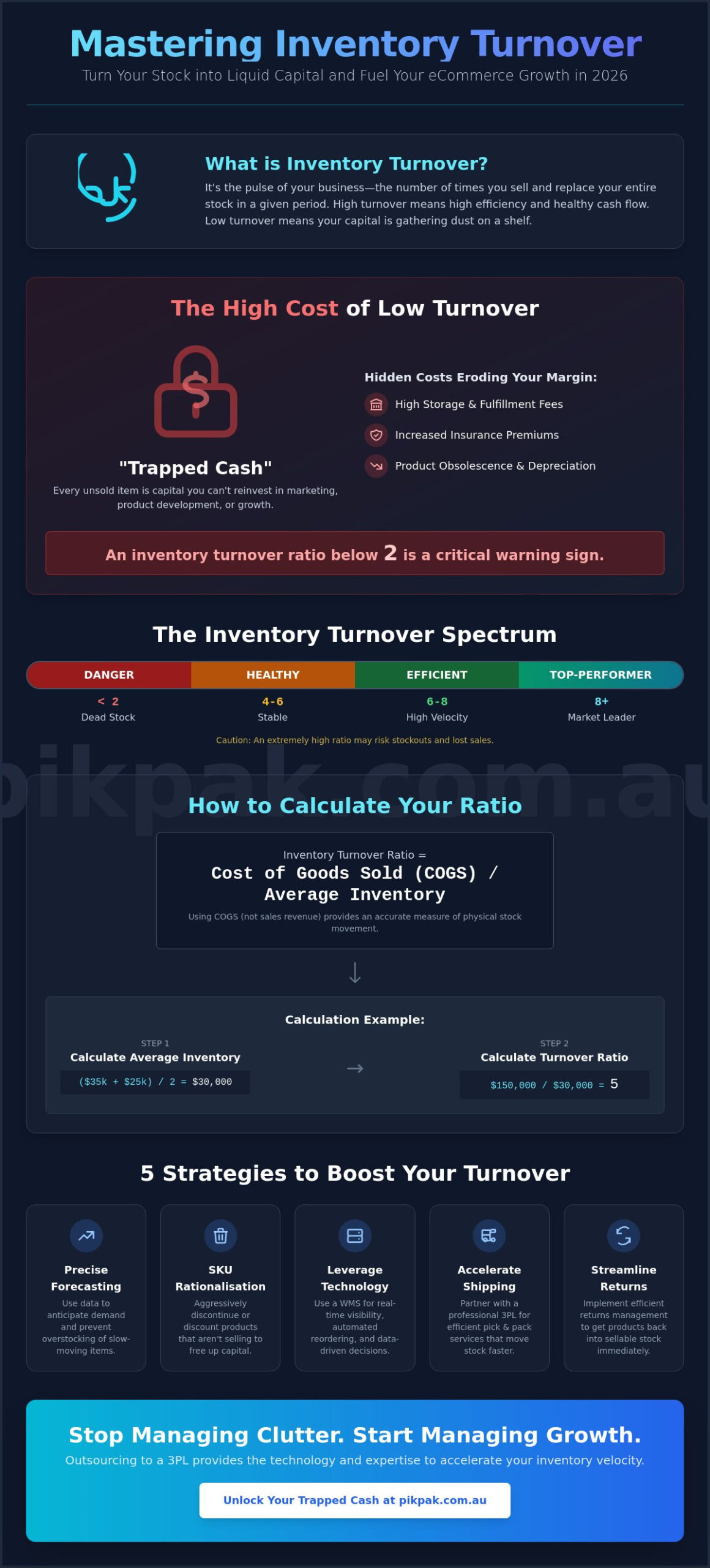
5 Smart Strategies to Improve Your Inventory Turnover
Knowing your ratio is just the beginning. Learning how to improve inventory turnover requires a shift from reactive counting to proactive management. It’s about ensuring every pallet in your warehouse has a clear path to a customer’s doorstep. When you implement these five strategies, you stop treating inventory as a static pile of goods and start treating it as a high-velocity asset.
- Demand Forecasting: Don’t rely on guesswork. Use historical sales data to predict future cycles. This ensures you have enough stock for peak periods without over-ordering during the quiet months.
- SKU Rationalisation: Identify your “zombie” stock. These are the items that haven’t moved in 90 days or more. If a product isn’t contributing to your bottom line, it’s time to clear it out and reclaim the shelf space.
- Marketing Alignment: Your marketing team should be your warehouse’s best friend. Instead of running generic ads, sync your promotions with current stock levels. If you have an oversupply of a specific SKU, put your ad spend behind it to move it faster.
- Supplier Lead Time Reduction: Long lead times force you to hold more safety stock. Work with suppliers to order smaller batches more frequently. In 2026, many brands are adopting a “China Plus One” strategy to diversify suppliers and reduce the risk of long-distance delays.
- Strategic Kitting: This is a powerful alternative to heavy discounting. By bundling a slow-moving item with a best-seller, you increase the perceived value for the customer while clearing out stagnant inventory.
Forecasting for the Australian Market
Success in Australia requires accounting for local seasonality that differs from the Northern Hemisphere. You must plan for the End of Financial Year (EOFY) in June, the intense Australian summer peak, and the global pressure of Black Friday. Transparency with your suppliers regarding these dates is non-negotiable. Precise forecasting prevents the double-edged sword of overstocking, which traps cash, and stockouts, which drive customers to your competitors. It’s the foundation of a resilient supply chain.
The Power of Kitting and Bundling
Kitting is an underutilised tool for velocity. When you use professional kitting and assembly services, you gain the flexibility to pivot your inventory strategy without ordering new stock. Bundling products doesn’t just move “zombie” stock; it also reduces your individual pick and pack costs. Instead of paying to ship two separate orders, you ship one kit. This increases your average order value and gets your inventory turnover ratio moving in the right direction. It’s a simple, manageable way to regain control over your warehouse floor.
Leveraging Technology: Preventing Dead Stock Before it Happens
Technology is the bridge between a theoretical math formula and a truly profitable warehouse. If you’re still manually updating spreadsheets, your data is likely outdated by the time you’ve finished the last row. A cloud-based Warehouse Management System (WMS) eliminates this lag by providing real-time visibility across every sales channel. This level of precision is exactly how to improve inventory turnover in 2026. It allows you to spot declining demand trends before they become expensive liabilities, giving you the chance to pivot your strategy before your capital is locked away in stagnant stock.
Automation is your best defense against the “just in case” ordering habits that lead to overstocking. By setting automated reorder points, your system only triggers a restock when inventory hits a specific threshold. This keeps your stock levels lean and your cash flow healthy. API integrations play a vital role here, ensuring your eCommerce store and your warehouse speak the same language. When your data flows seamlessly, your business moves faster. You no longer have to guess if you have enough stock for a weekend sale; the system tells you instantly.
Analytics act as the crystal ball of your supply chain. Modern systems don’t just tell you what you have; they tell you where your velocity is trending. By identifying products with slowing momentum, you can adjust your procurement strategy before the next shipment arrives. This proactive approach is a core part of learning how to improve inventory turnover because it prevents the accumulation of dead stock before it ever reaches the shelf. Precision in data leads directly to precision in profit.
Real-Time Visibility via WMS
Knowing exactly what’s sitting in your 3pl warehouse at any given moment is a game-changer for your marketing team. When they have access to live data, they can make informed decisions about which SKUs need a promotional push and which are selling themselves. Our technology support removes the friction of manual counting, significantly reducing the human error that often leads to stockouts or double-selling. It’s about having total control over your assets without the stress of manual tracking.
Automated Reporting and Alerts
Dead stock is a silent profit killer that thrives in the dark. You can configure your platform to send automatic alerts for any stock that has been sitting for 90 days or more. These “zombie stock” notifications allow you to take action immediately, whether through a kitting strategy or a targeted clearance event. Automated reports save business owners hours of manual labor, letting you refocus on growth rather than logistics. The Pik Pak Logistics platform is designed to put this analytical power directly into your hands, ensuring you always know where your money is.
How Outsourcing to a 3PL Accelerates Your Inventory Velocity
Software provides the vision, but physical execution provides the momentum. If your warehouse staff is slow or prone to errors, even the best forecasting won’t save your cash flow. Professional picking and packing services reduce the critical gap between a customer’s order and the shipment date. This physical speed is a fundamental pillar of how to improve inventory turnover. When orders move out faster, you clear shelf space for new arrivals and shorten your cash conversion cycle. It’s about moving from a stagnant warehouse to a high-velocity fulfillment center.
Scalability is equally important for growing eCommerce brands. In 2026, third-party logistics (3PL) fulfillment for domestic orders typically costs between $8 and $15 per order. By outsourcing, you convert fixed warehousing costs into variable expenses. You only pay for the storage you actually use, which prevents your margins from being eaten by empty shelf space during quiet periods. This flexibility is essential for maintaining a healthy balance sheet as you scale, especially as the average monthly minimum spend for 3PL services has trended upward to $517 in recent years.
Perhaps the greatest benefit is the gift of focus. As a business owner, your value lies in marketing, product development, and customer acquisition. Spending your afternoons packing boxes is an expensive use of your time. Delegating these operational burdens to a seasoned partner allows you to reclaim your schedule. It transforms logistics from a chaotic hurdle into a simple, manageable task that runs in the background. This allows you to focus on the high-level strategies needed to learn how to improve inventory turnover across your entire product range.
Speed of Execution as a Turnover Driver
Faster customer delivery doesn’t just please the shopper; it clears your shelves faster. Professional warehouse management ensures that mispicks and damaged stock are kept to an absolute minimum. Every error is a delay that keeps your capital locked in a box. 3PLs optimize the physical flow of goods using advanced layout strategies to maximize space efficiency. This ensures your high-velocity items are always within reach for immediate shipping, keeping your stock moving at a record pace.
Streamlining Returns (Reverse Logistics)
Returns management is often the most overlooked part of the turnover equation. Slow returns processing is a silent killer of inventory velocity. If a returned item sits in a corner for weeks, it’s effectively dead stock. A dedicated returns process ensures that items are inspected and returned to the digital shelf quickly. This keeps your inventory pool fresh and sellable, preventing the depreciation that comes with long-term storage. Ready to move stock faster? Speak with Pik Pak Logistics today.
Take Control of Your Inventory Velocity Today
Mastering how to improve inventory turnover is the difference between a business that survives and one that scales with ease. You’ve seen that true success requires a synergy of precise data calculation and aggressive physical execution. By moving away from manual spreadsheets and adopting real-time WMS visibility, you eliminate the guesswork that leads to overstocking and trapped capital. Implementing expert kitting and assembly services further ensures that your stock remains fluid and your cash flow stays healthy.
Logistics shouldn’t be a source of operational friction. It’s meant to be an enabling force that allows you to refocus on your brand’s core mission. Partnering with a specialist for eCommerce fulfilment in Australia gives you the high-tech infrastructure needed to move stock faster without the burden of private warehouse overheads. It’s time to stop managing clutter and start managing your expansion.
Ready to accelerate your growth and unlock your liquid capital? Request a Quote from Pik Pak Logistics Today and turn your warehouse into a high-performance asset. Your business is ready for the next level; we’re here to help you reach it.
Frequently Asked Questions
What is a good inventory turnover ratio for eCommerce?
A good inventory turnover ratio for eCommerce businesses in 2026 is generally between 4 and 6 times per year. Top-performing brands often achieve a ratio of 8 or higher, which indicates a highly efficient sales cycle and lean stock management. If your ratio falls below 2, it’s a sign that your capital is trapped in slow-moving goods and your storage costs are likely too high.
How does low inventory turnover affect my business?
Low turnover directly reduces your liquid cash flow and increases your operational overhead through higher storage and insurance fees. When products sit in a warehouse for too long, they risk becoming obsolete or damaged, which leads to significant depreciation. This trapped capital prevents you from reinvesting in marketing or new product lines, effectively stalling your ability to scale in a competitive market.
Can a 3PL help me improve my inventory turnover?
Yes, a professional 3PL provides the technology and execution speed needed to understand how to improve inventory turnover effectively. By using a cloud-based WMS, you gain real-time visibility that allows for more accurate demand forecasting and automated reordering. Faster picking and packing cycles also ensure that orders move out the door immediately, clearing shelf space for high-velocity stock and reducing your storage duration.
What is the difference between inventory turnover and days sales of inventory (DSI)?
Inventory turnover measures the frequency at which you replace your entire stock within a year, while Days Sales of Inventory (DSI) calculates the average number of days it takes to turn that stock into a sale. They are essentially two ways of looking at the same data. A high turnover ratio results in a lower DSI, meaning your products spend less time sitting in the warehouse and more time generating revenue.
How often should I calculate my inventory turnover ratio?
You should calculate your turnover ratio monthly to stay ahead of seasonal trends and shifting consumer demand. While annual figures provide a broad overview, monthly audits allow you to pivot your procurement strategy before slow-moving stock becomes a major liability. This is particularly important for Australian brands navigating peak periods like the summer sales or the End of Financial Year (EOFY) rush.
Does kitting actually help with inventory turnover?
Kitting is a highly effective strategy for moving stock faster by bundling slow-moving items with your most popular products. This increases the perceived value for the customer and allows you to clear “zombie stock” without relying solely on heavy individual discounts. It also streamlines the fulfillment process, as multiple items are picked and packed as a single unit, which improves your overall warehouse efficiency.
What is the most common cause of low inventory turnover?
The most common cause of low turnover is inaccurate demand forecasting based on guesswork rather than historical data. When businesses over-order stock “just in case,” they often end up with a surplus of SKUs that don’t align with actual market demand. This issue is usually worsened by manual tracking errors, which hide declining sales trends until the warehouse is already full of stagnant inventory.
How do I handle obsolete or dead stock?
You should handle dead stock by implementing aggressive clearance promotions, kitting strategies, or selling excess inventory back to suppliers where possible. If an item hasn’t moved in 90 days, it’s costing you more in warehousing fees than its potential profit margin. Learning how to improve inventory turnover often starts with the difficult decision to liquidate stagnant products to make room for items that actually drive growth.