
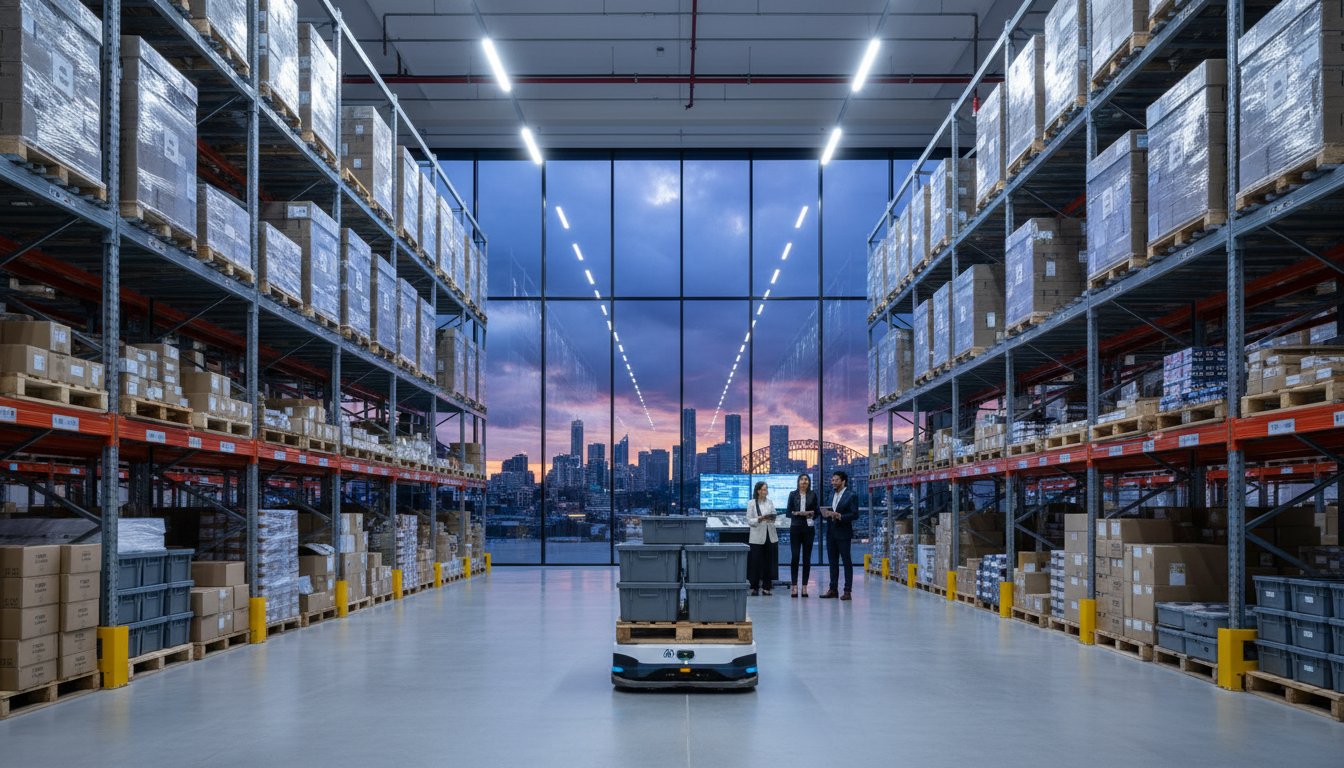
If your warehouse flooded tomorrow or a major carrier strike halted the Australian transport network, is your business continuity plan a living strategy or just a dusty document in a drawer? You likely recognize that relying on a single in-house facility is a high-stakes gamble. With 69% of businesses facing workforce shortages in 2026, the cost of maintaining redundant systems yourself has become unsustainable. It’s stressful to manage these moving parts while trying to scale.
This article explains how achieving business continuity with a 3pl australia secures your eCommerce operations against volatility. You’ll discover how a strategic partnership provides the resilient infrastructure needed to meet APRA’s CPS 230 standards and keep orders flowing during tech outages or natural disasters. We will look at how automated WMS platforms and scalable storage allow you to reclaim your time, delegating the operational heavy lifting so you can focus entirely on your growth targets for 2026 and beyond.
Key Takeaways
- Learn why a physical backup for your stock is just as critical as a digital one to eliminate single points of failure in your supply chain.
- Compare the recovery speeds of in-house warehousing against professional 3PL setups to see how fast your brand can bounce back from a crisis.
- Discover how achieving business continuity with a 3pl australia acts as an operational shock absorber during seasonal peaks and carrier disruptions.
- Identify the five essential features your logistics partner must have to ensure they don’t become your biggest liability during an emergency.
- See how real-time inventory accuracy and 99.9% system uptime keep your orders moving so you can focus on growth without the operational stress.
Beyond the Paper Plan: Why Logistics is the Weak Link in Australian Business Continuity
Most business owners view Business continuity planning as a checklist for IT systems or office access. In the world of eCommerce, however, a plan that doesn’t account for your physical stock is just a piece of paper. True business continuity with a 3pl australia means your orders keep moving even when the roads are closed or the power is out. It is about ensuring that your customers receive their packages regardless of external chaos. If your logistics strategy can’t survive a physical disruption, your business can’t survive it either.
Traditional Australian business plans often fail because they ignore the physical reality of the ‘last mile’. We have seen how quickly East Coast floods or industrial action at major ports can paralyze a supply chain. If your entire inventory sits in one small warehouse or a home garage, you have created a single point of failure. One localized event could stop your revenue entirely. You need a setup that doesn’t break when the environment becomes unpredictable.
The Reality of Supply Chain Volatility in 2026
Consumer expectations have shifted. In 2026, fast delivery isn’t a bonus; it’s the standard. This has removed the ‘buffer time’ brands once used to recover from shipping delays. With climate-related disruptions becoming more frequent in the Australian logistics corridor, ‘resilience’ has replaced ‘efficiency’ as the primary goal. You can’t just be lean. You have to be durable. High-performing brands are now prioritizing business continuity with a 3pl australia to ensure they have the infrastructure to withstand these recurring shocks without losing momentum.
Identifying Your Logistics Vulnerabilities
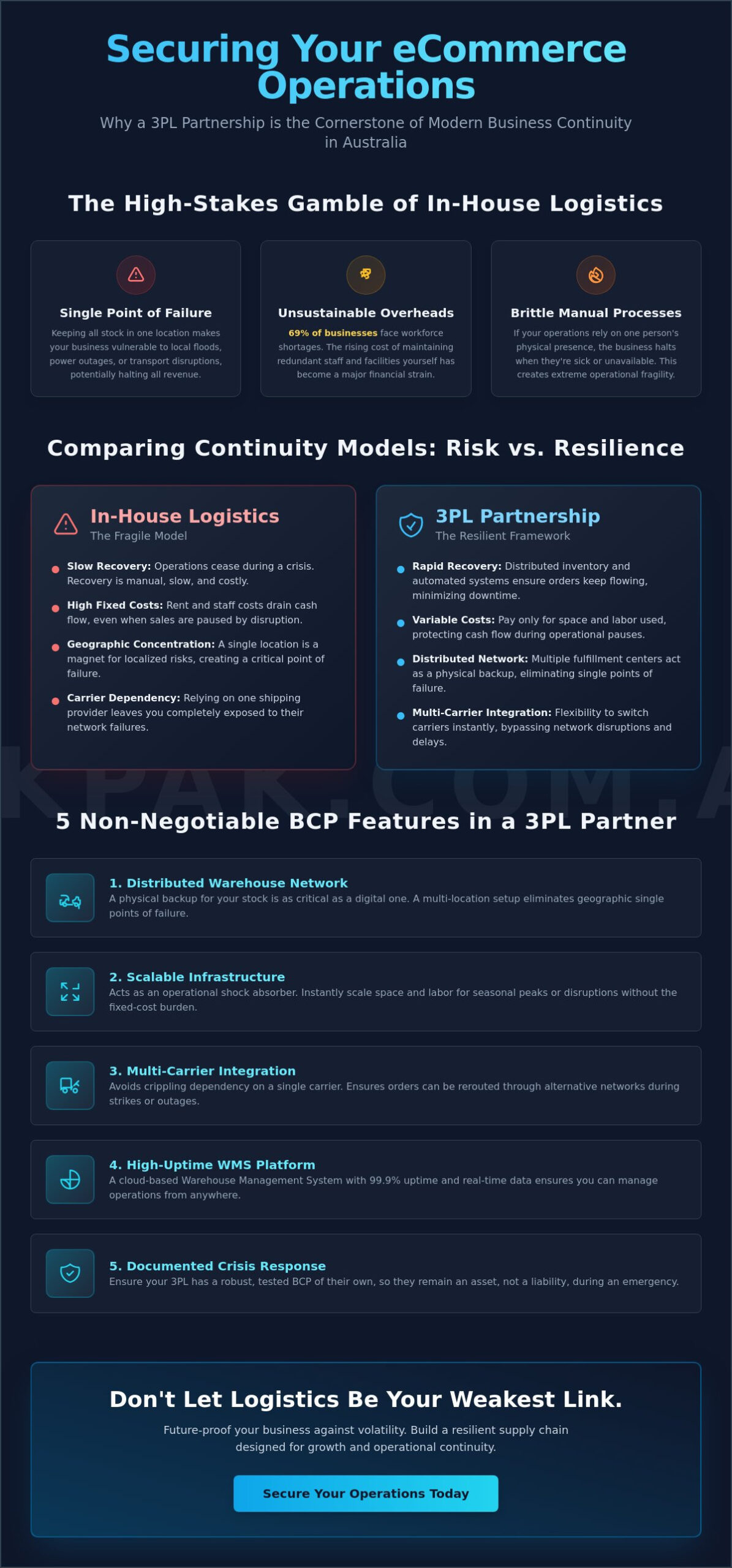
Start with a logistics-first Business Impact Analysis (BIA) for your online store. You must look at your dependencies and identify where the chain might snap. Common vulnerabilities include:
- Carrier Dependency: Relying solely on a single provider like Australia Post leaves you exposed to strikes or system crashes.
- Geographic Concentration: Keeping all your stock in one postcode makes you vulnerable to local disasters or power outages.
- Manual Processes: If your shipping relies on the founder’s physical presence, the business stops if you get sick.
The hidden costs of downtime are brutal. You don’t just lose a single sale. You lose customer trust and face marketplace ranking penalties on platforms like Amazon or eBay. Evaluating your logistics services early prevents these expensive surprises and keeps your brand’s reputation intact.
The 3PL Resilience Framework: How Outsourcing Safeguards Your Operations
Business continuity isn’t just about having a backup server. It is about having a physical infrastructure that doesn’t stop when things get difficult. A professional 3PL provides a structural resilience that most small to medium businesses simply cannot build on their own. By moving from a centralized, in-house model to a distributed network, you create a system that absorbs shocks rather than breaking under them. This is the core of business continuity with a 3pl australia; it’s about building a foundation that stays solid even when the local environment is in flux.
Industry experts at the Australasian Supply Chain & Logistics Association emphasize the need for effective resilience strategies for Australian supply chains to combat modern volatility. A key part of this strategy is the shift from fixed overheads to variable costs. When you manage your own warehouse, your rent and staff costs remain high even if a disruption pauses your sales. A 3PL partnership turns these into variable expenses. You only pay for the space and labor you actually use, protecting your cash flow during lean periods or operational pauses.
Cloud-based technology plays a silent but vital role here. When your inventory and order data live in a professional Warehouse Management System (WMS), your business remains functional regardless of what happens to your physical office. You can manage your entire operation from a laptop anywhere in the country. This digital continuity ensures that even if you can’t reach your storefront, your brand stays online and your orders keep shipping. If you want to see how this looks in practice, you can explore our technology support options.
Distributed Warehousing and Inventory Redundancy
One of the biggest risks to Australian eCommerce is geographic concentration. Professional warehousing and fulfilment allows you to split your inventory across multiple locations. This means if a flood or fire impacts one region, your business doesn’t go dark. You can still fulfill orders from another site, maintaining “Business as Usual” for your customers. It’s a simple way to eliminate the single point of failure that haunts many in-house setups.
Multi-Carrier Networks: Beating the Shipping Bottleneck
Relying on one carrier is a gamble that rarely pays off during a crisis. A 3PL provides immediate access to a wide range of customer delivery options, from national post to private couriers like Direct Freight. If one network experiences a strike or a major outage, a tech-savvy 3PL can automatically switch your shipments to an alternative provider. This agility ensures your delivery speeds remain consistent, even when the primary transport corridors are under pressure. It’s about keeping your promises to your customers, no matter what.
In-House vs. 3PL: Comparing Continuity Risks and Recovery Speeds
When assessing your operational risk, the most important metric to understand is the Recovery Time Objective (RTO). This is the duration of time it takes to get back to full capacity after a disruption. For an in-house warehouse, the RTO is often measured in weeks or even months. If your local facility is compromised by a fire or a flood, you have to find new space, hire new staff, and move equipment. Achieving business continuity with a 3pl australia changes this timeline. Because the infrastructure is already in place and distributed, your RTO can often be reduced to just hours or days.
In-house logistics carries a heavy load of hidden risks that many founders overlook until it’s too late. A simple forklift breakdown or a localized power outage can halt your entire shipping process. Professional 3PL providers invest in redundant power systems, high-tier security, and industrial-grade fire suppression that most SMEs simply can’t afford on their own. These facilities are built to keep running when the surrounding area goes dark. This level of investment ensures that a 500% order spike doesn’t crash your systems; it’s just another Tuesday.
True business continuity with a 3pl australia also acts as a safeguard for your cash flow. In-house warehousing requires fixed costs that you must pay regardless of whether you are shipping orders. If a disruption stops your sales, those overheads can quickly drain your reserves. A 3PL partnership shifts these to variable costs, meaning you only pay for the activity that actually happens. This financial flexibility is a critical component of staying resilient during unpredictable economic shifts in 2026.
Technology Continuity: WMS vs. Spreadsheets
Many in-house operations rely on “person-dependent” knowledge. If your lead packer is away, the spreadsheets and manual logs become a maze that no one else can navigate. A technology-led 3PL removes this vulnerability. By using a centralized Warehouse Management System (WMS), all data is backed up in the cloud and accessible from anywhere. You get real-time inventory visibility, which is a vital tool for honest crisis communication with your customers if a delay does occur.
The Labour Factor: Managing Human Risk
With 69% of Australian businesses anticipating workforce shortages in 2026, the risk of “key person” dependency has never been higher. If your small warehouse team is hit by a local health crisis, your shipping stops. 3PLs mitigate this by maintaining a large, flexible labour force that can flex during peak times. By adhering to professional warehouse receiving guidelines, they ensure operational consistency that doesn’t depend on any single individual’s presence. You can finally step away from the packing bench and focus on high-level growth.
Evaluating Your Partner: 5 Non-Negotiable BCP Features in an Australian 3PL
Choosing a logistics partner is one of the most significant decisions you will make for your brand’s future. You aren’t just outsourcing a task; you are delegating your reputation. Before you sign a contract, you must audit their ability to survive a crisis. A professional provider should be transparent about their own Business Continuity Plan (BCP). If they can’t show you how they handle a power outage or a localized disaster, they aren’t ready to protect your business. Achieving business continuity with a 3pl australia requires a partner who treats resilience as a core feature, not an afterthought.
Local Australian support is a non-negotiable requirement. When a bushfire closes a major highway or a port strike delays incoming stock, you need to speak with someone who understands the local geography. Multi-channel communication, including dedicated phone support and real-time portals, ensures you aren’t left in the dark. You should also evaluate their carrier diversity. A ‘Tier 1’ infrastructure status means the 3PL has direct relationships with multiple couriers, allowing them to bypass shipping bottlenecks instantly. Finally, ask about their ‘Reverse Logistics’ resilience. Returns management is often the first thing to break during operational chaos, but a resilient partner keeps your returns flowing smoothly to maintain customer trust.
If you are ready to secure your supply chain, you can explore our resilient 3PL solutions today.
Integration and API Stability
Your logistics setup is only as strong as its digital foundation. You must ensure your e-Storefront integration is robust and self-healing. This means if a connection drops, the system should automatically retry until the data syncs. Automated order syncing is vital during high-stress periods because it prevents the manual data entry errors that often occur when teams are rushed. Always test the ‘handshake’ between your store and the WMS to verify that data flows accurately in both directions before going live.
Location and Facility Standards
Geographic risk is a reality in the Australian landscape. When evaluating a partner, look at the physical location of their primary warehouses. Are they situated in known flood zones or areas prone to seasonal disruptions? Infrastructural requirements like backup generators and redundant internet connections are essential for business continuity with a 3pl australia. Review the 3PL’s service priorities to understand how they rank tasks during a recovery phase. You need to know that your brand’s most critical operations will be the first ones back online after an incident.
Future-Proofing with Pik Pak: Tech-Driven Continuity for AU eCommerce
Building business continuity with a 3pl australia isn’t just about surviving a single bad day. It is about creating a long-term competitive advantage that keeps your brand moving while others stall. At Pik Pak, we build resilience into every stage of the order fulfilment process. By combining cloud-based technology with a pragmatic, Australian-focused logistics network, we ensure your business remains operational regardless of external volatility. We don’t just store products; we secure your revenue stream.
Our commitment to 99.9% system uptime and real-time inventory accuracy means you never have to guess about your stock levels. In a market where 1 in 7 goods are now bought online, according to Australia Post, even a few hours of downtime can be devastating. The ‘Pik Pak Advantage’ lies in our ability to act as your operational anchor. We provide the high-tier infrastructure and multi-carrier access required to bypass shipping bottlenecks and local network failures. Transitioning to this resilient model is a straightforward process that begins with a shift in mindset from ‘managing tasks’ to ‘scaling results’.
A Partner Focused on Your Growth and Safety
We empower business owners to reclaim their time by taking the operational heavy lifting off their plates. Our approach to 3PL services prioritises transparency and security at every touchpoint. We don’t believe in a one-size-fits-all solution. Instead, we offer customised BCP consulting to help you integrate our logistics capabilities into your broader brand resilience strategy. You get a partner who is as invested in your business continuity as you are.
Working with us means your data is always backed up and your orders are always visible. This level of precision eliminates the stress of manual tracking and the fear of ‘key person’ dependency. When your backend is automated and secure, you can focus entirely on high-level growth targets and customer acquisition. It’s about building a business that works for you, not the other way around.
Ready to Secure Your Supply Chain?
The peace of mind that comes with professional 3PL logistics is invaluable in today’s unpredictable environment. You deserve a setup that doesn’t break when the unexpected happens. If you are concerned about your current vulnerabilities, our team is ready to help. We can conduct a thorough resilience audit of your fulfilment setup to identify risks before they become crises. Stop worrying about the ‘what ifs’ and start building a foundation that lasts. Secure your business with Pik Pak today and ensure your brand is ready for 2026 and beyond.
Secure Your Brand’s Future Against Tomorrow’s Disruptions
Building a durable supply chain in the Australian market requires moving past paper-based plans and investing in physical resilience. By distributing your inventory and leveraging multi-carrier networks, you eliminate the single points of failure that threaten in-house warehousing. You’ve seen how professional systems reduce your recovery time objective and protect your cash flow by turning fixed overheads into manageable variable costs.
Achieving business continuity with a 3pl australia isn’t just an operational choice; it is a strategic insurance policy for your brand’s reputation. At Pik Pak, we provide the tech-driven foundation you need with a real-time WMS boasting 99.9% uptime and a robust multi-carrier delivery network across Australia. Our expert local support in Melbourne ensures you are never navigating a crisis alone.
Protect your eCommerce growth; discover Pik Pak’s resilient 3PL solutions today.
Take the lead in 2026 by delegating your logistical burdens to a partner built for volatility. Your growth is our priority, and we are ready to help you build a business that stays strong no matter what the environment throws your way.
Frequently Asked Questions
What is the difference between a disaster recovery plan and a business continuity plan for 3PL?
Disaster recovery is the tactical process of restoring specific technical systems, such as your website or database, after a failure. Business continuity is the broader strategy that ensures your entire operation, including physical fulfilment, keeps moving during a crisis. While disaster recovery might focus on a server reboot, business continuity with a 3pl australia ensures your customers still receive their orders even if your primary office is inaccessible.
Does using a 3PL in Australia actually reduce my operational risk?
Outsourcing to a professional provider significantly reduces your operational risk by eliminating the single point of failure inherent in small, in-house warehouses. A 3PL offers distributed infrastructure and redundant systems that most individual brands cannot afford to build alone. This setup protects you from localized issues like power outages, floods, or staff shortages that would otherwise halt your entire shipping process and stop your revenue.
How does a 3PL handle major shipping delays like those seen in 2024 and 2025?
3PLs manage shipping volatility through multi-carrier networks and automated carrier switching. Unlike businesses that rely on a single provider, a tech-savvy 3PL can instantly reroute parcels to alternative couriers if a specific network experiences a strike or a major backlog. This agility was vital during the disruptions of 2024 and 2025, allowing brands to maintain delivery speeds even when primary transport corridors were under heavy pressure.
Can a 3PL help my business survive a cyberattack on my eCommerce store?
A 3PL provides a critical layer of protection during a cyberattack by keeping your fulfilment data separate from your eCommerce storefront. Even if your website is compromised, the 3PL’s independent Warehouse Management System (WMS) remains functional. You can still access inventory data and process orders manually or through secondary channels, ensuring that a digital breach doesn’t lead to a total physical shutdown of your business.
What happens to my stock if my 3PL provider faces its own disruption?
If a 3PL faces a disruption, their own internal Business Continuity Plan activates to keep your stock safe and moving. Professional providers invest in industrial-grade fire suppression, backup generators, and secondary facility access to mitigate their own risks. You should always review a partner’s BCP before signing to ensure they have the physical and digital redundancies required to protect your inventory during an emergency event.
How quickly can I switch my fulfilment to a 3PL if my current warehouse fails?
Onboarding with a 3PL can happen quickly if you use standard API integrations for your e-storefront. While a full transition is best handled as a proactive strategy, many providers have streamlined frameworks to help brands move stock and sync data within a few business days during a crisis. The key to speed is having a clear inventory list and choosing a partner with a tech-first approach to automated integration.
What are the most common logistics disruptions for Australian businesses in 2026?
The most common disruptions in 2026 include acute workforce shortages, climate-related events, and new regulatory requirements like APRA’s CPS 230. According to the Australian Industry Group, 69% of businesses anticipate being affected by labour shortages this year. These factors make business continuity with a 3pl australia a necessity for brands that want to remain competitive and compliant while navigating a volatile operating environment.
Is a 3PL partnership cost-effective for a small business’s continuity plan?
Partnering with a 3PL is highly cost-effective because it transforms fixed overheads like warehouse rent and staff wages into variable costs. You only pay for the storage space and shipping volume you actually use. For a small business, this financial flexibility is a vital part of a continuity plan, as it protects your cash flow during periods of low sales or unexpected operational pauses.