

What if the inventory your customers are waiting for is currently sitting in a warehouse bin as unsellable scrap? It’s the nightmare scenario every e-commerce founder fears, yet many don’t ask what happens if 3pl damages my stock until the first pallet arrives crushed. While industry data from May 2026 shows inventory accuracy has improved to 99% thanks to better technology, even the most efficient warehouses aren’t immune to human error. Finding out your stock is damaged shouldn’t lead to a stressful blame game or a deep dive into confusing contractual jargon.
You’ve worked hard to build your brand, and you deserve a partner who treats your products with the same care you do. It’s frustrating to face financial losses from stock you can’t sell, especially when you feel left in the dark. This guide will help you understand your rights, the standard 3PL liability limits, and the exact steps to take when inventory is lost or broken. You’ll learn how to navigate “Shrinkage Allowances” and build a repeatable process for filing claims. We’ll give you the tools to manage your 3PL partnership with total transparency and confidence.
Key Takeaways
- Learn how to differentiate between normal inventory shrinkage and active damage to ensure your provider is held accountable.
- Discover why 3PL liability caps exist and how to protect your business using the right mix of insurance coverage.
- Master the five specific steps required to understand what happens if 3pl damages my stock, including why the first 48 hours are critical for a successful claim.
- Protect your inventory from “inherent vice” defenses by optimizing your packaging standards before your stock reaches the warehouse.
- See how real-time WMS visibility and proactive reporting turn potential logistics friction into a manageable process that saves you time.
Understanding 3PL Liability: What is ‘Normal’ Inventory Loss?
Seeing your inventory levels dip unexpectedly is a gut-punch for any business owner. When you partner with a Third-party logistics (3PL) provider, you’re trusting them with your most valuable physical assets. You need to know exactly what happens if 3pl damages my stock before the first shipment arrives at the warehouse. Most logistics agreements distinguish between “Inventory Shrinkage” and “Active Damage,” and understanding the line between the two is the key to protecting your bottom line.
Shrinkage typically refers to small, unexplained discrepancies in stock levels that occur during cycle counts. This might happen because of minor barcode misreads or small items getting tucked behind a shelf. Active damage is different. This is the physical breakage of goods caused by warehouse activity, such as a forklift tine piercing a carton or a pallet being dropped from a high rack. While minor shrinkage is expected, you’re likely more concerned about what happens if 3pl damages my stock through direct accidents or mishandling. It’s vital to remember that 3PLs are not insurers; they are service providers with limited liability based on their “Duty of Care.”
The Shrinkage Allowance Explained
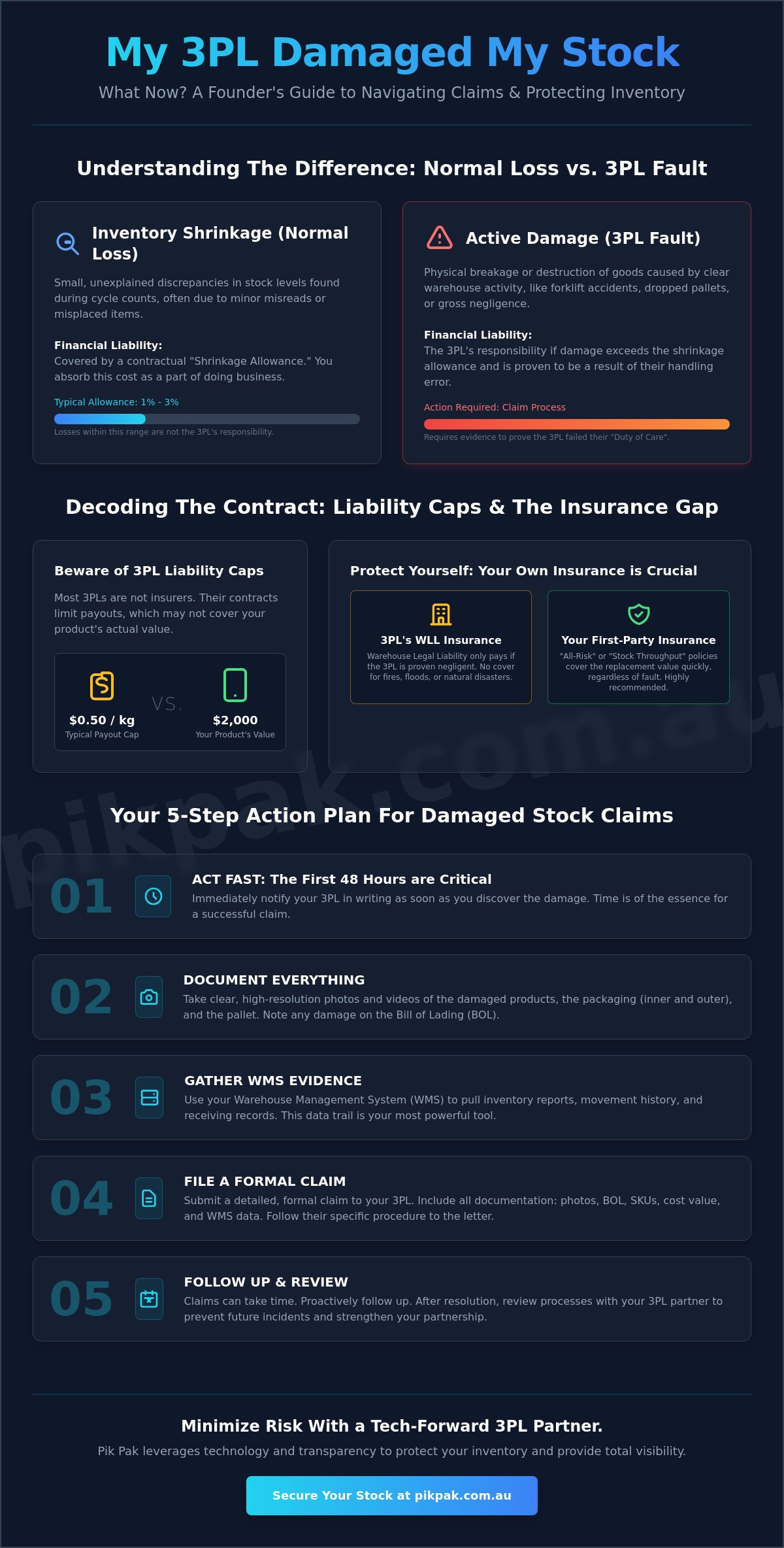
Most 3PL contracts include a shrinkage allowance, which is a percentage of total inventory value that the provider isn’t liable for. This usually ranges from 1% to 3% depending on the product type and volume. A shrinkage allowance is a contractual buffer for minor variances that occur during standard warehouse operations. If your total annual loss stays under this threshold, the 3PL doesn’t owe you a cent. You are responsible for the costs within that agreed-upon percentage because it’s considered a standard cost of doing business in a high-volume environment. If you have more questions about how these thresholds work, checking out common warehousing questions can help clarify your specific situation.
When Loss Becomes the 3PL’s Financial Liability
The 3PL’s financial responsibility kicks in when damage or loss exceeds the shrinkage allowance or is caused by gross negligence. In the Australian logistics market, providers have a “Duty of Care” to manage your goods with reasonable skill and attention. If a warehouse roof leaks because of poor maintenance or an employee ignores safety protocols and breaks a pallet, the shrinkage clause usually won’t protect the provider. These extraordinary events bypass standard buffers because they represent a failure in the 3PL’s core operational promises. To get a payout, you’ll need to prove the damage was a direct result of the 3PL’s handling error rather than “inherent vice” or poor original packaging. Establishing this trail of evidence is where your Warehouse Management System (WMS) becomes your most powerful ally.
Decoding the 3PL Contract: Liability Limits and Insurance
Contracts are where the theoretical protection of your stock meets the practical reality of logistics. Many shippers assume that once a pallet enters a warehouse, the 3PL becomes an insurer. This is a common misconception. Most 3PL contracts and liability limits are designed to protect the warehouse operator as much as the client. When you ask what happens if 3pl damages my stock, the answer is almost always buried in the fine print of your Service Level Agreement (SLA). These documents often include caps that limit payouts to a fixed dollar amount per kilogram or a set amount per unit, regardless of the item’s retail value. If your high-end electronics are damaged, a $0.50 per kilo cap won’t even cover the cost of the cardboard packaging.
Warehouse Legal Liability vs. First-Party Insurance
A 3PL typically carries Warehouse Legal Liability (WLL) insurance. This policy only pays out if the warehouse is proven to be at fault through negligence. If a fire starts due to an external lightning strike or a natural disaster, the 3PL’s insurance likely won’t cover your inventory because they weren’t at fault. This is why eCommerce brands need their own “Stock Throughput” or “All-Risk” insurance policies. While the Australian Consumer Law provides some protection regarding service guarantees, it doesn’t replace the need for dedicated first-party coverage. Having your own policy ensures you’re paid the replacement value quickly, while your insurer handles the subrogation process with the 3PL. This approach removes the stress of waiting for a warehouse to admit fault before you can replenish your stock.
Common Liability Caps in Australia
In the Australian market, liability is often tied to fixed dollar amounts or international standards. You might see caps like $50 per pallet or $0.50 per kilogram. Some contracts use Special Drawing Rights (SDRs), which is an international reserve asset that fluctuates in value. If you sell high-value luxury goods, these standard caps will leave you significantly underinsured. You should always look for “hidden” clauses that require you to report damage within a strict 24 or 48 hour window. If you miss that window, you might waive your right to a claim entirely. Ensuring your goods are correctly labeled and packed according to Pik Pak’s warehouse receiving guidelines is the first step in avoiding these disputes. If you’re looking for a partner who prioritizes transparency, you can explore our range of logistics services designed for growth. Clear documentation and the right insurance policy turn a potential catastrophe into a manageable business task.
The Blame Game: Shipper Fault vs. 3PL Handling Errors
Determining fault is the most contentious part of the claims process. When you ask what happens if 3pl damages my stock, you’re looking for a clear answer, but the reality is often a forensic investigation into how the goods were packed versus how they were moved. The 3PL signed for the pallet, so they’re responsible, right? Not necessarily. A “Clean Receipt” simply means the exterior of the pallet looked acceptable at the time of delivery. It doesn’t mean the warehouse team has verified the condition of every individual unit inside the shrink-wrap. This is where the “Blame Game” begins, and having a clear audit trail is your only way to win it.
Logistics providers often use the “Inherent Vice” defense to protect themselves. This legal term refers to damage caused by the product’s own nature rather than external handling. For example, if a liquid product ferments and bursts its container because of a manufacturing defect, the 3PL isn’t liable. Similarly, environmental factors like humidity or extreme temperature can affect certain goods. If your product requires climate control but you booked standard ambient storage, the resulting spoilage is a shipper error. Precision in your storage requirements prevents these disputes before they start.
When the Fault Lies with the Shipper
Most damage disputes trace back to inadequate dunnage or poor palletization. If your manufacturer used thin-walled cartons that can’t support the weight of a standard stack, the bottom layers will eventually crush under their own weight. This is internal crushing, and it’s rarely the 3PL’s fault. To avoid these issues, you must strictly follow the 3PL’s receiving guidelines. These rules exist to ensure your stock can survive the rigors of warehouse movement. If “concealed damage” is discovered weeks after arrival, but the external pallet wrap was intact, the burden of proof shifts back to you to show the damage didn’t happen during the initial transit to the warehouse.
When the 3PL is Clearly Responsible
There are scenarios where the 3PL is undeniably at fault. Forklift punctures, rack collapses, or dropping a carton during the “pick” process are clear handling errors. Water damage from a poorly maintained warehouse roof or storing moisture-sensitive electronics next to liquids also falls under 3PL negligence. To secure a payout, you need immediate evidence. This includes high-resolution photography of the damaged pallet while it’s still on the warehouse rack. What happens if 3pl damages my stock in these cases depends on your ability to produce a time-stamped photo and a corresponding entry in the Warehouse Management System (WMS). When the data shows a pallet was moved and then immediately flagged as damaged, the “Blame Game” ends quickly in your favor.
How to File a Claim: A 5-Step Action Plan for 2026
Knowing who is at fault is only half the battle. To recover your costs, you need a structured methodology that leaves no room for debate. When asking what happens if 3pl damages my stock, the answer depends entirely on your ability to follow a disciplined recovery process. Most claims fail not because the damage didn’t happen, but because the paperwork was incomplete or submitted too late. Follow this 5-step plan to ensure your business is protected.
- Step 1: Immediate Notification. Speed is your greatest asset. Most contracts require notice within 24 to 48 hours of discovery. If you wait longer, the 3PL can argue the damage occurred during a subsequent move or was caused by environmental factors outside their control.
- Step 2: Evidence Collection. Use your WMS data to pinpoint exactly when the stock was last scanned in good condition. Capture high-resolution photography from multiple angles. You need wide shots of the pallet in its storage location and close-ups of the specific damage.
- Step 3: Quantifying the Loss. Apply the “Cost Price” rule to determine the exact value of the claim. Do not include your retail markup. You are seeking to be made whole for your manufacturing or acquisition costs, not your lost profit.
- Step 4: Formal Claim Submission. Compile your commercial invoice, the original Bill of Lading (BOL), and your photo evidence into a single claim packet. Clear documentation makes it easy for the 3PL’s insurance adjuster to approve the payout.
- Step 5: Resolution and Adjustment. Once the claim is approved, the 3PL will typically apply a credit to your next monthly invoice. This is faster and more efficient than waiting for a physical check to clear.
The Importance of the ‘Cost Price’ Rule
Logistics providers reimburse the manufacturer’s cost rather than the retail price. This is a standard industry practice. If you utilize kitting and assembly services, your claim should include the cost of individual components plus the labor cost of the assembly already performed. This ensures you aren’t losing the value of the work your 3PL has already completed on your behalf. Always keep updated cost sheets in your records to expedite this calculation.
Managing an Unresponsive 3PL
If your claim hits a wall of silence, you must escalate. Start with the warehouse manager, but don’t hesitate to contact the account director if you don’t receive a response within three business days. Your WMS portal serves as the “objective truth” in these situations. It provides a timestamped audit trail that is difficult to dispute. If inventory discrepancies or damage become a recurring theme, it may be time to involve a third-party auditor to review the facility’s safety protocols. Ready for a partner who prioritizes transparency? See how our WMS gives you total control over your inventory data and claim status.
How Pik Pak Minimizes Risk Through Tech and Transparency
At Pik Pak, we believe the best way to handle stock damage is to prevent it from happening in the first place. You shouldn’t have to wonder what happens if 3pl damages my stock when you have a partner that prioritizes precision and accountability. While industry data from May 2026 shows that inventory accuracy has reached 99% due to increased tech adoption, we strive for even higher standards. We eliminate the blunders of manual handling by providing a transparent window into our warehouse operations. This turns what could be a complex logistical hurdle into a simple, manageable part of your growth strategy. By delegating your operations to us, you reclaim the time needed to focus on your brand’s core objectives.
Technology as a Shield for Your Inventory
With 86% of 3PLs now utilizing a Warehouse Management System (WMS), technology is the baseline for security. Our platform tracks every movement of your goods, from the moment they pass through our doors to the final home delivery. Barcode scanning at every touchpoint ensures that picking errors and accidental handling damage are virtually eliminated. If a discrepancy occurs, our cloud-based reporting provides instant cycle count transparency. This allows you to see the “objective truth” of your inventory levels in real-time, removing the fear of the blame game. Our strict adherence to warehouse receiving guidelines ensures your stock is checked and secured the moment it arrives. You can explore our specific digital tools on our technology support page.
A Partnership Built on Accountability
A true partnership is built on accountability, not just service. We take a proactive approach to damage management. If a team member identifies a broken unit or a crushed carton, we notify you immediately. We don’t wait for you to find it. When you know what happens if 3pl damages my stock at Pik Pak, you realize the process is designed for speed and fairness. This honesty removes the friction from the claims process and allows you to maintain trust with your own customers. We also help you optimize your packaging standards to prevent future transit issues, ensuring your products are resilient enough for the entire supply chain. Reclaim your time and secure your stock with a partner that values transparency as much as you do. Get a quote from Pik Pak today and experience logistics that works for you, not against you.
Take Control of Your Inventory Security Today
You now have a clear roadmap to handle inventory mishaps with precision. By mastering the difference between shrinkage allowances and active damage, you can protect your margins from unexpected losses. A clear audit trail and prompt notification are your best defenses when determining what happens if 3pl damages my stock. Don’t let confusing contractual jargon or a lack of transparency hold your business back from its full potential. When you understand your rights, you can move from a place of fear to a position of total operational control.
Logistics doesn’t have to be a source of constant friction. Pik Pak provides state-of-the-art secure warehousing and real-time WMS visibility to keep you in total command of your assets. Our dedicated Australian support team is always available to help you navigate discrepancies with the transparency you deserve. It’s time to stop managing warehouse crises and start focusing on your next big product launch. We’ve built our systems to ensure that your inventory is safe, tracked, and ready for your customers.
Secure your eCommerce growth with Pik Pak’s transparent 3PL services. Your inventory is the lifeblood of your brand; protect it with a partner that values precision and accountability as much as you do.
Frequently Asked Questions
Will my 3PL pay the full retail price if they break my item?
No, your 3PL will not reimburse you for the full retail price of damaged goods. Liability is typically limited to the manufacturer’s cost or your acquisition price. This “Cost Price” rule ensures you’re made whole for your direct investment but doesn’t cover your lost profit margin. You should always keep updated records of your landed costs to ensure your claims are calculated accurately and processed without unnecessary delays.
What is a standard shrinkage allowance in Australia for 2026?
The industry standard for shrinkage allowance in 2026 generally falls between 1% and 3% of your total inventory value. This contractual buffer accounts for minor discrepancies like miscounts or small handling errors. If your losses stay within this percentage, the 3PL isn’t financially responsible. Understanding this threshold helps you plan your inventory budget more effectively while maintaining a realistic expectation of high-volume warehouse operations.
How long do I have to report damaged stock to my 3PL?
You typically have a strict window of 24 to 48 hours to report damaged stock after its discovery. This timeframe is often defined in your Service Level Agreement (SLA). Reporting quickly is essential because it prevents the 3PL from claiming the damage happened later or was caused by external factors. Fast reporting ensures the evidence is fresh and makes the question of what happens if 3pl damages my stock much easier to resolve.
Does my 3PL’s insurance cover fire or flood damage to my stock?
Standard 3PL insurance, known as Warehouse Legal Liability, generally doesn’t cover “Acts of God” like fire or floods unless the 3PL was negligent. For example, if a fire starts because of faulty warehouse wiring, they may be liable. However, for natural disasters, you need your own “all-risk” or “stock throughput” insurance. This ensures your inventory is protected against events that fall outside the 3PL’s direct control.
What should I do if my 3PL refuses to admit they damaged my goods?
If a provider denies responsibility, you should use your Warehouse Management System (WMS) as the primary source of truth. Present timestamped photos and inventory logs that show the stock was in good condition when it arrived. If internal data doesn’t resolve the issue, escalate the matter to an account director. Professional 3PLs value transparency and will work to resolve discrepancies when faced with clear, objective evidence from the system.
Can I deduct the cost of damaged stock from my 3PL’s monthly invoice?
You should never unilaterally deduct the cost of damaged stock from your monthly 3PL invoice. Most logistics contracts explicitly forbid “offsetting” invoices against pending claims. Doing so could result in service suspensions or late fees. Instead, wait for the formal claim process to conclude. Once approved, the 3PL will typically apply a credit to your next bill, ensuring your accounts remain accurate and your partnership stays healthy.
What documentation do I need to prove a 3PL lost my inventory?
To prove a loss, you need a comprehensive paper trail starting with your commercial invoice and the signed Bill of Lading (BOL). These documents prove the 3PL received the goods. You should also provide WMS cycle count records and timestamped inventory reports that show the item was previously in stock but is now missing. This data-driven approach removes the guesswork from what happens if 3pl damages my stock and speeds up the reimbursement process.