

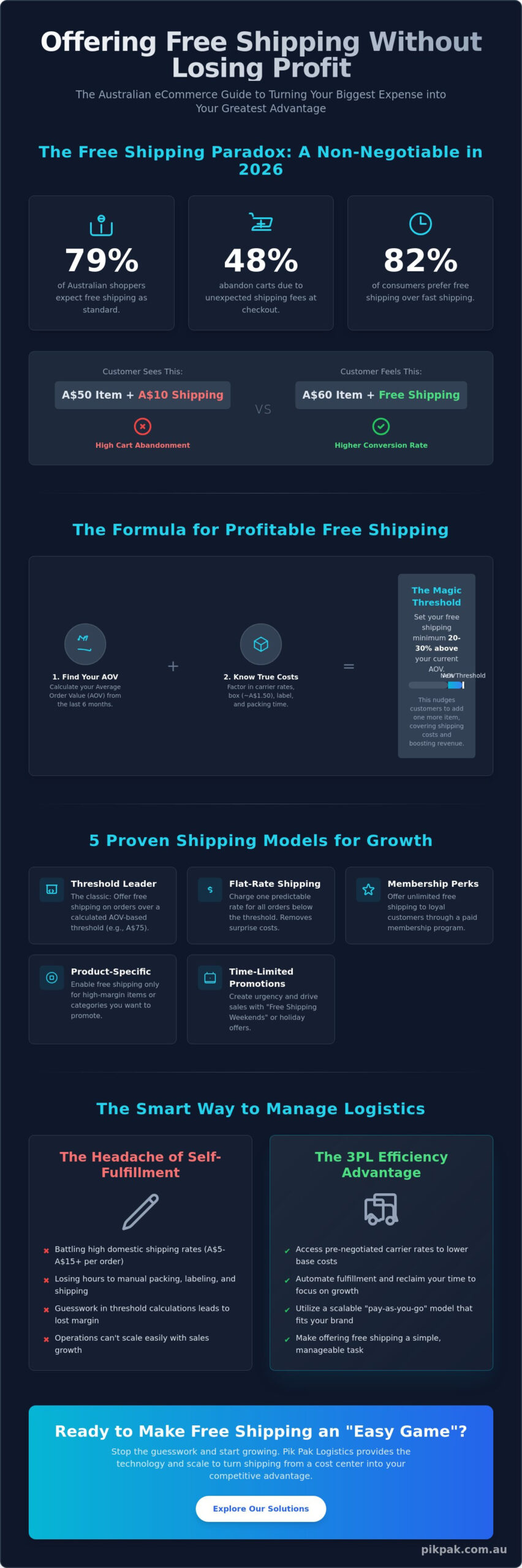
Did you know that 79% of Australian online shoppers now expect free shipping as a standard, yet 48% will abandon their carts the moment they see an unexpected delivery fee at checkout? It’s a frustrating reality for eCommerce owners who are already battling domestic shipping rates that have climbed to between A$5 and A$15 per order in 2026. You likely feel caught between losing customers to high costs or losing your margins to shipping subsidies. We understand the headache of trying to balance the books while keeping your customers happy.
The good news is that offering free shipping without losing profit is entirely possible when you stop viewing it as a marketing gift and start treating it as a logistics output. This article promises to reveal the exact mathematical frameworks and 3PL strategies used by Australia’s most profitable brands to increase their average order value by up to 25%. We will show you how to calculate your perfect break-even point and use smart fulfillment to make your operations run like clockwork. You’ll discover how to reclaim your time and focus on growth while your logistics handle the heavy lifting.
Key Takeaways
- Learn why setting your free shipping threshold 20-30% above your current Average Order Value (AOV) is the most effective way to boost revenue and cover delivery costs.
- Master the “Threshold Formula” to calculate your exact break-even point, ensuring every “free” delivery actually contributes to your bottom line.
- Explore five proven shipping models, from membership perks to threshold leaders, that turn logistics from a cost center into a competitive advantage.
- Discover how 3PL efficiency and pre-negotiated carrier rates make offering free shipping without losing profit a simple, manageable task for growing Australian brands.
- Shift from the headache of self-fulfillment to a scalable “pay-as-you-go” model that frees up your time to focus on business growth.
The Free Shipping Paradox: Why “Free” is Non-Negotiable in 2026
Consumer psychology is a strange thing. While a total price of A$60 feels like a fair deal to most shoppers, a A$50 item paired with a A$10 delivery fee often triggers an immediate exit from the checkout page. This mental hurdle is known as The Free Shipping Paradox. In 2026, the word “free” carries more weight than ever before. It isn’t just about the money; it’s about the friction. When a customer sees a shipping charge, they see a barrier. When they see free shipping, they see a gift. This shift in perception is exactly why offering free shipping without losing profit has become the primary challenge for Australian eCommerce brands.
Recent data from March 2026 shows that 82% of consumers now prefer free shipping over fast shipping. They’re willing to wait an extra day or two if it means they don’t have to pay for the post. For business owners, this means you can stop stressing over expensive express couriers and focus on more economical ground options. Instead of viewing shipping as a painful expense, successful retailers now treat it as a Customer Acquisition Cost (CAC). It’s an investment in conversion that often pays for itself through higher volume and fewer lost leads.
The High Cost of Cart Abandonment in Australia
Unexpected costs are the number one reason for cart abandonment in Australia. As of early 2026, 48% of online shoppers walk away because of shipping fees that appear too late in the journey. This has a massive ripple effect on your marketing ROI. If you’re spending A$2.00 per click on ads only to have half your customers leave at the finish line, your actual cost per acquisition doubles. Being transparent about shipping early in the process, or removing the cost entirely, keeps your ad spend working hard. It’s the simplest way to compete with the “Amazon Effect” that has conditioned Australian shoppers to expect zero-dollar delivery as the baseline.
Free Shipping as a Competitive Moat
Building a brand in a crowded niche is difficult, but your shipping policy can be a powerful moat. By automating your shipping decisions, you eliminate the headache of manual quoting and the risk of undercharging. This level of operational maturity starts with a solid understanding of how professional order fulfilment sets your foundation. When your logistics run like clockwork, offering free shipping without losing profit becomes an easy game. You can reclaim your time and focus on scaling your business while your shipping strategy does the heavy lifting for your conversion rates.
The Profitability Math: Finding Your Magic Free Shipping Threshold
Guessing your free shipping threshold is a quick way to erode your margins. To make this work, you need to treat your shipping cost as a variable expense that must be balanced against your gross profit. Offering free shipping without losing profit requires a clear look at your Average Order Value (AOV) and your Gross Margin Buffer. Start by calculating your true cost per order, which includes more than just the carrier’s rate. You must factor in the “hidden” expenses like A$1.50 for a mailing box, the cost of a thermal label, and the physical time spent packing the order. When these costs are ignored, a “free” shipping offer can quickly turn a profitable sale into a net loss.
Your AOV is the most powerful lever you have. If your current average order is A$70, offering free shipping on all orders is likely unsustainable. However, setting a threshold that nudges customers to spend more creates a win-win scenario. The extra margin from that additional item covers the shipping cost while increasing your total revenue. If you aren’t sure where to start, you can explore our logistics services to see how automated data can simplify these calculations for you. By using real-time data, you can stop the guesswork and start making logistics an easy game.
Calculating Your Break-Even Point
The Break-Even Threshold is the specific order value where the gross profit earned from the sale exactly equals the cost of fulfilling and shipping that order. To find your baseline, pull your sales data from the last six months to determine your median AOV. A smart strategy is to set your free shipping limit 15% to 20% higher than this number. This gap creates a psychological incentive for shoppers to add one more product to their cart. This increased volume is what effectively pays for the “free” delivery without hurting your bottom line.
Protecting Margins on Low-Value Items
Not every product should qualify for a free ride. Small, low-margin items or heavy, bulky goods can easily cost more to ship than they’re worth. You should exclude specific SKUs or implement weight-based restrictions to protect your bottom line. Utilizing 3PL warehousing provides the granular visibility needed to track these costs in real time. When you know exactly what each pick and pack costs, you can make informed decisions about which items are eligible for free shipping. This level of control ensures your operations run like clockwork while keeping your profits secure.
5 Strategic Free Shipping Models for eCommerce Growth
There isn’t a one-size-fits-all approach to logistics. The right model depends entirely on your margins, your product dimensions, and where your customers live. By selecting a specific strategy, offering free shipping without losing profit becomes a repeatable system rather than a financial gamble. Here are the five most effective models used by Australian retailers in 2026:
- The Threshold Leader: This is the gold standard for increasing Average Order Value. By offering free shipping only on orders over a set amount, such as A$100, you nudge shoppers to add more to their cart.
- The Membership Model: Build recurring loyalty by offering free shipping as a perk for a paid or points-based loyalty program. It turns occasional buyers into frequent fans.
- Product-Specific Free Shipping: Use this as a promotional tool for your highest-margin SKUs. If a product has enough “Gross Margin Buffer” to absorb the delivery cost, highlight it with a “Ships Free” badge to drive conversions.
- The Flat-Rate Hybrid: Charge a predictable, low flat rate for most orders (e.g., A$9.95) but waive it once a customer hits a premium spending tier. This balances cost recovery with customer satisfaction.
- Seasonal/Promotional: Drive urgency during peak Australian retail periods like Black Friday or Boxing Day. Limiting free shipping to a 48-hour window creates a powerful incentive to buy now.
Choosing the Right Model for Your Product Category
Matching your strategy to your product’s physical traits is vital. Heavy or fragile items require more expensive packaging and handling, often costing an extra A$3.00 to A$5.00 per parcel. For these categories, “Unconditional Free Shipping” is usually a trap that leads to negative margins. It’s better to test your models through A/B testing on your storefront. Show free shipping to half your visitors and a flat rate to the other half. The data will tell you exactly which model keeps your bottom line healthy.
Leveraging Regional Shipping Zones in Australia
Australia’s geography is a unique challenge. Shipping a parcel within Sydney might cost A$10, but sending that same box to a remote part of Western Australia can easily jump to A$40. You don’t have to offer nationwide free shipping if the math doesn’t work. Many successful brands limit their free offers to metro areas and apply a surcharge for regional postcodes. Transparency is key here. Use a clear shipping calculator or a header banner to communicate these exclusions. By leveraging diverse customer delivery options, you can ensure your remote customers still get a fair deal without your business absorbing an unsustainable loss. This pragmatic approach makes offering free shipping without losing profit an easy game.
Optimizing Logistics: Reducing the Base Cost of “Free”
The secret to offering free shipping without losing profit isn’t just about raising your prices. It’s about lowering the cost of the label itself. Most small eCommerce stores pay retail carrier rates because they don’t have the volume to negotiate directly with major providers. By partnering with a 3PL, you gain immediate access to “Tier 1” rates. These are the same discounted prices that massive retailers use to dominate the market. In Sydney, as of April 2026, professional pick and pack fees start at approximately A$2.50 per order. This predictable cost structure replaces the chaos of manual fulfillment and lets you scale as you grow without adding overhead.
Outsourcing your logistics does more than just lower shipping rates. It eliminates the hidden waste in your warehouse. When your operations run like clockwork, you stop overpaying for storage and start paying only for what you use. This “pay as you go” model is essential for maintaining liquidity. If you’re ready to stop overpaying for your postage, get started with our logistics services and let us handle the hard work for you.
The Power of Kitting and Assembly
Bundling products is a strategic move to protect your margins. When you use kitting services to create “Free Shipping Bundles,” you’re effectively increasing the amount of profit available to cover the postage. Instead of shipping three separate orders, you ship one. This reduces your carrier fees and packaging waste. Right-sizing your packaging is equally important. Carriers charge based on volumetric weight, so shipping a small item in a large box is a profit killer. Eliminating unnecessary “air” in your parcels can significantly lower your per-parcel spend and make offering free shipping without losing profit a realistic goal.
Technology and Automation
Manual shipping decisions are slow and prone to error. A modern Transport Management System (TMS) automatically compares carriers to find the cheapest route for every single parcel. This technology ensures your operations run smoothly and prevents costly redeliveries caused by address errors. Real-time inventory visibility is also crucial. It prevents the “split-shipment” margin killer where one order is sent from two different locations, which would otherwise double your shipping costs. By automating these tasks, you free up your time to focus on your business.
How Pik Pak Logistics Makes Free Shipping an “Easy Game”
Self-fulfilment is often the biggest hurdle for Australian eCommerce owners. Packing boxes in a garage or a small backroom might work at the start, but it quickly becomes a bottleneck that prevents growth. When you transition to a professional partner, offering free shipping without losing profit becomes a logistical reality rather than a mathematical dream. Pik Pak provides the infrastructure you need to stop worrying about carrier negotiations and start focusing on your brand. We give you access to our pre-negotiated networks, ensuring you pay the lowest possible base rates from day one. What seems like a complex challenge is actually a simple task when you have the right partner.
Our “Pay-As-You-Go” model is designed to protect your cash flow. You don’t have to worry about long-term contracts or minimum monthly spends that drain your capital. Whether you’re storing a few pallets in Sydney for A$15 to A$25 per week or shipping thousands of orders, you only pay for the space and services you actually use. This transparency allows you to bake your fulfilment costs into your strategy with 100% certainty. The hours you save every week by not dealing with tape and labels are the real profit. That reclaimed time is what allows you to find new products, run better ads, and scale your business while we ensure everything runs like clockwork.
Seamless Integration with Your Storefront
We aren’t all computer geeks, so we’ve made the technical side as simple as possible. Our Warehouse Management System (WMS) offers a simple “point, click, and connect” solution for platforms like Shopify and WooCommerce. This automation means your threshold logic is handled instantly without any manual intervention. When a customer hits your free shipping target, our system receives the order and begins the process immediately. You can focus on your business while we handle the pick, pack, and ship process for you. It’s about creating a feeling of effortlessness and control over your entire supply chain.
Scalability for the 2026 eCommerce Landscape
The 2026 market moves fast, especially during peak retail periods like Black Friday and Boxing Day. Handling these seasonal spikes yourself usually means hiring temporary staff or leasing extra space you don’t need year-round. With Pik Pak, you can scale as you grow without the overhead. Our technology and dedicated support ensure your operations stay secure and efficient, even during the busiest weeks of the year. Offering free shipping without losing profit is much easier when you aren’t paying for empty warehouse space. Ready to stop bleeding profit? Get a tailored fulfilment quote from Pik Pak today and see how we make logistics an easy game.
Master Your Margins and Scale Your Brand
Logistics doesn’t have to be a headache. By implementing a smart threshold and optimizing your base costs, offering free shipping without losing profit becomes a predictable part of your business growth. You’ve seen how the right math and the right 3PL partnership turn a complex challenge into an easy game. It’s time to stop worrying about shipping labels and start focusing on your vision. You’ve built a great brand; now it’s time to let it reach its full potential without delivery costs holding you back.
Pik Pak is here to ensure your operations run like clockwork. We provide you with immediate access to wholesale shipping rates and seamless API integration with all major platforms. With real-time inventory and order tracking, you always have total control without the physical burden of fulfillment. Our “pay as you go” model ensures your cash flow stays secure while you scale. It’s all about freeing up your time so you can do what you do best. Let us handle the hard work while you reap the rewards of a more efficient business.
Let Pik Pak handle your logistics so you can focus on growth. You’ve done the hard work of building a brand; now let us make the delivery easy.
Frequently Asked Questions
Is free shipping really better than a discount code?
Free shipping usually outperforms discount codes because it removes a major psychological barrier at the final step of the checkout journey. Data from March 2026 shows that 79% of shoppers expect free shipping as a standard service. While a 10% discount might save the customer the same amount of money, the word “Free” has a much higher conversion impact than a calculated saving that still requires a delivery fee.
How much should my free shipping threshold be?
Your threshold should ideally be 20% to 30% higher than your current Average Order Value (AOV). If your median order is A$70, set your threshold at A$90 or A$100 to encourage upsells. This gap ensures the extra gross margin from the additional items covers the delivery cost. It’s a proven way to start offering free shipping without losing profit while simultaneously growing your total revenue.
What if my products are heavy and expensive to ship?
You should exclude heavy or bulky items from your general free shipping policy to protect your bottom line. Many Australian retailers use weight-based rules to ensure that items costing over A$20 to ship are charged at a fair flat rate. This prevents a single heavy order from turning your entire day’s profit into a loss. Transparency is key; just make sure these exclusions are clearly noted on your product pages.
Can I offer free shipping only to certain Australian postcodes?
Yes, you can and should limit free shipping to specific metro zones where carrier rates are lower. Shipping to regional WA or the NT can be four times more expensive than a local delivery in Sydney or Melbourne. Use your checkout settings to offer free shipping to metro postcodes while applying a surcharge for remote areas. This pragmatic approach keeps your logistics sustainable and prevents unexpected cost blowouts.
Does offering free shipping affect my return policy?
Offering free shipping doesn’t require you to offer free returns, which is a common misconception. You can provide free outbound shipping to encourage the sale while maintaining a policy where the customer pays for return postage. This balance is crucial for offering free shipping without losing profit, as it prevents reverse logistics from eroding your margins. It keeps the initial transaction attractive without creating a long-term financial liability.
How do I track if my free shipping strategy is actually profitable?
Track your “Net Margin per Order” before and after implementing the strategy to see the real impact. If your AOV increases by 15% but your shipping costs only rise by 8%, the strategy is a success. Use your WMS data to monitor these shifts in real time. This allows you to adjust your threshold quickly if carrier rates change or if your product mix shifts toward lower-margin items.
Should I include the shipping cost in the product price?
“Baking” part of the shipping cost into the product price is a strategy used by approximately 72% of Shopify stores. If an item costs A$45, pricing it at A$50 and offering free shipping often leads to higher sales than the lower price plus a separate fee. It simplifies the decision-making process for the customer and makes your margins more predictable across your entire inventory.
How does a 3PL help with free shipping?
A 3PL helps by giving you access to wholesale carrier rates that you simply can’t get as a solo shipper. Logistics providers use their massive volume to lower the base cost of every parcel they send. This reduction in the base cost is the most effective way to maintain healthy margins. It also frees up your time to focus on your business while the logistics experts handle the hard work.