
The 4 hours you spend every morning manually printing labels and fixing address errors isn’t just a chore; it’s the glass ceiling preventing your brand from hitting its next A$500,000 revenue milestone. You know that scaling shouldn’t feel like drowning in cardboard and bubble wrap. Shipping is meant to be the final step of a sale, not a full-time administrative burden that keeps you from working on your actual business strategy. It’s time to stop being a warehouse manager and start being a CEO again.
In this guide, we’ll show you exactly how to automate order fulfillment to transform those manual headaches into a streamlined engine that runs like clockwork. You’ll learn how to build a system that handles the chaos of a Black Friday rush without the technical stress or the need for a degree in computer science. We’re breaking down the precise tech stack and logistics strategies that help Australian brands achieve 99.9% packing accuracy while cutting shipping costs. By the end of this article, you’ll have a clear roadmap to reclaim 20 hours of your week and ensure your customers get their packages faster than ever.
Key Takeaways
- Replace manual “pen and paper” headaches with a real-time digital sync that keeps your inventory accurate across every sales channel.
- Master a “point, click, and connect” tech strategy that allows you to integrate your eCommerce store without needing any technical expertise.
- Learn how to automate order fulfillment using digital pick lists and automated imports to achieve 99.9% shipping accuracy.
- Evaluate the “pay-as-you-go” 3PL model to avoid the heavy capital expenditure and long-term risks of leasing your own Australian warehouse.
- Discover how to reclaim your schedule and focus on high-level business growth while your logistics engine runs like clockwork in the background.
What is Order Fulfillment Automation?
Order fulfillment automation is the strategic integration of digital technology to manage order processing, inventory updates, and carrier selection. It marks a definitive shift away from the “pen and paper” methods that dominated the early 2010s. Instead of manual data entry, your systems use real-time digital sync to move information between your storefront and the warehouse floor. By 2026, this technology has evolved into a standard requirement for Australian eCommerce brands. Leading retailers now rely on AI-driven carrier selection to choose the fastest route through Australia Post or StarTrack based on live transit data. They also use predictive restocking to ensure popular items never hit “out of stock” status during peak seasons.
Understanding how to automate order fulfillment starts with a mindset shift. Automation does not mean replacing every human with a robot. It means using data to drive human efficiency. When your team knows exactly where an item is located and which box size is optimal for a specific shipment, they work faster and with fewer mistakes. It turns a chaotic warehouse into a high-speed logistics hub where every movement is intentional and every second is accounted for.
The “Order-to-Door” Lifecycle in an Automated World
In an automated environment, the data flow begins the millisecond a customer clicks “buy” on your website. This information travels via API directly to your warehouse management system. The system automatically verifies stock levels, prints a shipping label, and assigns the task to a picker. As soon as the parcel is scanned for delivery, the system pushes a tracking update back to the customer without any human intervention. This ensures the buyer stays informed while your team stays focused on moving the next order. The fulfillment loop is a self-correcting data cycle.
Why Manual Fulfillment is the #1 Growth Killer
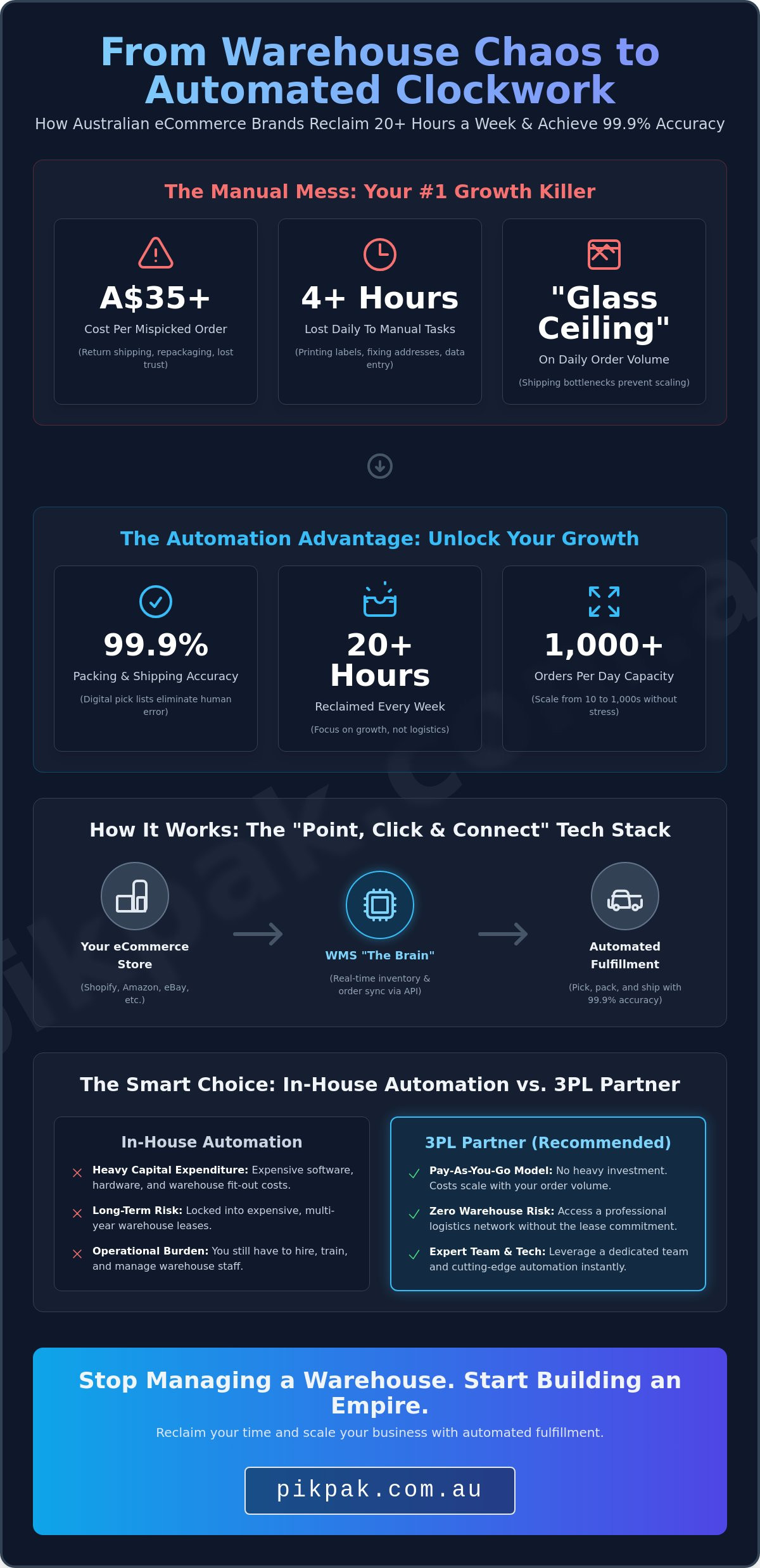
Manual fulfillment is a hidden drain on your profit margins. While “doing it yourself” might seem cost-effective, the hidden expenses of human error are staggering. Industry data from 2024 suggests that a single mispicked order can cost an Australian business upwards of A$35 when you factor in return shipping, repackaging, and lost customer trust. Manual processes create shipping bottlenecks that cap your daily volume. If your team can only process 40 orders before the courier arrives, your growth is effectively dead in the water.
Beyond the financial cost, there is a significant emotional burden. The “lunch rush” mentality, where staff scramble to beat the 3:00 PM courier cutoff, leads to high turnover and burnout. Transitioning to technology support systems removes this stress. It replaces the frantic scramble with a steady, predictable workflow. Learning how to automate order fulfillment allows you to scale from 10 orders to 1,000 orders a day without increasing your heart rate or your error rate. It ensures the pick-pack-and-ship process runs like clockwork, allowing you to focus on your business growth instead of hunting for lost parcels.
The Tech Stack: How to Connect Your Store for Success
Setting up a modern fulfillment system doesn’t mean you need to be a computer geek. In the past, connecting a digital storefront to a physical warehouse required expensive custom coding and weeks of testing. Today, the philosophy has shifted to a “Point, Click, and Connect” approach. You can link your sales channels to a professional logistics partner in minutes, not months. This simplicity is the first step in learning how to automate order fulfillment without the technical headache.
The Warehouse Management System (WMS) acts as the brain of your entire operation. It sits in the middle of your tech stack, receiving orders from your website and sending instructions to the warehouse floor. For this to work like clockwork, you need API access and pre-built connectors that allow data to flow freely between your store and the packing bench. According to recent industry data on the growth of warehouse automation, these seamless integrations are now the standard for 85 percent of high-growth eCommerce brands because they eliminate manual data entry and human error.
Inventory Sync: Preventing the “Out of Stock” Nightmare
Automation ensures your website only sells what is physically sitting on the shelf. When an item sells on Shopify, the system instantly updates your stock levels across eBay and Amazon. To stay safe, you can set “buffer stock” levels. For example, if you set a buffer of 5 units, the system tells your website you’re “Out of Stock” when you hit that limit, protecting you from overselling during a flash sale. This real-time visibility gives you total control over your inventory without ever picking up a spreadsheet.
Order Routing and Warehouse Logic
Once an order drops, the system uses smart logic to decide the most efficient way to fulfill it. It identifies exactly which shelf the product is on and creates the shortest walking path for the picker. This logic is also essential for “kitting and assembly.” If you sell a “Summer Gift Bundle” that consists of three separate products, the system automatically tells the warehouse to grab one of each and pack them into a single branded box. You can see how this logic works in practice by looking at the Pik Pak Warehousing and Fulfilment model, which turns complex tasks into simple, repeatable processes.
By getting your tech stack right, you stop being a data entry clerk and start being a business owner. Let the software handle the heavy lifting while you focus on your next big marketing campaign. If you’re ready to see how easy it is to link your store, you can explore our integration options to get started today.
Step-by-Step: Automating the Pick, Pack, and Ship Workflow
Learning how to automate order fulfillment is about turning a chaotic warehouse into a high-speed engine. It’s not just about robots; it’s about a seamless digital thread that connects your customer’s click to their front door. According to recent industry insights on the e-commerce revolution and logistics, businesses that lean into fulfillment technology see a massive boost in operational efficiency. When you master how to automate order fulfillment, the system does the heavy lifting for you. Here is how the workflow looks when it’s running like clockwork.
- Step 1: Automated Order Import. Your store connects directly to the Warehouse Management System (WMS) via API. Orders flow into the queue the second they’re placed. No manual data entry, no typos, and no delays.
- Step 2: Digital Pick Lists. Paper is gone. Staff use mobile scanners to find items in the warehouse. This process ensures 99.9% accuracy, which means you aren’t wasting money on reshipping incorrect items.
- Step 3: Smart Packing. The system analyses the dimensions of every item in an order. It suggests the smallest possible box size to reduce waste and lower your shipping costs by avoiding bulky packaging.
- Step 4: Automated Label Generation. Labels are booked instantly with carriers like Australia Post or StarTrack. It’s a point, click, and connect solution that removes the manual work from your desk.
- Step 5: Real-Time Tracking. The moment a label is scanned, an automated email goes to your customer. They stay informed with their tracking links, and your support inbox stays empty.
Eliminating the “Label Headache”
Multi-carrier automation is the secret to scaling without the stress. The system automatically compares rates to choose the cheapest or fastest route for every parcel based on the destination. You get the benefit of pre-negotiated rates that come standard with automated 3PL platforms, which often beats standard retail pricing. Direct freight connections save hours of manual booking by eliminating the need to log into multiple carrier portals just to get a single shipment out the door. It’s logistics made easy.
Reverse Logistics: Automating the Return Process
Returns don’t have to be a nightmare. An automated return portal lets customers generate their own labels, making the experience painless for them and hands-free for you. Once the item arrives back at the warehouse, automated inspection workflows determine if the goods can be resold or need to be refurbished. This keeps your inventory levels updated in real-time. For a deeper look at how this fits into your overall strategy, check out the Pik Pak Logistics guide to 3PL. Focus on your business and let the automation handle the rest.
Automation Debate: In-House Software vs. Outsourcing to a 3PL
Deciding how to automate order fulfillment often comes down to a choice between building your own tech stack or plugging into an existing one. Leasing a physical warehouse in Australia requires massive capital expenditure (CapEx). You’re looking at long-term leases, security bonds, and the cost of racking, forklifts, and safety equipment. A 3PL model shifts this to a “pay as you go” operational expense. You only pay for the shelf space you use and the orders you ship.
Some owners fear a loss of control when they move stock out of their sight. It’s a myth. A professional Warehouse Management System (WMS) provides better visibility than a messy backroom. You see every stock movement on your screen in real time. It makes your operations run like clockwork without you needing to be on the floor.
- Effortless Scaling: Scaling shouldn’t mean a hiring crisis every November. When you outsource, you don’t need to find or train temp staff for peak seasons. The 3PL absorbs the volume surge.
- Tech Maintenance: If your Shopify integration breaks at 2 AM, who fixes it? If you DIY, you’re the IT manager. With a 3PL, the provider handles all software updates and API maintenance.
- Reduced Risk: You aren’t locked into a five-year warehouse lease in Sydney or Melbourne if your business model changes.
When is Your Business Ready to Outsource?
The “50 orders a month” rule is a solid benchmark for Australian eCommerce brands. At this volume, the time you spend packing boxes is time stolen from marketing and growth. If your garage is overflowing or you’re consistently missing shipping deadlines, you’ve outgrown your space. You can review these 5 signs you need a third party warehousing company to see if you’ve hit the tipping point.
The Hidden Costs of DIY Automation
When you’re figuring out how to automate order fulfillment, don’t overlook the IT burden. DIY automation isn’t just a one-time software purchase. You face ongoing licensing fees and hardware maintenance for scanners and label printers. A “simple” custom integration often turns into a bill for thousands of dollars in developer hours. Most 3PLs include their warehouse technology as part of the service. You get a professional-grade WMS without a A$10,000 setup fee. It’s a point, click, and connect solution that lets you focus on your business.
How to Start Automating Your Fulfillment with Pik Pak
Transitioning to a third-party logistics provider shouldn’t feel like a hurdle. Many Australian retailers spend up to 20 hours a week on manual logistics, which is time stolen from marketing and product development. What seems to be a challenge is an easy game with Pik Pak. We turn a complex headache into a streamlined process that starts with a simple conversation. Learning how to automate order fulfillment is the first step toward reclaiming your weekends and focusing on what actually moves the needle for your brand.
Our “Point, Click, and Connect” Integration
We aren’t all computer geeks, so we’ve made the technical side effortless. Our platform integrates directly with Shopify, WooCommerce, and Magento. If you have a bespoke setup, our custom APIs handle the heavy lifting without requiring you to write a single line of code. Think of the Pik Pak dashboard as your remote control for the warehouse. You’ll gain instant access to a range of customer delivery options across Australia, ensuring your buyers get their parcels exactly how they want them. You click a few buttons, and your orders flow from your store to our floor automatically.
The onboarding process is designed to be fast and transparent. You don’t need to worry about complex software installations or long-term training sessions. We follow a clear, three-step path to get you moving:
- Connect your store: Sync your eCommerce platform with our WMS in minutes.
- Ship your stock: Send your inventory to our secure warehouse facility.
- Go live: We receive your orders in real-time, then pick, pack, and ship them immediately.
It’s that simple. You stop doing the hard work of taping boxes and printing labels. We handle the pick and pack with professional precision, letting you step back from the warehouse floor. This shift doesn’t just save time; it eliminates the human error that often leads to costly returns and unhappy customers.
Get a Quote and Scale Your Business
Knowing how to automate order fulfillment is one thing; seeing the actual ROI is another. When you stop managing physical inventory, you reclaim the mental space needed to scale your operations. Our “pay as you go” model means you only pay for the space and services you actually use, which is vital for managing the seasonal ebbs and flows of the Australian market. There are no hidden software fees or locked-in contracts that stifle your growth.
Ready to see the numbers? We invite you to Request a Quote from Pik Pak Logistics to find out exactly how much time and energy you can save. Automation isn’t just about technology; it’s about giving you the freedom to grow your brand while we ensure every package arrives on time. Your business deserves to run like clockwork, providing you with the peace of mind that comes from a truly professional operation.
Scale Your eCommerce Business Without the Logistics Headache
Success in 2026 requires moving beyond manual spreadsheets and late nights spent packing boxes. You’ve seen how the right tech stack can eliminate human error while freeing up your team to focus on marketing and product development. Whether you choose to manage software in-house or partner with an expert 3PL, the goal remains the same: creating a seamless, invisible workflow that delights your customers. Mastering how to automate order fulfillment is no longer a luxury reserved for global retailers; it’s a survival strategy for every Australian brand looking to scale effectively.
Pik Pak makes this transition effortless. You get full visibility through our real-time WMS platform and the peace of mind that comes with an expert Australian-based support team. There’s no need for long-term lock-in contracts because our pay as you go model puts you in total control of your costs. Let us handle the heavy lifting while you focus on the big picture. It’s time to reclaim your time and let your operations run like clockwork. What seems like a challenge is an easy game when you have the right partner by your side.
Ready to automate? Get your Pick, Pack & Ship Quote from Pik Pak today!
Frequently Asked Questions
How much does it cost to automate order fulfillment?
Costs for automated fulfillment typically involve storage fees, pick and pack rates, and shipping expenses. According to the 2024 State of Logistics report, warehousing costs in Australia rose by 10% recently, making efficiency more critical than ever. You don’t have to worry about fixed overheads like warehouse rent or staff wages because most 3PLs use a pay as you go model. You’ll likely pay between A$2 and A$5 per order for basic picking and packing services depending on your total SKU count and monthly volume.
Can I still use my own custom packaging if I automate with a 3PL?
You can definitely use your own branded boxes, tissue paper, and stickers when you automate. Custom packaging is a powerful tool for the unboxing experience, with 40% of consumers stating it makes them more likely to recommend a brand. Just send your materials to the warehouse and the system will track your packaging stock levels just like your products. This ensures every order looks exactly how you want it without you touching a single roll of tape.
How long does it take to integrate my Shopify store with an automated warehouse?
Connecting your Shopify store to an automated fulfillment system takes less than 30 minutes. You don’t need to be a computer geek to make it work. Most modern systems use a point, click, and connect API integration that syncs your products and orders instantly. Once the connection is live, your orders flow directly to the warehouse team. This means you can start learning how to automate order fulfillment and see results on the very same day.
Is my business too small for automated fulfillment services?
No business is too small to benefit from automation. Many 3PLs offer “scale as you grow” models specifically for startups shipping as few as 50 orders per month. Outsourcing early allows you to focus on marketing and product development instead of packing boxes in your garage. It’s a strategic move to ensure your operations run like clockwork from day one. You’ll save hours every week that can be reinvested into growing your sales and brand presence.
What happens if the system makes a mistake in an order?
Automated systems boast accuracy rates of 99.9% because barcode scanning eliminates the common human errors found in manual warehouses. If a mistake does happen, the system logs the error and triggers a resolution process immediately. Most providers offer a dedicated support team to handle returns or reshipments at no extra cost if the fault lies with the warehouse. This level of accountability gives you peace of mind and keeps your customers happy without the headache of manual troubleshooting.
How does automation help with international shipping from Australia?
Automation simplifies international shipping by automatically generating customs declarations and commercial invoices for every parcel. The system selects the most cost effective carrier for destinations like New Zealand or the UK based on real time rates and delivery speeds. This reduces the risk of parcels being held at the border due to paperwork errors. By using an automated partner, you can access bulk shipping discounts that are usually reserved for high volume retailers, making global expansion a simple, manageable task.
Can I see my inventory levels in real-time with an automated system?
You have 24/7 visibility into your stock levels through a digital dashboard that updates every time an item is scanned. Every time an order is picked or a new shipment arrives, your inventory count updates instantly across all your sales channels. This prevents the frustration of overselling and helps you manage reorder points effectively. Knowing exactly what you have in stock allows you to plan your marketing campaigns with total confidence. It’s all about giving you control without the manual data entry.
What is the difference between a WMS and an ERP in fulfillment?
A Warehouse Management System (WMS) focuses specifically on the daily operations within the warehouse like picking, packing, and receiving. An Enterprise Resource Planning (ERP) system is a broader tool that manages finance, HR, and procurement across your entire company. Most eCommerce brands use a WMS to handle the how to automate order fulfillment part of their business because it’s more specialized for logistics. These two systems often integrate to share data and ensure your entire operation runs like a well oiled machine.