
Did you know that Australian retailers lose an average of 30% of an item’s purchase value just by processing a single return? It’s a staggering figure that turns a simple customer request into a major operational headache. You probably feel the sting every time a return label is scanned or a perfectly good product sits in “returns limbo” instead of being back on your digital shelf. It’s frustrating to watch your hard-earned margins disappear into shipping costs and wasted inspection time.
The good news is that handling returns without losing money is entirely possible when you stop viewing reverse logistics as a cost centre and start seeing it as a profit-protecting asset. We’re going to show you how to streamline your workflow to lower the cost of every return while getting items back into your sellable inventory faster. You’ll learn the exact steps to transform a clunky process into a smooth operation that actually builds customer loyalty. We’ll cover everything from smarter shipping choices to restocking strategies that ensure your Australian eCommerce business runs like clockwork.
Key Takeaways
- Identify the hidden “Double Shipping” trap and learn why unmanaged reverse logistics can cost your business three times more than outbound delivery.
- Develop an ACCC-compliant returns policy that protects your bottom line by setting strategic return windows to keep your stock current.
- Discover the secret to handling returns without losing money by implementing “Save the Sale” strategies that turn potential losses into revenue.
- Streamline your operations by automating the RMA process and adopting “Drop and Ship” transport options to eliminate manual errors and delays.
- Learn how partnering with a tech-driven 3PL like Pik Pak provides real-time visibility on returned stock, allowing you to focus on growing your business.
The Hidden Costs: Why You Are Currently Losing Money on Returns
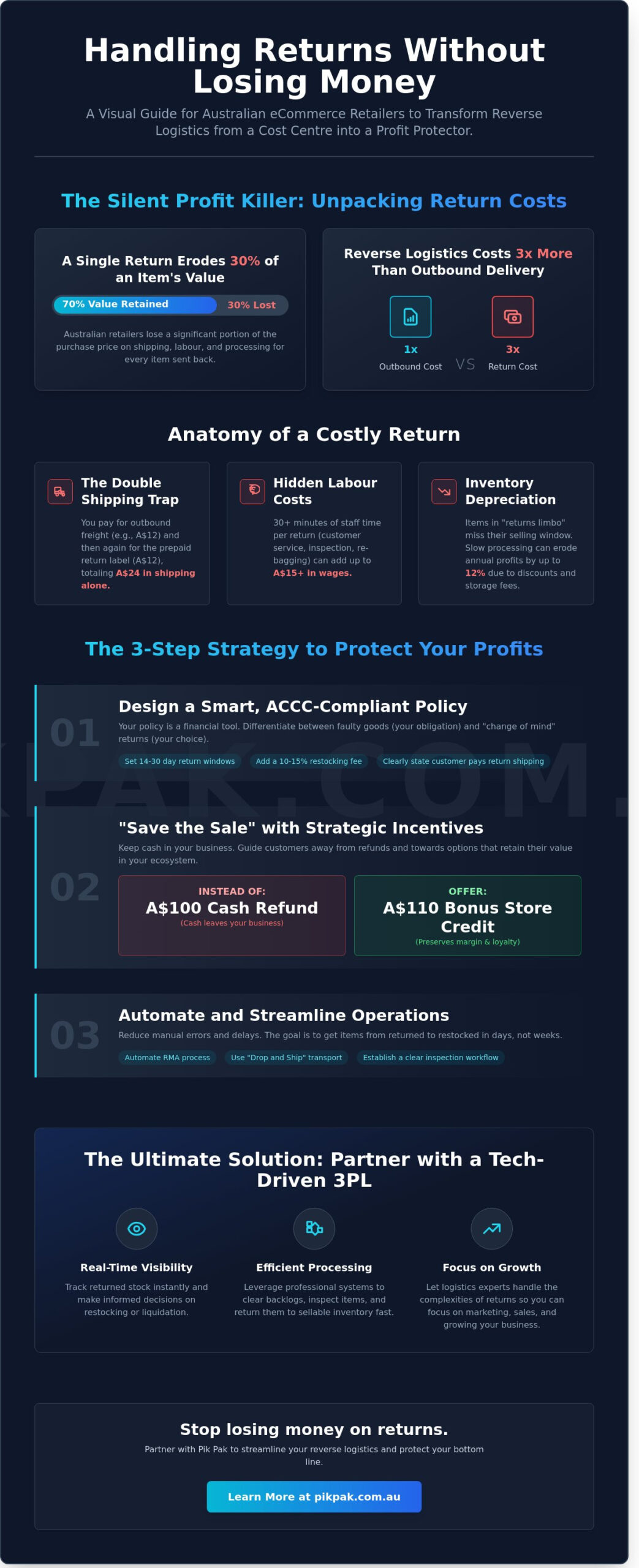
Returns are the silent profit killer for Australian eCommerce brands. Most merchants focus on the initial sale, but the real challenge is Reverse logistics. This process involves moving goods from the consumer back to the seller or manufacturer. It is not just a reversed version of shipping. Industry data shows that processing a return costs up to 3x more than the original outbound delivery. This happens because the journey back is unpredictable and manual.
You fall into the “Double Shipping” trap when you pay for the outbound freight and then provide a prepaid return label. If a standard parcel costs A$12 to ship and the return label is another A$12, you have spent A$24 before even touching the product. Handling returns without losing money requires you to look beyond these surface costs. You must account for the time spent on customer service emails, manual inspections, and re-bagging items that arrive in damaged packaging.
Labour costs are often the most underestimated factor. A staff member might spend 10 minutes answering emails, another 15 minutes inspecting the item, and 5 minutes re-bagging it. At an average Australian warehouse wage of approximately A$30 per hour, that is A$15 in labour alone. When you add the cost of “returns limbo”, where stock sits in a corner for weeks, you lose the ability to reinvest that capital into new, fast-moving inventory. It is an operational headache that drains your resources.
The Anatomy of a Return Cost
Every return involves freight, warehouse labour, and packaging waste. While “free returns” are a powerful marketing tool, they are never actually free for the merchant. You are essentially subsidising the customer’s change of heart. To stay profitable, you need to track your recovery rate closely. Return ROI is the value recovered minus the total processing cost.
Inventory Depreciation and Seasonal Risks
Time is your enemy in the warehouse. If a summer dress is returned in January but isn’t processed and restocked until March, it becomes dead stock. Slow processing makes seasonal items unsellable at full price, forcing heavy discounts. This delay also increases your warehousing and fulfilment costs. You are paying to store items that aren’t generating revenue. For many Australian retailers, these storage fees for stagnant stock can erode annual profits by as much as 12%. Handling returns without losing money means moving stock back to “available” status in days, not weeks. Focus on your business and let a professional system clear the backlog so your operations run like clockwork.
Designing a Returns Policy That Protects Your Bottom Line
Your returns policy isn’t just a legal requirement. It’s a strategic financial tool. In Australia, the ACCC mandates that you must provide a remedy like a repair, replacement, or refund if a product has a major failure. However, for “change of mind” requests, you have the power. You don’t have to offer a refund if the customer simply decided they didn’t like the colour or found it cheaper elsewhere. By setting a strict 14 or 30 day window for these returns, you ensure stock remains current and doesn’t sit in a box while its market value drops. This is a critical step in handling returns without losing money.
If you choose to accept change of mind returns, consider a restocking fee. A 10% or 15% fee helps cover the labour costs of inspection and re-shelving. Research from designing a reverse logistics program shows that clear cost-recovery steps discourage “serial returners” who treat your inventory like a rental service. Make sure your policy clearly distinguishes between these scenarios:
- Faulty Goods: Full refund or replacement including shipping costs as per Australian Consumer Law.
- Change of Mind: Optional store credit or refund minus a restocking fee and original shipping costs.
The Strategic Use of Store Credit and Exchanges
Cash leaving your bank account is a direct hit to your liquidity. To protect your revenue, always lead with an exchange or store credit option. Many successful Australian retailers now offer a “Bonus Credit” incentive. If a customer returns an A$100 item, you might offer them A$110 in store credit instead of an A$100 cash refund. This keeps the customer in your ecosystem and preserves your margin. Phrase your policy to highlight the speed of credit versus the 5 to 10 business days it takes for a bank to process a refund. This naturally guides users toward non-cash resolutions.
Condition Requirements and Evidence
To keep your operations running like clockwork, mandate that all returns must include original packaging. This reduces the time and cost of re-kitting items before they can be resold. Ask customers to upload photo evidence of the item and its packaging through a returns portal before you approve the request. This simple requirement stops fraudulent claims and ensures you aren’t paying for the return of a damaged product that can’t be salvaged. For a deeper look at how to manage incoming stock efficiently, check our warehouse receiving guidelines.
Setting these rules early takes the headache out of logistics. It lets you focus on your business while we ensure your inventory stays profitable. If you want to automate your fulfilment and simplify your reverse logistics, we can help you set up a system that works for your bottom line.
Optimising Reverse Logistics: The Practical How-To
Turning a logistical headache into a streamlined process is the secret to handling returns without losing money. You need a system that eliminates manual errors and moves items back into your sellable stock quickly. Follow these four steps to take control of your reverse flow and keep your margins intact.
- Step 1: Automate the RMA process. Stop using manual email chains. A self-service Return Merchandise Authorisation (RMA) portal allows customers to initiate their own returns. This can reduce customer service enquiries by up to 45%, freeing up your team to focus on sales rather than admin.
- Step 2: Streamline transport. Use “Drop and Ship” options. With over 4,300 Australia Post locations and thousands of third-party drop-off points across the country, letting customers drop parcels at their convenience is cheaper and more efficient than scheduling individual home pickups.
- Step 3: Standardise inspections. Give your warehouse team a clear, digital checklist. This ensures every item is judged by the same criteria every time, removing guesswork and speeding up the grading process.
- Step 4: Real-time inventory updates. Your warehouse management system must talk to your online store. The moment an item is cleared for resale, it should appear back on the digital shelf automatically to be sold to the next customer.
Reducing Touch Points in the Warehouse
Profit leaks happen every time an item is moved, inspected, or set aside for later. We advocate for the “One-Touch” rule. A staff member opens the package, grades it, and decides its fate in a single session. To make this work, you need a “Disposition Matrix.” This is a simple logic flow that tells the team exactly what to do: Resell (Grade A), Repair or Refurbish (Grade B), Recycle, or Dispose. Robust technology support eliminates manual data entry, ensuring your records stay accurate without the extra labour costs that eat into your bottom line.
Packaging and Labelling for Easier Processing
Smart packaging design reduces friction for both you and your customer. Using reusable mailers with a second adhesive strip means the customer doesn’t need to find tape or a new box. It’s a small detail that makes a big impact on brand loyalty and ensures the product returns in better condition. Additionally, always provide scannable return labels. When a parcel arrives at the warehouse, a single scan should tell the team who sent it, why it’s back, and what’s inside. This level of transparency is essential for handling returns without losing money, as it slashes processing time from several minutes down to just seconds per item.
Turning Returns into a Revenue Opportunity
Returns don’t have to be a financial sinkhole. When you focus on handling returns without losing money, you shift your strategy from damage control to active growth. The most successful Australian eCommerce brands use a “Save the Sale” approach. Instead of processing a silent refund, reach out the moment a return is initiated. Offer an incentive, such as a A$10 bonus in store credit, if the customer chooses an exchange over a refund. This keeps the capital within your business and maintains the customer relationship.
You can also use the exchange process to increase your Average Order Value (AOV). If a customer returns a pair of boots because of sizing, your system should suggest matching socks or a leather care kit during the exchange checkout. This turns a logistical hurdle into a fresh sales opportunity. It’s about making the process feel like a service rather than a failure.
Data-Driven Product Improvement
Every return contains a lesson. If you aren’t analysing your “Reason for Return” codes, you’re throwing away valuable intelligence. When a specific SKU shows a 15% return rate due to “item not as described,” it’s a signal to update your photography or size charts. Fixing these recurring faults at the source is the fastest way to protect your margins. Returns data is the best free market research you have.
The financial impact of these small adjustments is massive. Reducing your overall return rate by just 1% can lead to a substantial increase in annual profit. For a business with A$1,000,000 in annual turnover, a 1% drop in returns can save over A$15,000 in shipping costs, warehouse labour, and inventory depreciation. This is pure profit that goes straight back to your bottom line.
The Marketing Value of Trust
A “no-headache” return policy is one of your strongest marketing tools. Industry data shows that 92% of customers will buy from a retailer again if the return process is easy. In the competitive Australian market, trust is a primary differentiator. When you resolve a return quickly and professionally, you often turn a frustrated buyer into a lifelong brand advocate. They know that if something goes wrong, you’ve got their back.
This level of service requires a deep understanding of your entire supply chain. Managing the reverse journey is just as critical as knowing what is order fulfilment and how it impacts your initial delivery. By automating the return labels and providing clear tracking, you remove the friction that kills repeat business. You aren’t just moving boxes; you’re building a reputation for reliability.
Ready to stop the profit bleed and streamline your logistics? Explore how Pik Pak simplifies your operations.
Scaling Your Solution: Why a 3PL is the Ultimate Returns Partner
Managing returns in-house often leads to a growing pile of “dead stock” taking up valuable office or warehouse space. For many Australian SMEs, the cost of industrial warehouse space in major hubs like Sydney or Melbourne can exceed A$250 per square metre annually. When you factor in the labour hours spent inspecting damaged boxes, handling returns without losing money becomes a losing battle. A 3PL partner transforms these fixed overheads into variable costs that scale with your sales volume.
Pik Pak’s cloud-based Warehouse Management System (WMS) provides the real-time visibility you need to stay profitable. Instead of wondering what’s sitting in a return pile, you can see exactly when an item is received, graded, and restocked. Our team uses professional “Pick, Pack, and Ship” expertise to handle re-kitting and repackaging. This ensures that a returned item doesn’t just sit in a corner; it gets back into your inventory and ready for the next customer as quickly as possible.
- Eliminate hidden labour costs: Stop paying your team to untangle logistics messes.
- Variable pricing: You only pay for the space and processing you actually use.
- Inventory accuracy: Our WMS updates your stock levels across all sales channels instantly.
The 3PL Advantage in Reverse Logistics
Professional 3PLs provide a level of scrutiny that’s hard to maintain when you’re busy growing a brand. We offer dedicated grading and cleaning services to determine if a product is “as new” or requires refurbishment. This professional touch prevents faulty items from being sent to new customers, which protects your brand reputation. Additionally, small businesses often pay premium retail rates for return postage. By using your logistics service through Pik Pak, you gain access to bulk shipping rates that are usually reserved for enterprise-level retailers. These savings are a critical component of handling returns without losing money in the competitive Australian market.
Making the Switch to Managed Fulfilment
Transitioning to a managed model is a straightforward process that removes the logistical “headache” from your daily routine. You can connect your Shopify, WooCommerce, or eBay store to our system using a simple “point, click, and connect” approach. There’s no complex software to install and no steep learning curve. Our “Pay as you go” model is designed for flexibility. If you have a quiet month, your costs drop. If you experience a post-Christmas return surge, we scale our resources to meet the demand without you needing to hire temporary staff. This efficiency ensures your operations run like clockwork while you reclaim your schedule. Focus on your business and let Pik Pak handle the hard work so you can spend your time on marketing and product development rather than processing parcels.
Take Control of Your Reverse Logistics
Returns are a reality of modern retail, but they don’t have to be a financial burden. By implementing a clear policy and treating reverse logistics as a revenue opportunity rather than a loss, you can protect your bottom line. Research from Australia Post indicates that approximately 1 in 4 online shoppers return items, making a streamlined process essential for survival. Mastering the art of handling returns without losing money is simply a matter of having the right systems and partners in place.
Pik Pak makes this transition effortless. You get real-time inventory visibility through our cloud-based WMS and expert Australian-based support to handle the heavy lifting. We offer pay-as-you-go pricing with no hidden software fees, so you only pay for what you use. Stop letting logistical headaches slow your growth and start focusing on your business. Let Pik Pak simplify your returns and protect your profits today. It’s time to make your operations run like clockwork.
Frequently Asked Questions
Is it possible to offer free returns without losing money?
Yes, you can offer free returns by building the cost into your product margins from the start. Many successful Aussie retailers add a small buffer of A$2 to A$5 to their base price to cover reverse logistics expenses. This strategy ensures you maintain profitability while meeting the expectations of the 62% of shoppers who demand free returns. It’s about balancing your initial markup against the long-term lifetime value of a loyal customer.
How do I calculate the total cost of a return for my business?
To find the true cost, add the return shipping fee, the warehouse labor for inspection, and any loss in resale value. A 2023 industry report suggests that a single return can cost up to 66% of the item’s original price. You must track every touchpoint from the moment the customer prints a label until the item is back on the shelf. Handling returns without losing money requires a clear view of these hidden expenses.
What is the best way to prevent return fraud in eCommerce?
Use tamper-evident packaging and require photo evidence before you approve any return request. Research by the Australian Retailers Association shows that “wardrobing” and return fraud cost businesses millions of dollars annually. Implementing a 3PL system that records the condition of items upon arrival provides a clear audit trail. This makes it easy to spot serial offenders and refuse refunds for items that aren’t in their original, sellable condition.
Should I offer a refund or store credit as the default option?
Offer store credit as the default to keep revenue within your business and protect your cash flow. Statistics show that customers who receive store credit are 30% more likely to spend more than the original purchase value on their next order. You can incentivize this choice by offering a small bonus, like an extra A$5 credit, for choosing credit over a cash refund. This keeps your operations running smoothly while turning a return into a future sale.
How does a 3PL handle damaged items that cannot be resold?
A 3PL like Pik Pak inspects damaged items and categorizes them based on your specific business rules. Items that can’t be resold are either recycled, donated to local charities, or disposed of according to Australian environmental regulations. We provide clear reporting on these items so you can claim them as a loss for tax purposes. This keeps your inventory clean and ensures your warehouse space isn’t wasted on unsellable stock that just gathers dust.
What are the ACCC rules for returns in Australia in 2026?
Under ACCC rules in 2026, you must provide a remedy if a product has a major failure, regardless of your store policy. This includes a choice between a refund or replacement for the consumer. However, you aren’t legally required to accept returns for a simple change of mind. Ensure your policy is visible at the checkout to comply with the Australian Consumer Law and avoid unnecessary disputes with the regulator or your customers.
Can I charge a restocking fee for change-of-mind returns?
You can charge a restocking fee for change-of-mind returns as long as it’s clearly disclosed in your terms and conditions. Many Australian electronics retailers charge between 10% and 20% to cover the cost of testing and repackaging the goods. This helps in handling returns without losing money by offsetting the labor costs involved in processing the item. Just be sure the fee is reasonable and reflects the actual cost to your business operations.
How long should the return window be for an online store?
A 30 day return window is the industry standard for Australian eCommerce stores. Shorter windows can feel restrictive to buyers, while longer windows like 60 or 90 days can actually reduce return rates by removing the urgency to send an item back. Data indicates that a 30 day period provides enough time for the customer to decide without significantly delaying your ability to resell seasonal inventory. Keep it simple and clear for everyone.