Your garage was never meant to be a warehouse, yet you’re likely spending over five hours every single day taped up in bubble wrap and cardboard. It’s a common story for Australian retailers. By the time you’ve managed your 50th order of the morning, you’ve already missed the chance to actually grow your brand. You know that scaling is impossible when you’re the one hand-writing labels and dealing with shipping error rates that lead to stinging one-star reviews. It’s a cycle that keeps you small and keeps your office cluttered with stock.
This guide shows you how to master ecommerce fulfillment to reclaim your time and slash your freight costs by up to 30% through professional logistics. We’ll show you how to automate your shipping, eliminate the daily headache of manual packing, and prepare your business for a record-breaking Black Friday in 2026. Discover how to turn your complex logistics into a simple, automated engine that lets you focus on your business while we handle the hard work.
Key Takeaways
- Learn to identify the “garage ceiling” and transition from DIY logistics to a scalable model that supports your business growth.
- Understand the end-to-end journey of an order and how smart technology ensures real-time inventory accuracy from click to delivery.
- Evaluate the true costs of in-house operations versus 3PL and Amazon FBA to choose the most cost-effective ecommerce fulfillment path for the Australian market.
- Identify the essential criteria for selecting a reliable logistics partner, focusing on strategic location, tech integration, and proven service priorities.
- Discover how to simplify your operations and reclaim your time by leveraging a flexible logistics model with no long-term leases or upfront software costs.
What is eCommerce Fulfilment and Why Does it Matter?
At its simplest level, ecommerce fulfillment is the engine room of your online brand. It is the complete journey a product takes from the moment a customer clicks the buy button to the second that package arrives at an Australian doorstep. This process involves everything from inventory management and picking to packing and final delivery. Understanding What is order fulfillment? helps you see that it is not just a back-end chore. It is the primary touchpoint between your digital storefront and your physical customer.
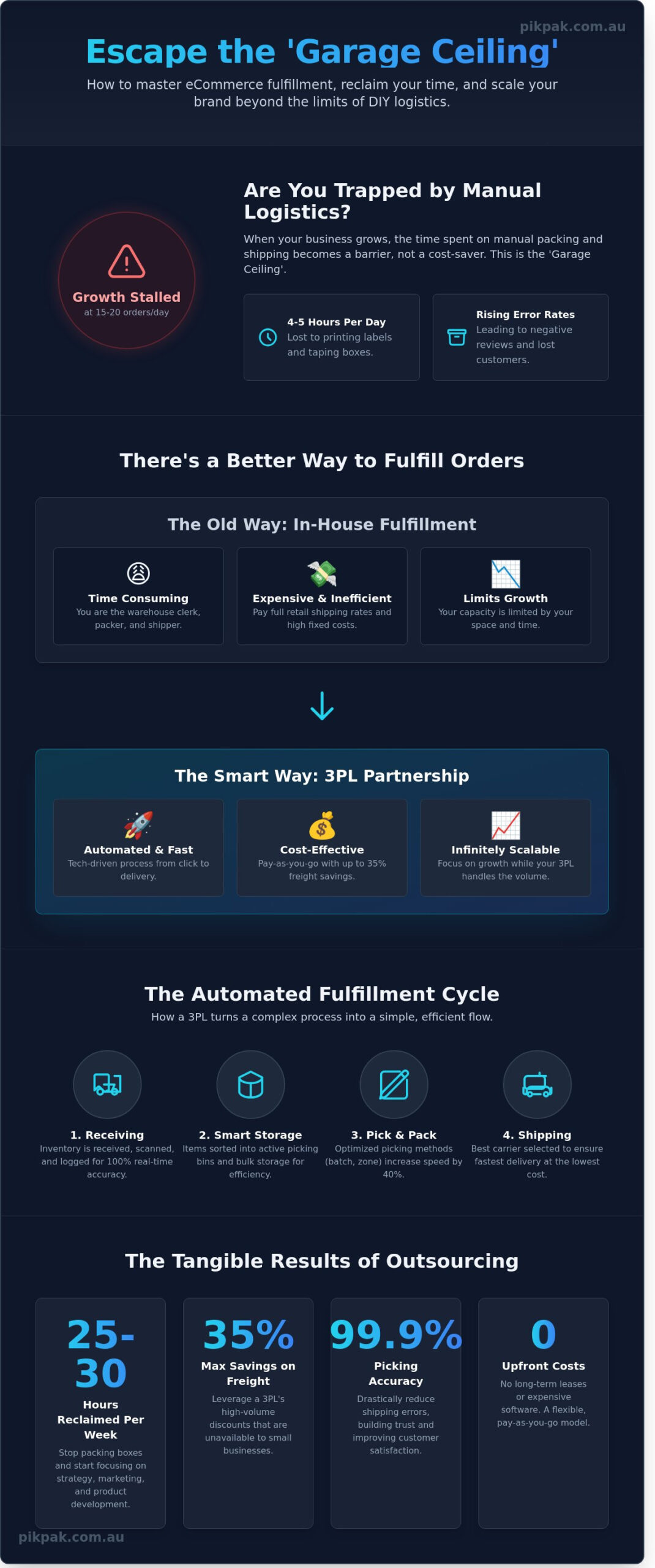
Many Aussie startups begin their journey in a home office or a spare room. This DIY approach works until you hit what we call the Garage Ceiling. This usually happens when your volume reaches 15 to 20 orders per day. At this stage, the time spent printing labels and taping boxes consumes 4 to 5 hours of your workday. Your growth stalls because you are too busy acting as a warehouse clerk to focus on marketing or product development. The Garage Ceiling is the point where manual logistics stops being a cost-saver and starts being a growth-killer.
Modern ecommerce fulfillment has evolved far beyond traditional warehousing. Old-school warehouses were often dusty spaces where stock was manually counted on clipboards. Today, tech-enabled fulfillment centres use cloud-based Warehouse Management Systems (WMS) that sync with your store in real time. These hubs operate with 99.9% picking accuracy and provide instant data on stock levels. This shift from “storage” to “active logistics” allows businesses to scale without the overhead of long-term commercial leases or expensive staff management.
This is where a Third-Party Logistics (3PL) provider becomes a strategic partner. Instead of you managing a team and a building, you plug into an existing infrastructure. It is a pay-as-you-go model that turns your fixed costs into variable ones. You only pay for the space you use and the orders you ship.
The Core Components of the Fulfilment Cycle
The process follows a logical flow designed to eliminate waste and ensure speed. It starts with Receiving. This is where your inventory enters the warehouse. We log every item for accuracy so your online store reflects the exact stock available. Storage is the next phase. We separate your goods into active picking bins for fast access and dead storage for bulk backup. This keeps the workflow efficient. Finally, Shipping handles the final mile. We select the best carrier for the specific Australian postcode to ensure the fastest delivery at the lowest cost.
Why Outsourcing is the Secret to Scaling in 2026
By 2026, Australian consumers will expect even faster delivery windows and cheaper shipping. Outsourcing your logistics allows you to reclaim your time. When you stop packing boxes, you gain back roughly 25 to 30 hours a week to focus on strategy. You also gain immediate access to commercial shipping rates. Small businesses often pay full retail prices at the post office, but a 3PL leverages high-volume discounts to save you up to 35% on freight costs. Most importantly, professional fulfillment improves customer satisfaction. Error-free shipping and automated tracking emails build the trust needed to turn a one-time buyer into a loyal fan of your brand.
How the Pick, Pack, and Ship Process Actually Works
The journey of an order begins the millisecond a customer clicks the buy button on your website. In a high-performing ecommerce fulfillment setup, this action triggers an instantaneous data transfer. There’s no manual data entry or delayed emails; the order flows directly into the warehouse queue. This speed is vital because 82% of Australian households now shop online, and their expectations for rapid delivery are higher than ever before. When the process is automated, the risk of human error drops by over 95%, ensuring the right product reaches the right doorstep every time.
The core of this efficiency is the Warehouse Management System (WMS). Think of the WMS as the central nervous system of the warehouse. It provides real-time inventory tracking, meaning your online stock levels update automatically as items move. This technology prevents the dreaded “out of stock” notification after a customer has already paid. With a smart WMS, you gain total control over your inventory without ever stepping foot in a storeroom.
Once the order is live, the ‘picking’ phase starts. We don’t just wander the aisles; we use strategic methods to save time. Batch picking allows a staff member to collect items for 10 or 20 orders in a single trip, while zone picking assigns team members to specific warehouse sectors to minimize walking distance. These methods can improve picking speed by 40% compared to traditional manual methods. After picking, the items head to the ‘packing’ phase. Here, we focus on protection and presentation. We use sustainable materials like compostable mailers and FSC-certified cardboard to meet modern consumer demands. According to the latest eCommerce trends in Australia, shoppers are increasingly loyal to brands that prioritize eco-friendly packaging and reliable delivery windows.
Seamless Technology Integrations
You don’t need to be a computer geek to master your logistics. Our “Point, Click, and Connect” philosophy means you can link your Shopify, WooCommerce, or Amazon store to the warehouse in just a few minutes using secure API connections. This tech syncs your sales channels and provides real-time visibility. You’ll always know exactly what’s on your shelves, which helps you manage cash flow and stock orders more effectively. If you want to simplify your logistics today, starting with a clean tech integration is the first step toward scaling your brand.
Value-Added Services: Kitting and Special Projects
Logistics involves more than just moving a single item from a shelf to a box. Kitting is the process of combining multiple products to create bundles, gift sets, or subscription boxes. This is a powerful tool for increasing your average order value. We also handle special projects like adding promotional inserts, applying custom labels, or managing seasonal re-packaging. These services allow you to execute complex marketing campaigns and maintain brand consistency without the usual warehouse headaches. It’s about making sure your ecommerce fulfillment partner does the hard work so you can stay focused on growing your business.
Comparing Your Options: In-House vs. 3PL vs. FBA
Choosing the right path for your logistics determines how fast your business can scale without breaking. The eCommerce fulfillment market in Australia is growing rapidly as sellers move away from “garage operations” toward professionalized systems. You generally have three choices: manage it yourself, use Amazon’s massive network, or partner with an independent 3PL. Each path has a different impact on your bottom line and your brand’s future.
The Hidden Costs of DIY Logistics
Many founders start by packing orders themselves to save money. This is often a mathematical trap. If a founder spends 15 hours a week on ecommerce fulfillment tasks instead of growth strategies, and their time is valued at A$100 per hour, the business loses A$1,500 in weekly opportunity cost. That is A$78,000 a year spent on tape and cardboard rather than marketing.
The physical costs are equally demanding. Industrial rent in cities like Sydney or Melbourne now averages between A$210 and A$250 per square metre. Add the cost of a forklift lease (roughly A$150 per week), warehouse management software licenses, and workers’ compensation insurance. DIY logistics also leaves you vulnerable to seasonal shifts. You pay for the same warehouse space in a quiet February as you do during the November peak. This fixed-cost model creates a financial bottleneck that stops SMEs from staying agile.
Independent 3PL vs. Amazon FBA
Amazon FBA Australia is a powerful tool for reaching Prime members, but it comes with strings attached. You lose control over the unboxing experience because everything ships in Amazon-branded packaging. If you want to build a lasting brand identity, FBA can feel like a generic commodity service. Independent 3PLs allow you to use custom mailers, thank-you notes, and branded tape, ensuring your customer remembers your name, not the marketplace’s name.
- Multichannel flexibility: Amazon FBA prioritizes its own platform. An independent 3PL handles orders from Shopify, eBay, Catch, and your own website from a single pool of stock. This prevents “stockouts” on one platform while inventory sits idle on another.
- Data and Ownership: With a 3PL, you own your customer data and inventory insights. You aren’t competing against a marketplace that might eventually launch a “basics” version of your best-selling product.
- Transparent Pricing: Amazon’s fee structure includes referral fees, storage premiums, and complex removal orders. Independent 3PLs typically offer a clearer breakdown of pick, pack, and storage costs.
For many Australian businesses, the “Pay as You Go” model offered by partners like Pik Pak is the ultimate risk-reducer. Instead of signing a three-year warehouse lease, you only pay for the shelf space you use and the orders you ship. It turns a massive fixed expense into a flexible variable cost. If you ship 10 orders this week, you pay for 10. If you ship 1,000 next week, the system scales with you automatically. It’s about making ecommerce fulfillment run like clockwork so you can get back to the work that actually grows your revenue.
Choosing the Right eCommerce Fulfilment Partner in Australia
Selecting a 3PL partner in Australia requires looking far beyond the monthly storage fee. You need a partner that aligns with your specific business goals and offers transparent service priorities. Reliability stands as the foundation of this relationship. If your provider can’t guarantee a 99% pick accuracy rate, your brand’s reputation will suffer before you even have a chance to scale.
Technology acts as the backbone of modern ecommerce fulfillment. Your partner’s systems should offer a “point, click, and connect” experience that integrates directly with your storefront. If you’re stuck doing manual data entry or dealing with “computer geeks” who can’t explain things simply, you’re losing valuable time. A scalable partner allows you to move from 50 orders a month to 5,000 during a November peak without a single hiccup in your operations.
Strategic placement in Melbourne or Sydney is critical for maintaining competitive delivery speeds. Since roughly 80% of the Australian population resides along the East Coast, shipping from these hubs slashes transit times significantly. A Melbourne-based warehouse can reach most Victorian customers overnight and Sydney customers within two days using standard road freight. This proximity reduces the “last mile” cost, which typically accounts for 41% of total supply chain expenses.
Don’t settle for a partner that hides behind a ticket system or a generic “no-reply” email address. You need a team that answers the phone when a delivery goes sideways. Logistics is a fast-moving field where a ten-minute conversation can solve a problem that might take three days to fix via email. This human connection creates the emotional reassurance you need to stop worrying about boxes and start focusing on your business growth.
Inventory Receiving and Quality Control
Speed starts at the loading dock, not the dispatch station. Strictly following warehouse receiving guidelines ensures your stock is live and ready for sale within 24 hours of arrival. When items arrive correctly labelled and palletised, the warehouse team avoids the manual “triage” that causes delays. Professional receiving prevents stock discrepancies, which saves you from the nightmare of overselling products you don’t actually have in the racks. A robust returns process also turns reverse logistics into a win; processing a return in under 48 hours can increase customer lifetime value by 20%.
Navigating the Australian Courier Landscape
Australia’s geography demands a multi-carrier approach. While Australia Post offers the most comprehensive reach for rural postcodes, StarTrack or direct freight options often provide better value for bulkier metro shipments. A smart Transport Management System (TMS) handles this complexity for you. It automatically selects the most cost-effective route for every parcel, potentially saving you A$2.15 per shipment on average. This automation allows you to manage customer expectations effectively, promising 1 to 2 day delivery for metro areas while providing realistic 5 to 7 day windows for the Outback.
Ready to reclaim your time and scale your brand? Let Pik Pak handle your ecommerce fulfillment so you can get back to what you do best.
Making Logistics an ‘Easy Game’ with Pik Pak
What often feels like a logistical nightmare is actually a simple process when you have the right partner. Pik Pak acts as the pragmatic expert your brand needs to stop worrying about warehouse floor space and start focusing on customer acquisition. We’ve designed the Pik Pak advantage to remove every barrier that usually stops an Australian business from outsourcing. You don’t have to buy expensive software or sign your life away on long-term warehouse leases. It’s a clean, professional solution for brands that want to move fast without the overhead.
Our ‘Scale as you grow’ model is built specifically to protect your cash flow. In the volatile Australian retail market, committing to fixed costs can be a death sentence for a growing brand. Instead of paying for empty shelf space during quiet months, you only pay for what you use. This pay-as-you-go approach means your A$ capital stays where it belongs: in your marketing and product development budgets. Whether you’re shipping 50 orders a month or 5,000, the system adjusts to your volume automatically.
- No hidden fees: Transparent pricing helps you calculate your exact margins per order.
- Zero software costs: Use our advanced technology without the monthly subscription “tax.”
- No long-term leases: Stay agile and avoid the risk of being locked into a warehouse that’s too big or too small.
- Expert support: Access a team that treats your inventory with the same care you do.
From Your Store to Their Door: The Setup Process
Integration isn’t a month-long IT project. It’s a “point, click, and connect” experience that links your Shopify, WooCommerce, or eBay store to our system in minutes. We don’t expect you to be a computer geek to get started. During your first 30 days, our onboarding team monitors every SKU and order to ensure the transition is seamless. One Melbourne-based skincare brand saw their order volume jump by 300% within six months of joining us. Because they weren’t restricted by their own garage space or limited packing hours, they could finally say yes to large-scale influencer campaigns and ecommerce fulfillment at scale.
Reclaiming Your Time for Growth
The real value of professional ecommerce fulfillment isn’t just about the shipping rates; it’s about the psychological relief. Knowing your orders are handled like clockwork allows you to step out of the warehouse and back into the CEO chair. The “headache” of missing tracking numbers or incorrect picks disappears. When you find an extra 20 to 30 hours a week, you can invest that “found time” into high-level business development and strategy.
Pik Pak isn’t just another service provider. We’re a partner committed to making your operations run like a well-oiled machine. We eliminate waste, simplify the complex, and ensure your customers receive their packages on time, every time. The partnership mindset means we grow only when you grow. Focus on your business and your vision for the future. Let Pik Pak do the hard work for you. It’s time to make logistics the easiest part of your day.
Take Control of Your Growth in 2026
Success in the Australian market requires a shift from manual labor to strategic oversight. Mastering ecommerce fulfillment is the most effective way to reclaim your schedule and ensure your operations run like clockwork. You’ve learned that the choice between in-house management and a 3PL partner defines your ability to scale without the weight of fixed overheads. By 2026, delivery speed and order accuracy are the primary drivers of customer loyalty.
Logistics is an easy game when you have the right technology and team. Pik Pak removes the traditional barriers to entry with a transparent pay as you go pricing model and A$0 software or setup fees. You get total control through real-time inventory visibility, so you’re always in command of your stock levels without ever touching a packing slip. It’s time to let go of the operational headache and put your energy back into what you do best.
Ready to scale? Get a tailored quote from Pik Pak Logistics today.
Your business deserves a partner that treats your packages with the same care you do. Let’s make this year your most efficient one yet.
Frequently Asked Questions
What is the difference between a fulfilment centre and a standard warehouse?
A fulfilment centre is designed for rapid turnover and order processing, whereas a warehouse is primarily for long-term storage. Warehouses often hold bulk inventory for 12 months or more. In contrast, a fulfilment centre like Pik Pak processes orders within 24 hours of receipt. We focus on movement rather than just storage to keep your ecommerce fulfillment costs low and your customers happy.
How much does eCommerce fulfilment typically cost for a small business?
Small businesses typically spend between A$15 and A$25 per order for end to end fulfilment in Australia. This includes receiving, storage, picking, packing, and shipping costs. At Pik Pak, we offer a pay as you go model. This means you don’t face large upfront fees, which helps you maintain a 20 percent higher cash flow compared to managing your own lease and staff.
Can I integrate my Shopify or WooCommerce store with your system?
You can connect your Shopify or WooCommerce store to our system in under 5 minutes using our native API integrations. It’s a simple point and click process that requires zero coding knowledge. Once connected, your orders sync automatically every 15 minutes. This automation removes manual data entry errors and ensures your stock levels remain 100 percent accurate across all sales channels.
Do I need to pay for a separate Warehouse Management System (WMS)?
No, you don’t need to pay for a separate Warehouse Management System (WMS) when you partner with us. We provide our proprietary technology as part of the service at no extra monthly cost. This saves you the A$200 to A$500 monthly subscription fee typically charged by standalone software providers. You get full visibility of your inventory and order status through one secure dashboard.
What happens if a customer wants to return an item?
We handle the entire reverse logistics process by inspecting returned items within 48 hours of arrival at our facility. Our team checks the product against your specific quality criteria to decide if it can return to shelf or needs disposal. You’ll receive a digital report for every return. This streamlined approach helps you process customer refunds 3 days faster than the industry average.
Is there a minimum order volume required to use a 3PL service?
Pik Pak has no minimum order volume requirements, making it easy for startups to scale as they grow. Whether you ship 5 orders or 5,000 orders a month, you get access to the same professional 3PL infrastructure. This flexibility is vital for the 45 percent of new Australian ecommerce businesses that experience seasonal fluctuations in their first year of operation.
How do you handle peak seasons like Christmas and Black Friday?
We manage peak seasons by increasing our warehouse staffing levels by 50 percent during November and December. Our systems are built to handle a 10x surge in daily order volume without dropping our 99.8 percent accuracy rate. We plan ahead so your ecommerce fulfillment stays on track. You can focus on your marketing while we ensure every Black Friday order ships within our agreed timeframes.
Can you handle international shipping from an Australian warehouse?
Yes, we ship to over 220 countries and territories directly from our Australian warehouses. We use a network of global carriers to provide competitive rates, often saving clients 30 percent on international postage compared to standard retail rates. All customs documentation is generated automatically. This makes global expansion a simple task rather than a logistical headache for your business.