

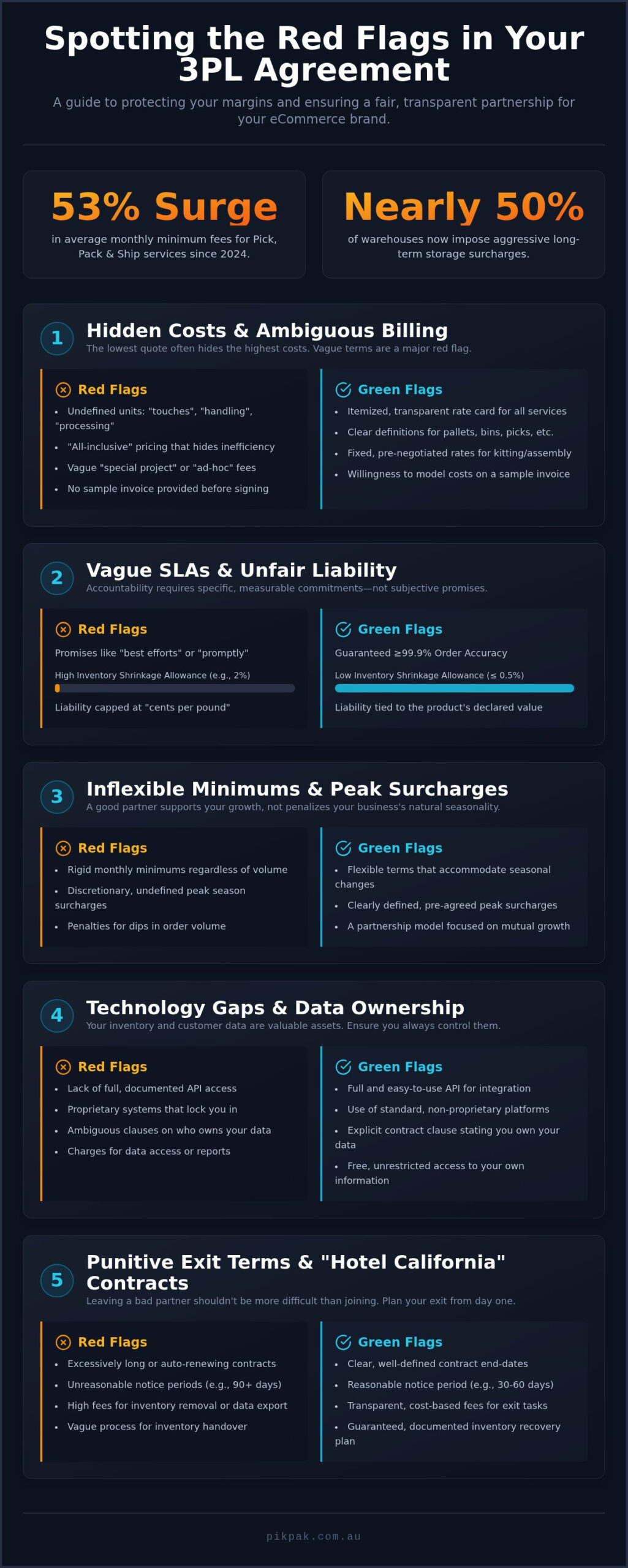
Did you know that average monthly minimum fees for Pick, Pack, and Ship services have surged by 53% since 2024? This sharp increase, combined with the fact that nearly half of all warehouses now charge aggressive long-term storage surcharges, means your fulfillment costs could spiral without you realizing it. Identifying red flags in a 3pl service agreement is no longer just a legal precaution; it’s a vital strategy to protect your eCommerce margins. You likely feel the pressure of rising costs and the anxiety of losing control over your inventory data, especially when faced with complex, jargon-heavy contracts.
It’s natural to worry that a “lock-in” clause might make it impossible to leave if service levels drop. We’ll help you spot the hidden traps and ambiguous language that could stall your growth in 2026. This guide provides a clear checklist of deal-breaker clauses and the confidence you need to negotiate better terms. You’ll learn exactly what a fair, transparent partnership looks like, from manageable liability caps to guaranteed data ownership, so you can focus on scaling your business rather than fighting your provider.
Key Takeaways
- Identify the hidden fees behind vague billing units like “touches” to prevent your “cheapest” quote from becoming an expensive monthly burden.
- Transition from qualitative promises to concrete percentages in your SLAs to ensure accountability for order accuracy and inventory shrinkage.
- Recognize red flags in a 3pl service agreement related to rigid monthly minimums and discretionary peak season surcharges that punish seasonal business growth.
- Secure your digital assets by verifying full API access and clear data ownership clauses before signing any long-term contract.
- Establish a clear exit strategy with reasonable notice periods to avoid “Hotel California” contracts that make switching providers impossible.
Hidden Costs and Ambiguous Billing Units
Choosing a Third-party logistics (3PL) provider based on the lowest quote is a gamble that rarely pays off for eCommerce brands. In 2026, one of the most common red flags in a 3pl service agreement is a lack of clarity regarding how you’re actually billed. A low headline rate often acts as a Trojan horse. It conceals a complex web of surcharges that only appear after you’ve moved your inventory and committed your stock to their facility.
Ambiguity usually hides in undefined billing units. If your contract mentions “touches,” “handling,” or “processing” without a strict definition, your margins are at risk. You need to know if a “touch” happens once per order or every time a staff member moves a bin. Without clear definitions for pallets, bins, and individual picks, a provider can essentially manufacture fees at will. Routine tasks like kitting and assembly or labelling also become massive profit centers for 3PLs if they aren’t pre-negotiated. A transparent rate card that lists every potential charge with zero ambiguity is the gold standard for 2026 logistics.
The ‘All-Inclusive’ Trap vs. Itemised Transparency
Undefined ‘Special Project’ Fees
Many 3PLs use vague “ad-hoc” or “special project” clauses to bill for tasks that should be standard. This is where costs for basic quality checks or inventory counts spiral out of control. To prevent this, ensure your warehouse receiving guidelines are explicitly linked to your price list. If your stock arrives exactly as requested, there should be no “non-compliance” surcharges. Negotiate fixed rates for common kitting and assembly tasks upfront. This turns a variable, unpredictable expense into a manageable operational task, giving you back control over your business growth.
Vague Service Level Agreements (SLAs) and Liability
Vague language is the enemy of accountability. When a contract uses subjective terms like “promptly” or “best efforts” to describe fulfilment speeds, it leaves you with no recourse when things go wrong. In 2026, top-tier providers commit to specific, measurable percentages. If a provider refuses to put hard numbers behind their performance, it’s one of the biggest red flags in a 3pl service agreement. You need to know exactly what happens if an order isn’t shipped on time or if it arrives at the customer’s door with the wrong items.
The “Inventory Shrinkage” allowance is another area where outdated terms can hurt your bottom line. While some providers still push for a 2% loss threshold, modern automation and scanning technology make this unacceptable. A fair benchmark for 2026 is closer to 0.5% or less. You shouldn’t be expected to subsidize a warehouse’s operational errors. For a look at how commitments should be structured, check out Our Service Priorities to see the level of precision you should demand from a partner.
Liability for damaged goods is often a sticking point. You must know exactly who pays when a courier loses a parcel or a forklift damages a pallet. Many contracts cap liability at a few cents per pound, which is useless for high-value eCommerce goods. Reviewing Key Clauses in 3PL Contracts can help you understand how to tie liability to the declared value of your products rather than arbitrary weight-based limits.
Order Accuracy and Despatch Timelines
“Same-day despatch” is a common promise, but it’s meaningless without a defined cut-off time. Is it 11:00 AM or 2:00 PM? A modern warehouse should maintain an order accuracy rate of at least 99.9%. If they miss these marks, your agreement should include clear penalties or service credits. This ensures the 3PL is financially incentivized to treat your orders with the same care you would. If you’re tired of vague promises, you can explore our transparent fulfilment model to see how we handle these critical KPIs.
Inventory Discrepancy Investigation Processes
Watch out for clauses that state the 3PL won’t investigate missing stock below a certain dollar value. This allows small losses to compound over time. Real-time WMS platform access is essential here. It provides a digital paper trail that reduces the need for manual audits by showing exactly where every SKU is at any moment. Your contract should also define a fixed schedule for stocktakes and reporting to ensure your digital records always match the physical reality on the warehouse shelves.
Disconnected Monthly Minimums and Peak Season Terms
Financial commitments in a logistics contract should reflect the reality of your sales cycle. One of the most punishing red flags in a 3pl service agreement is the presence of high, flat monthly minimums that don’t account for seasonality. Since 2024, industry data shows that average monthly minimum fees have increased by 53%, making it harder for growing brands to stay profitable during quiet months. If you sell fashion or giftware, paying a massive floor fee in July when your inventory is low can quickly drain your cash reserves.
Peak season terms are another area where ambiguity can cost you. Many 3PLs include “discretionary” peak season surcharges, which allow them to raise prices without notice during high-volume periods like Black Friday or Christmas. You need these costs documented in detail before you sign. A professional partner will provide clear 3PL Pricing Models that define exactly when surcharges apply and how much they’ll be. Without these protections, you’re essentially giving your provider a blank cheque during your most critical sales window.
Capacity guarantees are equally vital. It’s not enough for a provider to offer Pick, Pack, and Ship Services; they must guarantee they have the physical space and staff to handle your projected growth. If your contract doesn’t explicitly promise warehouse capacity for your Q4 stock levels, you risk having your inventory turned away when you need it most. Aligning your contract minimums with a realistic sales forecast is the best way to ensure your logistics costs scale alongside your revenue rather than against it.
For businesses seeking a logistics partner that can provide the necessary support for scaling operations and maintaining capacity, you might check out Tranzit Express Inc.
Scaling Up vs. Scaling Down
Avoid “take-or-pay” clauses that force you to pay for a specific volume regardless of market conditions. In 2026, flexibility is the most valuable currency for eCommerce brands. The fix is to negotiate tiered minimums that fluctuate based on your current inventory levels or historical order volume. This structure ensures you aren’t penalised during a market downturn while still providing the 3PL with the predictable revenue they need to maintain high service levels. You can view our flexible fulfilment options to see how a scalable partnership should function.
Peak Season Operational Guarantees
A major red flag is a 3PL that onboards too many new clients just before the holidays. This often leads to capacity limits and delayed shipping times for everyone. Your agreement should include documented labour surge plans that explain how the facility will maintain performance during spikes. Ensure your “Black Friday” service levels are identical to your “Quiet Tuesday” levels. If the 3PL won’t commit to these standards in writing, they likely don’t have the infrastructure to support your peak season success.
Technology Gaps and Data Ownership Restrictions
In 2026, your fulfilment partner’s tech stack is just as important as their warehouse floor space. A massive red flag in a 3pl service agreement is any clause that treats your own data as a premium upgrade. Some providers still try to charge extra for API access or hide fees for connecting to standard platforms like Shopify or WooCommerce. High setup costs for these common integrations are a warning sign that the 3PL is using outdated systems or looking for another profit centre. You shouldn’t have to pay a ransom to see your own stock levels.
The “Data Hostage” clause is perhaps the most dangerous trap. This happens when a contract doesn’t explicitly state that all order, customer, and inventory data belongs to the brand. If you decide to move to a new provider, you must be able to export your records easily and without cost. Without this protection, you’re locked in by technical friction rather than service quality. You can explore our technology support and integration capabilities to see how a modern, open system should operate.
Digital transparency is the only way to maintain control as you scale. If a provider’s technology feels like a “black box” where data goes in but doesn’t come out in real-time, it will eventually stall your growth. Identifying these red flags in a 3pl service agreement early prevents you from being tied to a partner that can’t keep up with the pace of modern eCommerce. Your logistics provider should empower your data, not restrict it.
Real-Time Visibility vs. Batch Reporting
Waiting for a weekly report or a daily CSV file is a major operational failure. You need 24/7 inventory tracking to make informed decisions about restocking and marketing. A cloud-based WMS is no longer optional; it’s the standard for real-time visibility. Always demand a live demo of the client portal before signing. If the interface is clunky or the data lags, it’s a sign that your operations will eventually suffer from lack of oversight.
Software Maintenance and Update Clauses
Software doesn’t stay static. When your eCommerce platform pushes a major update, your 3PL’s integration needs to keep pace. Your agreement should clarify who is responsible for these maintenance tasks and any associated costs. A tech-savvy partner ensures their stack is compatible with future customer delivery innovations, such as automated tracking updates or dynamic shipping options. Finally, verify that the provider complies with Australian privacy standards to protect your customer data. To ensure your business stays ahead of the curve, connect with us for seamless WMS platform access.
Punitive Exit Terms and Inventory Recovery Friction
Entering a logistics partnership should feel like opening a door to growth, not stepping into a trap. Some contracts are designed to be easy to sign but nearly impossible to terminate without significant financial pain. These “Hotel California” agreements are major red flags in a 3pl service agreement. If your contract requires an unreasonable notice period, such as 180 days, it’s a sign that the provider relies on “lock-in” tactics rather than service quality to keep clients. For a small or medium business, being stuck for six months with a failing provider can be fatal to your brand reputation.
Stock-out fees are another punitive measure to watch for. Some 3PLs charge a premium just to get your inventory back. While a small administrative fee for the final load-out is standard, excessive per-unit charges for removing your own property are predatory. In 2026, the gold standard for a fair partnership is a documented transition clause. This clause should outline a clear, cooperative handover process to your new partner, ensuring your business doesn’t skip a beat during the move. You can learn about our commitment to effortless eCommerce fulfilment and how we prioritize your operational freedom.
Termination for Cause vs. Convenience
You must distinguish between leaving because you’ve outgrown the provider and leaving because they’ve failed you. Your agreement should allow for “termination for cause” with immediate effect if the 3PL commits a material breach. This includes repeated failure to meet the 99.9% order accuracy or same-day despatch SLAs we discussed earlier. For termination for convenience, a 30-to-60 day notice period is the industry fair standard. Anything longer than this suggests the provider is trying to insulate themselves from the consequences of poor performance.
Inventory Recovery Timelines
A common red flag is a clause that allows the 3PL to hold your stock hostage until “all disputes” are settled. This is a high-pressure tactic used to force brands into paying contested invoices. Your contract should define a strict “Load-Out” window, specifying how quickly the warehouse must pack and ready your stock for removal once notice is given. Typically, this should happen within 5 to 10 business days depending on your SKU count. Without a defined timeline, your inventory could sit in a dark corner of the warehouse while your sales platforms show “out of stock” for weeks. Protect your business by ensuring your exit is as smooth and transparent as your onboarding.
Secure Your Operational Freedom in 2026
In 2026, a successful logistics partnership depends on absolute transparency and measurable performance. By identifying red flags in a 3pl service agreement, you protect your business from the hidden costs and rigid contracts that often stall eCommerce growth. Focus on securing quantitative SLAs and ensuring you maintain full ownership of your inventory data. These steps transform your supply chain from a source of operational friction into a scalable asset that supports your long-term objectives. You shouldn’t have to fight your provider to understand your own margins or access your own records.
We believe logistics should be simple and empowering. Our model eliminates the common frustrations of traditional warehousing by providing real-time WMS access and a dedicated Australian-based support team. You won’t find hidden tech fees or restrictive “data hostage” clauses here. Ready for a transparent 3PL partnership? Get a clear quote from Pik Pak today. Delegate your operational burdens to a partner you can trust, and reclaim the time you need to focus on what matters most: growing your brand. Your business deserves a logistics foundation that is as ambitious as your goals.
Frequently Asked Questions
What is a standard notice period in a 3PL contract?
A standard notice period for termination for convenience typically ranges between 30 and 90 days. This timeframe allows both parties to manage the transition of stock and data without disrupting operations. Seeing a notice period of 180 days or longer is one of the major red flags in a 3pl service agreement for small businesses. It suggests the provider relies on locking you in rather than maintaining high service levels to keep your business.
Should I pay a setup or integration fee for a 3PL?
You might encounter a one-time setup fee for onboarding, but excessive charges for standard integrations are a warning sign. Modern 3PLs use pre-built connectors for platforms like Shopify and WooCommerce, so these should be simple and cost-effective. If a provider quotes a high price for basic API access, they’re likely using outdated technology. We include WMS platform access to ensure your tech stack remains an asset rather than a financial burden.
What is a ‘reasonable’ inventory shrinkage allowance in 2026?
In 2026, a reasonable inventory shrinkage allowance is 0.5% or less. While older contracts often cited 2%, modern scanning technology and real-time WMS visibility make such high loss thresholds unacceptable. You shouldn’t be responsible for subsidising a warehouse’s operational errors. Ensure your agreement defines exactly how discrepancies are investigated and credited. Aim for a partner that prioritises precision and treats your stock with the same care you would.
Can I negotiate the terms of a 3PL service agreement?
Yes, you can and should negotiate the terms before signing. Most providers expect a degree of back-and-forth regarding liability caps, monthly minimums, and specific service level agreements. Use competitive quotes and a clear sales forecast as leverage during these discussions. If a provider presents a “take it or leave it” contract that ignores your seasonal needs, it’s a clear signal they may not be a flexible or supportive partner.
What happens to my inventory if the 3PL goes out of business?
Your inventory remains your legal property even if the 3PL faces insolvency. Most logistics agreements specify that the provider holds your goods as a “bailee,” meaning they have possession but not ownership. Under Australian Consumer Law, you have specific protections for B2B contracts. Ensure your contract explicitly states that your stock cannot be seized by the 3PL’s creditors. Real-time visibility into your inventory levels ensures you always know exactly what stock is on the warehouse floor.
Are shipping markups legal in 3PL contracts?
Shipping markups are legal and common, as 3PLs often use their bulk buying power to secure lower rates and then add a small margin for handling. The issue isn’t the markup itself, but a lack of transparency. You should know if you’re paying a flat rate or a percentage above the carrier’s cost. Undisclosed shipping margins are significant red flags in a 3pl service agreement that can quickly erode your product margins and stall growth.
What is the difference between an SLA and a KPI in logistics?
An SLA is the formal commitment to a specific performance level, such as “99.9% order accuracy.” A KPI is the metric used to measure that performance over time. Think of the SLA as the promise and the KPI as the scorecard. Both are essential for accountability. Your contract should define the SLAs clearly and specify how often you’ll receive KPI reports to verify that those promises are actually being kept.
How do I verify a 3PL’s performance before signing?
Start by requesting a live demo of their WMS platform to check for real-time data accuracy. Ask for references or case studies from eCommerce brands with a similar SKU profile to yours. You should also inquire about their warehouse receiving guidelines to see how they prevent initial inventory errors. A trustworthy partner will be happy to show you their facilities and explain their processes in detail rather than hiding behind vague contractual language.