
What if your logistics invoice actually made sense? For many eCommerce founders, a monthly 3PL bill is a source of dread rather than a clear operational report. You see hidden fees that blow out your budget and inflexible contracts that penalize you during slower months. It’s a common frustration; there’s often a total lack of clarity on where your money goes. Understanding the various 3pl pricing models australia uses shouldn’t feel like a guessing game. We believe logistics should be an enabling force for your growth, not a source of friction.
This strategic guide for 2026 simplifies complex logistics costs into manageable, transparent choices. You’ll learn how to choose a pricing structure that scales with your business and ensures a predictable budget every month. We will break down the four primary models, highlight the red flags in modern contracts, and show you how to align your 3PL’s profit with your own operational efficiency. It’s time to reclaim your time and get total clarity on every cent you spend.
Key Takeaways
- Learn the critical differences between transactional, tiered, and hybrid structures to find the perfect fit for your current order volume.
- Identify common hidden charges in inbound and storage fees to ensure your logistics budget remains predictable and transparent.
- Master the various 3pl pricing models australia offers to transition from a flat-rate mindset to an itemised, efficiency-driven strategy.
- Discover why investing in a Warehouse Management System (WMS) is the key to eliminating manual errors and reducing wasted labour costs.
- Use our step-by-step framework to determine the exact “pivot point” when your business should switch models to maximise profitability as you scale.
Navigating the Australian 3PL Pricing Landscape in 2026
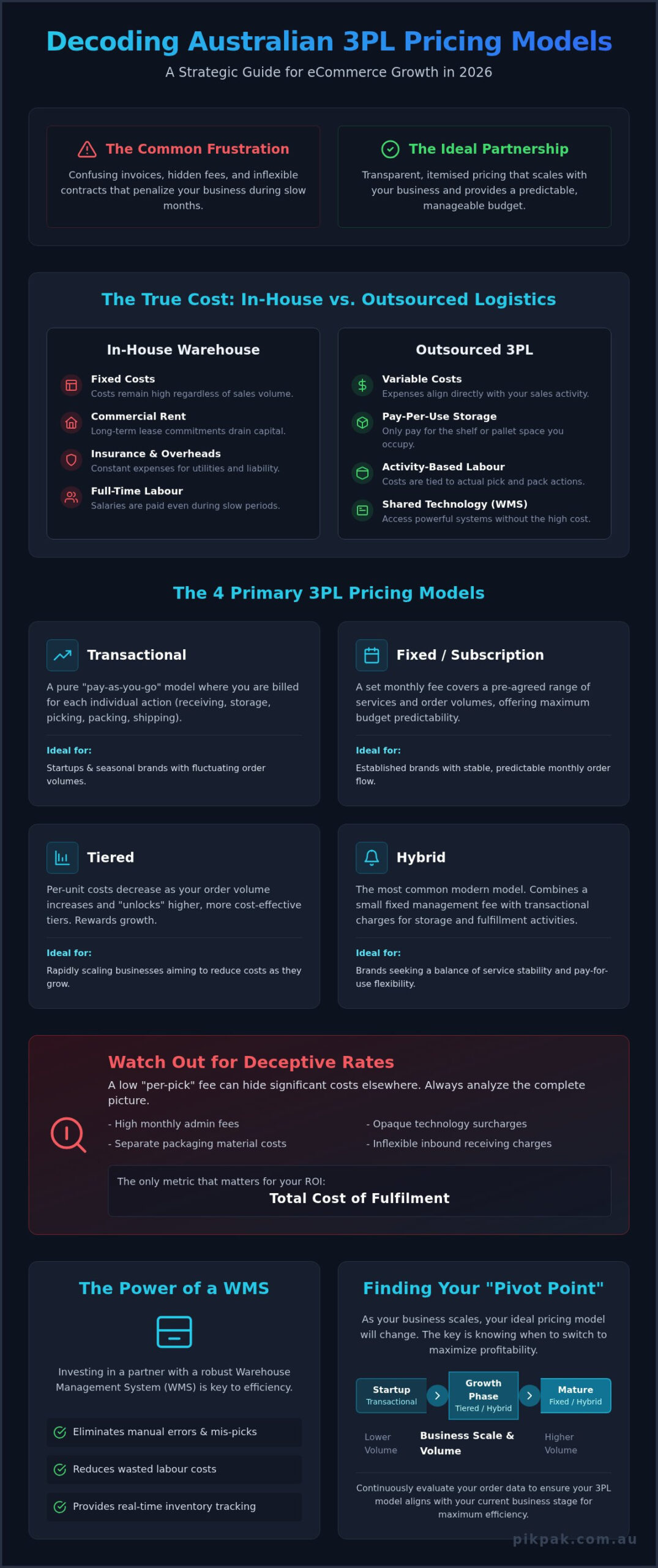
The Australian logistics market is undergoing a significant shift. In 2026, savvy eCommerce brands are ditching “one-size-fits-all” flat rates in favour of the itemised 3pl pricing models australia providers now use. This move toward transparency allows you to see the true cost of every action. It’s a pragmatic approach that eliminates the guesswork from your monthly budget. A 3PL pricing model is vastly different from a standard courier quote. While a courier only cares about moving a box from A to B, Third-party logistics (3PL) pricing accounts for the entire lifecycle of your inventory. This includes receiving, storage, and the technology that powers your order flow. Standardisation is currently rare in the Australian logistics industry. This makes it difficult to compare different providers “apples to apples” without a deep dive into the service level agreements. You need a partner that presents complex logistical challenges as simple, manageable tasks. Understanding these models is the first step toward reclaiming your time and refocusing on your core business objectives.
The True Cost of In-House vs. Outsourced Logistics
Managing your own warehouse often feels like a safe bet until you calculate the “hidden tax” of overheads. You are tied to fixed costs like commercial rent, insurance, and full-time labour that don’t care if your sales are up or down. Outsourcing turns these rigid expenses into flexible, variable costs. This shift is an enabling force that lets you reclaim your time for high-level strategy. You only pay for what you use, such as:
- The specific pallet or shelf space your inventory occupies each week.
- The actual human labour required to pick and pack each individual order.
- The cloud-based technology required to track your stock in real-time.
Why ‘Cheap’ Unit Rates Can Be Deceptive
Don’t get distracted by a low per-unit pick fee. Some providers offer “loss leader” rates only to claw back profit through high monthly admin fees or opaque technology surcharges. This lack of clarity makes it difficult to compare 3pl pricing models australia because there is no industry-wide standard for bundling. One provider might include packaging in their pick fee, while another bills it separately. If a provider’s pricing isn’t aligned with your efficiency, you might face slower shipping times because they aren’t incentivised to optimise their workflow. Total Cost of Fulfilment is the only metric that matters for your ROI.
By understanding the nuances of these structures, you can move away from simple cost-cutting and toward a partnership that rewards efficiency. Our goal is to make these complex logistical challenges feel simple and manageable. You deserve a partner that offers transparent services so you can scale with confidence.
The 4 Primary 3PL Pricing Models Explained
Choosing the right structure is critical for your bottom line. As the Australia Third Party Logistics (3PL) Market continues to mature, providers are moving away from rigid contracts toward models that prioritise flexibility and data. Understanding these four primary 3pl pricing models australia uses will help you select a partner that grows with you. Each model offers a different balance of cost efficiency and budget predictability.
Transactional (Pay-As-You-Go) Pricing
Transactional pricing is the ultimate flexible solution. It is ideal for seasonal brands and startups with fluctuating order volumes. You only pay for the specific storage you occupy and the orders you ship. This pay-as-you-go approach means you aren’t penalised with high overheads during quiet months like February. It’s a pragmatic way to keep your operations lean. However, as you scale, the lack of volume discounts can make this model more expensive than others in the long run.
Fixed, Tiered, and Hybrid Structures
For brands with stable or rapidly growing volumes, other structures often provide better value. A Fixed or Subscription model offers the highest level of predictability. You pay a set monthly fee for a specific range of services, which simplifies your accounting. Tiered pricing is designed to reward growth; as your order volume “unlocks” higher levels, your per-unit costs drop. This is excellent for scaling, though you must monitor your data closely to ensure you don’t slip back into a higher-cost tier during a slump.
The Hybrid model has emerged as the most common choice in 2026. It combines a small monthly management fee with transactional line items for picks, packs, and storage. This structure gives the 3PL a stable base to maintain high service standards while giving you the flexibility to only pay for the warehouse activity you actually generate. It’s an enabling force that balances security with scalability. If you are unsure which structure fits your current data, you can explore our service options to see how transparent pricing works in practice.
When comparing these models, consider SKU complexity and order frequency. A model with low storage fees but high pick rates suits brands with fast-moving inventory; whereas a model with low pick fees but higher storage is better for slow-moving, high-value goods. Selecting the right 3pl pricing models australia requires a clear-eyed look at your historical data and your growth projections for the next 12 months.
Anatomy of a 3PL Quote: Common Fees and Charges
Evaluating the different 3pl pricing models australia offers requires a granular look at your quote. Most providers break their services down into the ‘Big Three’: inbound, storage, and outbound. Inbound fees cover the labour of receiving and palletising your stock. Storage is the rent you pay for warehouse space, while outbound covers picking, packing, and courier delivery. Efficiency in these areas supports the broader goals of the National Freight and Supply Chain Strategy, which aims to boost productivity across the country.
Don’t overlook technology fees. In 2026, you aren’t just paying for a shed; you’re paying for data. A Warehouse Management System (WMS) is an enabling force that provides real-time visibility. While some 3PLs charge a monthly WMS access fee, this cost often pays for itself by eliminating manual errors and reducing ‘wasted’ labour charges. You should also account for value-added services like kitting and assembly. These tasks, along with custom packaging, are billed separately but are essential for creating a premium unboxing experience.
Storage and Warehousing Calculations
Storage isn’t a flat fee. It’s usually calculated based on the physical footprint of your goods. You’ll likely encounter three main types:
- Pallet Storage: Best for bulk quantities of the same SKU.
- Shelf Storage: Ideal for smaller items with high turnover.
- Bin Storage: Perfect for tiny components or individual units.
Choosing the right format is more cost-effective for your specific SKU mix. Pik Pak’s Warehousing and Fulfilment provides a benchmark for how secure, tech-integrated storage should function. Be wary of long-term storage fees. In Australian warehouses, stock that sits for over 180 days often incurs a penalty. This ‘inventory trap’ can drain your profits if you don’t maintain a healthy turnover rate.
Pick, Pack, and Shipping Costs
Your pick and pack costs depend heavily on your SKU count. Most 3PLs charge a base pick fee for the first item in an order and a smaller fee for each additional item. If your customers typically buy multiple different products, these costs can add up quickly. Packaging materials also vary. You can stick with standard brown boxes or invest in eco-friendly custom options to build brand loyalty.
Finally, understand how shipping is billed. Some 3PLs use a ‘cost-plus’ model where they pass on the courier rate with a small markup. Others offer flat-rate shipping regardless of the destination. Both have merits depending on your average package weight and delivery zones. Comparing these shipping rates alongside other 3pl pricing models australia provides ensures you select the most efficient partner. Always watch for hidden administrative charges, such as ‘account management’ or ‘system maintenance’ fees, which can quietly inflate your monthly spend.
Choosing the Right Model for Your Business Stage
Your logistics needs evolve as your order volume climbs. Selecting from the various 3pl pricing models australia offers requires a clear understanding of your current business stage. You shouldn’t be locked into a structure that penalises your growth or leaves you with high overheads during a slow month. A simple audit of your current spend can reveal waste, such as paying for unused pallet spaces or excessive manual handling fees. By matching your data to the right model, you align your 3PL’s incentives with your own success.
The Startup Phase (0-500 orders/month)
Preserving capital is your priority here. You need a model with low fixed costs and zero-commitment terms. This allows you to test the market without heavy bills. Onboarding fees are a necessary investment for long-term automation, ensuring your systems integrate correctly from day one. This is a common entry point for those exploring 3pl pricing models australia for the first time. Check our logistics services to learn more about foundational outsourcing.
The Scaling Brand (500-5,000 orders/month)
Crossing the 500-order threshold marks the ‘Pivot Point’. This is the time to move from transactional pricing toward volume-based discounts. Dedicated account support becomes essential to manage increased complexity. Real-time inventory data prevents ‘dead stock’ costs by ensuring you only pay for revenue-generating space. Our technology support reduces labour costs by automating order flows and eliminating manual data entry.
Negotiating your contract in 2026 is about finding balance. While base labour costs are often non-negotiable due to industry standards, you can usually find flexibility in volume tiers and kitting rates. Focus on the total cost of fulfilment rather than individual line items. If your current provider isn’t offering the transparency you need to scale, it’s time to switch. You can request a transparent quote today to see how we can support your next phase of growth.
The Pik Pak Approach: Transparent, Tech-Driven Pricing
At Pik Pak Logistics, we’ve designed our service around a simple idea: your growth should be rewarded, not penalised. We understand that evaluating the various 3pl pricing models australia uses can feel like a full-time job. That’s why we’ve removed the friction. Our approach is built on transparency and precision. We provide an enabling force for your business by aligning our fees with your operational efficiency. You get flexible kitting and assembly options alongside a robust returns management system. Everything is integrated into a core service model that prioritises your bottom line and eliminates the dread of the end-of-month invoice.
Surprise invoices are a symptom of poor communication and outdated systems. We solve this by providing end-to-end visibility into every cent you spend. Our seasoned team treats your inventory with the precision it deserves, ensuring that your logistics budget remains predictable. Whether you need complex kitting or simple pick and pack services, our pricing remains clear and scalable. We don’t just move boxes; we manage a vital part of your business with a tech-savvy mindset that eliminates inefficiency at every turn.
Why Technology is the Best Cost-Cutter
Manual data entry is a silent profit killer. It leads to errors, delays, and “wasted” labour charges that bloat your monthly bill. We use a cloud-based Warehouse Management System (WMS) to automate the order flow from your eCommerce store directly to our warehouse floor. This technology isn’t just about speed; it’s about accuracy. You get real-time visibility into your inventory and storage costs 24/7. Efficiency starts the moment your stock arrives. By following our receiving guidelines, you ensure your products are processed quickly and accurately, preventing unnecessary delays at the dock.
Ready to Scale? Getting Your Custom 3PL Quote
Moving to a professional logistics partner is a major step toward reclaiming your time. We make the transition effortless. To provide an accurate, no-surprise quote, we just need a few key data points from you. Tell us your average monthly order volume, your total SKU count, and your typical storage requirements. This allows us to build a custom plan that fits your current business stage while leaving plenty of room for rapid scaling. We match your data to the most efficient 3pl pricing models australia offers today.
The Pik Pak promise is simple. We don’t hide fees in the fine print. You get growth-focused logistics backed by a seasoned, supportive team. Stop guessing what your monthly fulfilment costs will be. It’s time to prioritise your business growth and delegate the operational burden to a partner you can trust. Request a transparent 3PL quote from Pik Pak today and see how simple logistics can be.
Future-Proof Your Logistics Strategy
Mastering the various 3pl pricing models australia uses is the first step toward a predictable and scalable logistics budget. By moving away from opaque flat rates and embracing itemised, tech-driven structures, you gain total clarity on every cent spent. You’ve learned how to identify hidden fees and exactly when to pivot your model to support rapid growth. Logistics should be an enabling force for your business, not a source of operational friction. With real-time WMS visibility and seamless eCommerce integrations, you can reclaim your time and refocus on your core objectives. Our dedicated Australian support team is here to ensure your transition is effortless and your operations remain precise.
Scale your eCommerce business with transparent 3PL pricing from Pik Pak today. It’s time to eliminate the guesswork and build a partnership that rewards your success. You have the tools and the strategic framework; now it’s time to take control of your fulfilment costs and grow with confidence.
Frequently Asked Questions
What is the most common 3PL pricing model in Australia?
The hybrid model is the most prevalent choice for Australian brands in 2026. It combines a small monthly management or technology fee with transactional charges for storage and order activity. This structure offers a balance of stability for the provider and flexibility for the business owner. It’s an enabling force that allows you to pay only for the warehouse resources you actually consume while ensuring high service standards.
Are there hidden fees in 3PL contracts I should look out for?
You should watch for administrative surcharges that aren’t clearly itemised in your initial quote. These often include account management fees, system maintenance levies, or minimum monthly spend requirements. Some providers also charge extra for standard packaging materials or pallet shrink-wrap without listing it upfront. Always ask for a comprehensive breakdown of 3pl pricing models australia providers use to ensure every potential cost is visible before you sign.
How do 3PLs charge for storage—is it per pallet or per square metre?
Most Australian 3PLs charge per pallet or per cubic metre rather than per square metre. Charging by the pallet is the industry standard for bulk inventory, while smaller items might be billed by the shelf or bin. This approach is more precise and ensures you aren’t paying for dead air in a warehouse. It turns your storage into a variable cost that scales directly with your actual inventory levels.
Does 3PL pricing include shipping costs to the customer?
Shipping is typically billed as a separate line item from the warehouse pick and pack fee. While some providers offer bundled all-in rates, most use a cost-plus or flat-rate courier model. This allows you to benefit from the 3PL’s bulk shipping discounts with national carriers. Separating these costs provides better transparency, helping you understand exactly how much of your budget goes to warehouse labour versus transport.
Is there an onboarding fee for integrating my Shopify store with a 3PL?
Most professional providers charge a one-time onboarding fee to set up your technical integration. This fee covers the API connection to platforms like Shopify or WooCommerce and the initial configuration of your inventory profile. It’s a necessary investment that eliminates manual data entry and ensures your order flow is automated from day one. Proper setup prevents costly shipping errors and inventory discrepancies as your business begins to scale.
Can I change my 3PL pricing model as my business grows?
Flexible providers allow you to renegotiate your structure as you reach specific volume milestones. Moving from a purely transactional model to a tiered structure often unlocks significant cost savings once you exceed 500 orders per month. It’s important to choose a partner that views pricing as an enabling force for growth. Regular audits of your 3pl pricing models australia data help identify the right time to pivot.
What is ‘kitting’ and how does it affect my fulfillment pricing?
Kitting is the process of pre-assembling individual items into a single bundle or kit before a customer orders it. This is a value-added service that’s usually billed at a separate hourly or per-unit rate. Kitting can reduce your long-term fulfilment costs by speeding up the final picking process for popular combinations. It’s an efficient way to manage subscription boxes or promotional bundles without slowing down your daily warehouse operations.
How much should I expect to pay for returns management in a 3PL model?
Returns management is typically charged as a per-order processing fee rather than a flat monthly rate. This fee covers the labour required to receive the return, inspect the item for damage, and restock it into your inventory. While costs vary based on the complexity of the inspection, a transparent model will itemise these charges clearly. Having a robust system in place ensures returns are handled effortlessly without disrupting your outbound flow.