

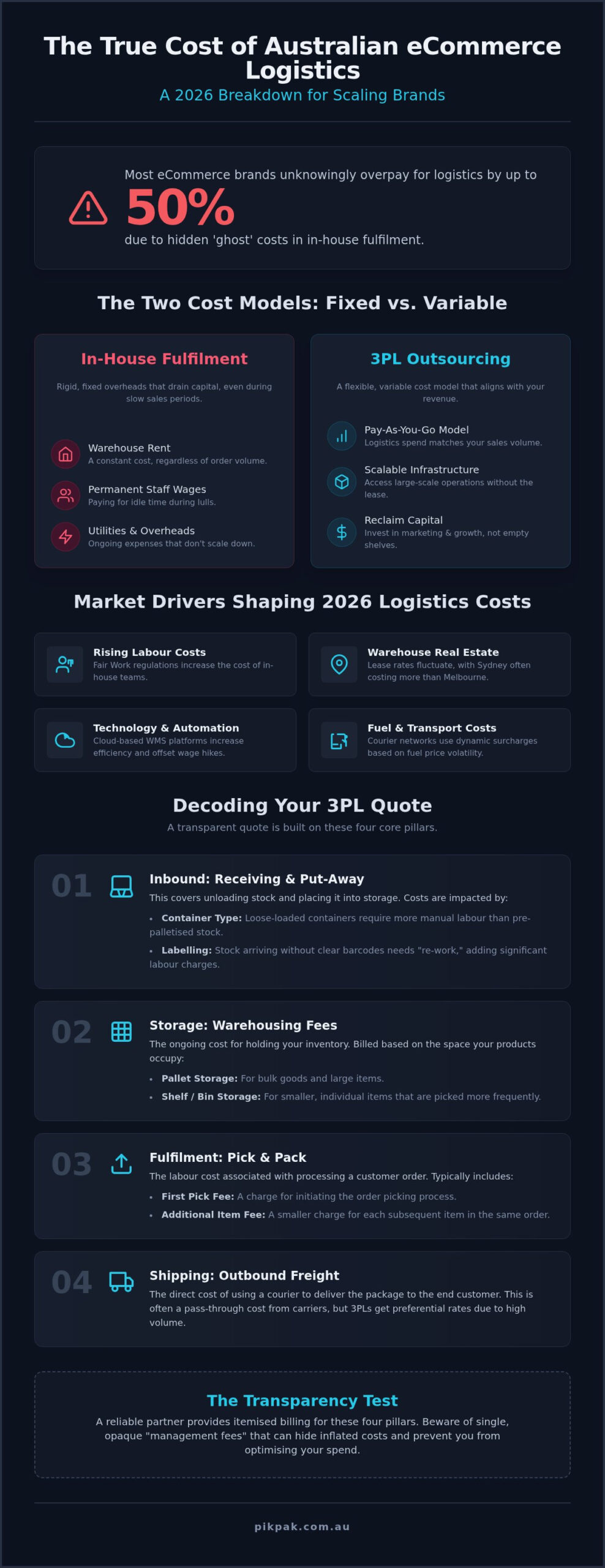
Most eCommerce brands in Australia are unknowingly overpaying for their logistics by up to 50 percent simply because they cannot see the ‘ghost’ costs of in-house fulfilment. It’s frustrating to watch your margins shrink while you are trying to scale, especially when warehouse rent in cities like Sydney and Melbourne continues to climb. You probably feel that a monthly logistics invoice should not feel like a riddle you have to solve every single time it arrives. We agree that transparency is the only way to build a partnership that actually works for your bottom line.
This guide will help you master the complexities of 3pl pricing australia by providing a pragmatic breakdown of every fee, from storage and pick-and-pack to kitting and returns. We’ll show you exactly how to compare quotes and predict your monthly spend, even during the chaos of major sales peaks. By the end of this article, you will have a clear framework to reclaim your time and transform your logistics into a predictable, scalable engine for business growth. Let’s break down the real costs of 2026 logistics so you can stop guessing and start growing with confidence.
Key Takeaways
- Identify the four core pillars of logistics billing—inbound, storage, fulfilment, and shipping—to eliminate hidden fees and gain total budget transparency.
- Calculate the true ROI of outsourcing by quantifying the “founder’s hour” and comparing in-house overhead against a scalable variable-cost model.
- Master the 2026 landscape of 3pl pricing australia to protect your margins from rising labor costs and warehouse lease rates in major cities.
- Discover actionable data-driven strategies to lower your monthly logistics spend without sacrificing the speed or quality of your customer deliveries.
- Leverage cloud-based technology to reclaim your time and transform complex operational hurdles into a simple, automated fulfilment process.
The Landscape of 3PL Pricing in Australia for 2026
Understanding 3pl pricing australia requires looking beyond a simple list of fees. 3PL pricing is the total cost of outsourced logistics operations. In 2026, the Australian market has moved decisively toward a “Transaction-Based” philosophy. This approach eliminates the guesswork by charging you based on actual activity rather than flat monthly retainers. It means your costs are directly tied to your sales volume, providing a level of financial clarity that was previously hard to achieve. Modern Third-party logistics (3PL) providers focus on this transparent model to help you maintain control over your margins during rapid growth.
Fixed vs. Variable Cost Models in Logistics
Managing your own fulfilment often feels like being anchored to a sinking ship during quiet months. You’re stuck with fixed costs like warehouse rent, utilities, and permanent staff wages even when sales are slow. These overheads are a major barrier to scaling an eCommerce brand because they create a high “break-even” point. When you partner with a 3PL, you convert these rigid liabilities into flexible, variable costs. Your logistics spend now matches your revenue. If you ship fewer orders, you pay less. This pay-as-you-go storage model is vital for navigating the seasonal fluctuations common in Australian retail, allowing you to reclaim your capital for marketing and product development.
2026 Market Drivers: Labor, Tech, and Fuel
The current economic climate has introduced new variables that every business owner must track. Recent updates to Australian Fair Work regulations have pushed warehouse labor rates higher, making in-house teams significantly more expensive to maintain. Professional providers mitigate this by investing heavily in automation. By using a cloud-based WMS platform, 3PLs process orders with a level of precision that manual teams simply can’t match. This tech-driven efficiency helps keep your per-order costs stable even as wages rise.
Real estate and transport also play major roles in your final bill. Warehouse lease rates in 2026 continue to fluctuate between major hubs, with Sydney space generally costing more than Melbourne facilities. Outsourcing allows you to tap into established infrastructure without signing a multi-year lease yourself. You also have to account for fuel volatility. Most Australian courier networks now use dynamic surcharges to manage transport costs. A transparent partner will itemise these surcharges in your warehousing and fulfilment reports, giving you the data needed to keep your shipping margins healthy. This transparency turns a complex logistical hurdle into a manageable, predictable task.
Breaking Down the Core Components of a 3PL Quote
A professional quote shouldn’t feel like a puzzle. When you evaluate 3pl pricing australia, you should see a clear breakdown of the four pillars: Inbound, Storage, Fulfilment, and Shipping. Transparency is the hallmark of a reliable partner. If a provider bundles everything into a single, opaque “management fee”, it’s a red flag. Modern logistics relies on itemised billing to ensure you only pay for what you actually use. This precision allows you to maintain control over your margins as you scale.
You should also look for technology fees. Access to a cloud-based WMS is often a separate line item. This platform gives you real-time visibility and automates order flows, which is exactly how you reclaim your time. Without a clear tech fee, you might find these costs buried in inflated pick-and-pack rates.
Receiving and Inbound Fees (The “Gatekeeper” Cost)
Inbound processing is the first point where costs can spiral. 3PLs typically charge different rates for unloading loose-loaded containers versus pre-palletised stock. Loose-loaded containers require more manual labor, which increases the price. Correct labelling is essential here. If your stock arrives without clear barcodes, the warehouse must perform “re-work,” which adds significant labor charges to your bill. A recent Productivity Commission report on logistics highlights that systemic inefficiencies often stem from poor data at the point of entry. Following strict warehouse receiving guidelines ensures your stock moves from the dock to the shelf without extra fees.
Warehousing and Storage Fees: Pallets vs. Bins
Not all storage is created equal. You’ll usually choose between pallet, shelf, or bin storage based on your product size. Pallet storage is cost-effective for bulk inventory, while bins are better for small, high-turnover SKUs. Your SKU density—how many different products you have relative to the total volume—heavily influences your bill. High SKU counts with low stock levels per item often require more bin space. This can be more expensive per cubic metre than pallet racking. You can explore different warehousing and fulfilment options to find the best fit for your inventory profile.
Pick and Pack Fees: The Heart of Fulfilment
This is where the bulk of your activity happens. Most providers use a “First Item” plus “Additional Item” logic. You pay a base rate for the order and a smaller fee for each extra item picked. Packaging materials, such as compostable satchels or custom boxes, are usually billed separately. If your orders require kitting and assembly, expect a separate labor charge per unit. This granular approach ensures you aren’t subsidising the complex orders of other clients with your simple ones.
To avoid surprises, use this checklist when reviewing competitor quotes:
- Is there a hidden account management or “admin” fee?
- Are there surcharges for peak season or weekend processing?
- What are the fees for processing returns (reverse logistics)?
- Is WMS integration and support included or extra?
If you want to see how transparent logistics can be, you can request a clear breakdown tailored to your specific business needs.
ROI Analysis: 3PL vs. In-House Fulfilment Costs
Many eCommerce founders start in a garage or spare room under the impression that “space is free.” This is a myth that limits your growth. As you scale, that “free” space quickly turns into a logistical bottleneck. Evaluating 3pl pricing australia requires a shift in perspective. You aren’t just paying for a service; you’re buying back the most valuable asset in your business: your time. Research shows that most brands underestimate their true in-house cost per order by 30 to 50 percent when they fail to account for labor and space properly. Moving to a professional partner often becomes more cost-effective once you exceed 30 to 50 orders per day.
The True Cost of In-House Operations
In-house fulfilment comes with a long list of visible and invisible expenses. Rent and utilities are obvious, but you must also factor in packaging materials and the rising cost of warehouse staff. Invisible costs are often what drain your margins. These include business insurance, WHS compliance, and equipment leases for things like trolleys or label printers. Errors also have a high price tag. A “mis-pick” or shipping error doesn’t just cost you the extra postage; it damages customer trust and requires expensive manual intervention to fix. When you delegate these tasks, you eliminate the friction of managing a physical warehouse and the risks associated with it.
Scale-Ability: The Hidden Value of Outsourcing
The real ROI of a 3PL lies in its ability to handle sudden growth spurts without a hitch. If your brand goes viral or hits a major sales peak like Black Friday, an in-house setup often crumbles. You can’t hire and train staff fast enough to meet the demand. A professional partner handles these peaks effortlessly, allowing you to scale up or down without the stress of hiring. You also benefit from the bulk shipping discounts that 3PLs pass on to their clients, which can significantly lower your total cost per order. This collective volume gives you access to rates that are usually reserved for much larger enterprises.
Quantify your “founder’s hour” to see the full picture. If you spend 15 hours a week packing boxes, you’re losing 15 hours that could be spent on high-level strategy or marketing. By using a cloud-based WMS platform, you gain real-time visibility into your inventory while someone else does the heavy lifting. This effortless control is what allows you to refocus on your core objectives. Outsourcing isn’t just an expense; it’s a strategic move to reclaim your time and ensure your business is ready for the next level of growth. Explore our range of services to see how we can simplify your operations.
How to Optimise Your 3PL Spend and Reduce Costs
Optimising your logistics spend is a continuous process of refining your operations. While 3pl pricing australia is influenced by market factors like fuel and labor, many variables remain firmly within your control. You don’t have to accept high bills as an inevitable cost of doing business. By using data to identify inefficiencies, you can transform your supply chain into a lean, high-performance engine. Regular logistics audits with your partner ensure that your storage and fulfilment strategies align with your current sales velocity.
Inventory Management and SKU Rationalisation
Dead stock is the silent killer of your bottom line. If products sit on shelves for months without moving, they drain your budget through ongoing storage fees. Use your cloud-based WMS platform to identify these slow-moving items and clear them out through promotions or bundles. This SKU rationalisation can slash your storage costs almost overnight. It’s about ensuring every pallet and bin in the warehouse is earning its keep.
Bundling products through specialised kitting and assembly services is another powerful way to save. Instead of paying for multiple “first item” pick fees, you can offer a pre-packed kit that counts as a single pick. This reduces your fulfilment spend while increasing your average order value. Precise inventory data also helps you avoid over-ordering, ensuring you only pay for the warehouse space you actually need. This level of precision makes managing a large inventory feel like a simple, manageable task.
Packaging Optimisation for Lower Shipping Rates
In the Australian courier network, you often pay for the space your parcel occupies rather than just its weight. This is known as volumetric weight. If your packaging is too large for the product inside, you are effectively paying to ship air. Optimising your box sizes to match your product dimensions can lead to significant savings on every delivery. It’s a small change that yields massive cumulative results over thousands of orders.
Consider custom-sized packaging that protects your items without adding unnecessary bulk. This not only lowers your shipping rates but also improves the unboxing experience for your customers. A pragmatic approach to packaging ensures you stay lean while maintaining high standards of security. By focusing on these details, you make your logistics feel effortless and controlled. If you’re ready to refine your strategy, you can optimise your fulfilment spend with our expert support team today.
The Pik Pak Advantage: Effortless and Transparent Pricing
Managing your logistics shouldn’t feel like a second job. At Pik Pak, we’ve designed our service to solve the “complex quote” problem that often holds back Australian eCommerce businesses. We believe that 3pl pricing australia should be clear, itemised, and easy to understand from day one. By integrating advanced technology with physical logistics, we provide a single value proposition that allows you to delegate operational burdens. This isn’t just about moving boxes; it’s about giving you the freedom to refocus on your core business objectives while we handle the heavy lifting.
Technology Support and Real-Time Visibility
The backbone of our operation is the Pik Pak WMS platform. This cloud-based system provides you with total inventory visibility, which is essential for making informed stock decisions. Connecting your existing sales channels is a simple, manageable task that takes the stress out of backend management. Whether you use Shopify, WooCommerce, or Magento, our platform integrates seamlessly to automate your order flow. This automation does more than just save time. It significantly reduces customer service inquiries by providing accurate, real-time tracking data for every delivery. When your customers know exactly where their orders are, your support costs go down and your brand trust goes up. You get to monitor everything from a single dashboard, maintaining effortless control without being bogged down in manual spreadsheets.
Customer-Centric Logistics in Australia
We pride ourselves on being a seasoned, tech-savvy partner that understands the local market. Our Melbourne-based expert support team is always available to help you navigate specific operational hurdles with a calm, expert approach. We align our service priorities with your specific growth goals, ensuring that every order is handled with precision and care. This includes managing the complex process of returns management, or reverse logistics, which is often a major source of friction for growing brands. By providing a smooth and reliable returns experience, we help you maintain customer trust even when a product isn’t the right fit.
Choosing a logistics partner is about finding an enabling force for your business. We eliminate the friction of hidden fees and operational inefficiency so you can reclaim your time for strategy and marketing. Your SKU profile is unique, and your pricing should reflect your actual activity. Stop guessing and start scaling with a partner that values transparency as much as you do. Request a transparent 3PL quote today and see how effortless your logistics can become.
Take Control of Your Logistics Strategy Today
Logistics shouldn’t be a source of stress or a mystery on your balance sheet. By mastering the core components of 3pl pricing australia, you’ve taken the first step toward building a more scalable and profitable eCommerce brand. You now have the framework to move away from rigid fixed costs and toward a flexible, variable model that matches your actual sales volume. Remember that optimising your SKU density and choosing transparent partners are the most effective ways to protect your margins in the 2026 market.
It’s time to delegate the operational hurdles and refocus on what you do best. We provide the technology and expertise needed to make your fulfilment feel effortless. With our real-time WMS visibility and dedicated Melbourne-based support, you can scale with confidence knowing there are no hidden fees. Take the next step toward reclaiming your time and growing your business. We are ready to help you simplify your backend and accelerate your growth.
Get an Effortless 3PL Pricing Quote from Pik Pak and start your journey toward simplified operations today.
Frequently Asked Questions
How much does 3PL cost per order in Australia?
Total 3PL costs generally range from $8 to $18 per order for businesses shipping between 500 and 3,000 orders monthly. This figure includes the base pick fee, additional item charges, and the cost of the final delivery. It’s a pragmatic way to view your expenses because it combines all operational steps into a single, predictable metric. Using this total cost per order helps you maintain clear margins even during rapid growth.
What are the typical monthly storage fees for an eCommerce business?
Storage is billed based on the physical space your inventory occupies, usually per pallet or bin. Typical monthly rates in Australia fall between $25 and $45 per pallet. You only pay for the space you actually use each month, which makes it a scalable alternative to a fixed warehouse lease. This variable model ensures you aren’t paying for empty shelving during your quieter sales periods throughout the year.
Is there a minimum order volume required for 3PL?
Most providers suggest that outsourcing becomes a strategic advantage once you exceed 30 to 50 orders per day. At this level, the time you reclaim from packing boxes is worth more than the service fees. The economics of 3pl pricing australia shift in your favour as your volume grows, allowing you to benefit from bulk shipping rates. It’s a simple way to move from a chaotic garage to a professional operation.
Are there hidden fees I should look out for in 3PL contracts?
Look closely for “ghost” costs like account management fees, peak season surcharges, or minimum monthly spend requirements. A transparent provider will itemise these clearly so you don’t face surprises on your invoice. Always ask for a full list of ancillary charges, such as fees for returns processing or manual re-work of non-compliant stock. Identifying these early ensures your logistics costs remain predictable and easy to manage as you scale.
How do 3PLs calculate shipping costs across Australia?
Yes, because it converts high fixed overheads into manageable variable costs. When you factor in warehouse rent, utilities, insurance, and the “founder’s hour,” outsourcing is often 30 to 50 percent cheaper for growing brands. It eliminates the wasted capital spent on empty warehouse space and permanent staff wages during your quieter months. This shift gives you more control over your cash flow and allows you to reinvest in marketing and product development.
What is an onboarding fee and why do I have to pay it?
This one-time fee covers the technical setup and integration of your eCommerce store with the warehouse management system. It ensures that your orders flow automatically and your inventory data stays accurate from day one. It’s a vital investment in precision that prevents costly manual errors and shipping delays later on. Think of it as the foundation for an effortless partnership that removes operational friction from your daily routine.
How does SKU count impact my total 3PL pricing?
Your SKU count directly influences how much shelf or bin space you occupy in the warehouse. Each unique product needs its own location for accurate picking, even if you only have a few units in stock. High SKU density often leads to higher storage costs per cubic metre compared to bulk pallet racking. Rationalising your inventory and removing slow-moving items is a fast way to lower your overall 3pl pricing australia.