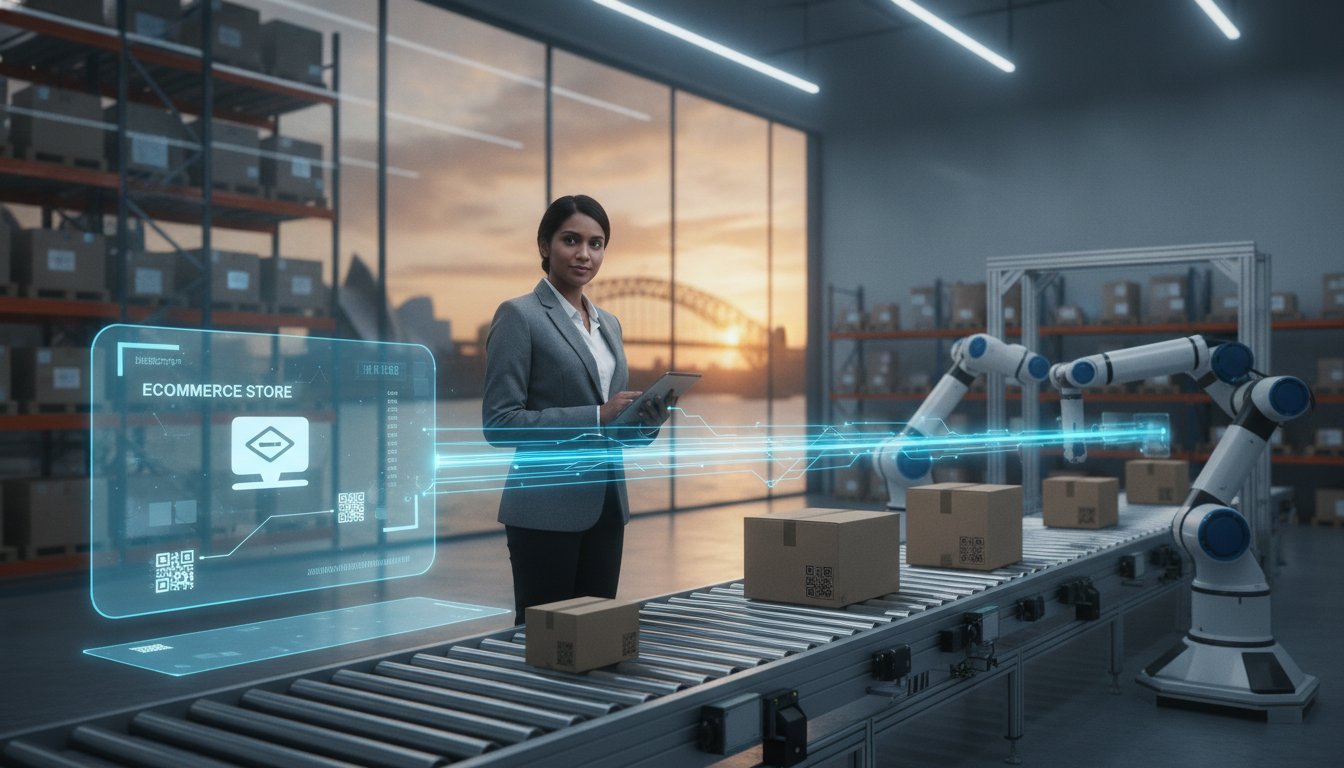
How much of your business growth is being held hostage by a manual spreadsheet? If you’re spending your evenings reconciling stock levels or manually typing customer addresses into shipping labels, you aren’t running a business; you’re managing a bottleneck. Achieving a seamless 3pl ecommerce integration is the single most effective way to break that cycle. It acts as a digital handshake between your online store and your warehouse, ensuring every order flows instantly without human intervention.
We understand the stress of seeing “out of stock” messages on your site when the warehouse is actually full, or dealing with frustrated customers who can’t track their parcels. It’s exhausting to focus on logistics when you should be focusing on scale. This guide will show you how to automate your order flow and reclaim your time through smart integration. We’ll explore how a Warehouse Management System (WMS) creates a single source of truth for your inventory, simplifies the pick, pack, and ship process, and provides the real-time visibility your customers expect.
Key Takeaways
- Understand how a digital handshake replaces manual spreadsheet logistics to ensure your inventory data stays accurate across every sales channel.
- Discover the step by step process of a successful 3pl ecommerce integration and how a tech savvy partner manages the complex backend work for you.
- Learn how to remove the operational ceiling on your brand by automating the pick, pack, and ship workflow to focus on scaling your business.
- Identify common integration hurdles before they happen and learn the strategies to keep your data flowing without technical friction.
- Find out why choosing a partner based on WMS capabilities and technical support is more valuable for long term growth than simple storage rates.
What is 3PL eCommerce Integration and Why Does It Matter?
Think of 3PL integration as the digital handshake between your online storefront and your logistics partner. It’s the technical bridge that allows your sales data to flow instantly into the warehouse. For many growing brands, Third-party logistics (3PL) providers offer the physical space and labour; however, the integration is what provides the intelligence. Without it, you’re stuck in the world of “spreadsheet logistics,” where manual data entry leads to inevitable delays and human error.
The core goal of a smart 3pl ecommerce integration is to ensure your store and the warehouse speak the same language in real-time. This creates a “Single Source of Truth” for your inventory. When a customer buys your last item on Shopify, the warehouse knows instantly. When a return is processed at the facility, your store’s stock levels update automatically. This level of precision eliminates the stress of overselling and allows you to focus on growth rather than troubleshooting.
The Components of a Seamless Integration
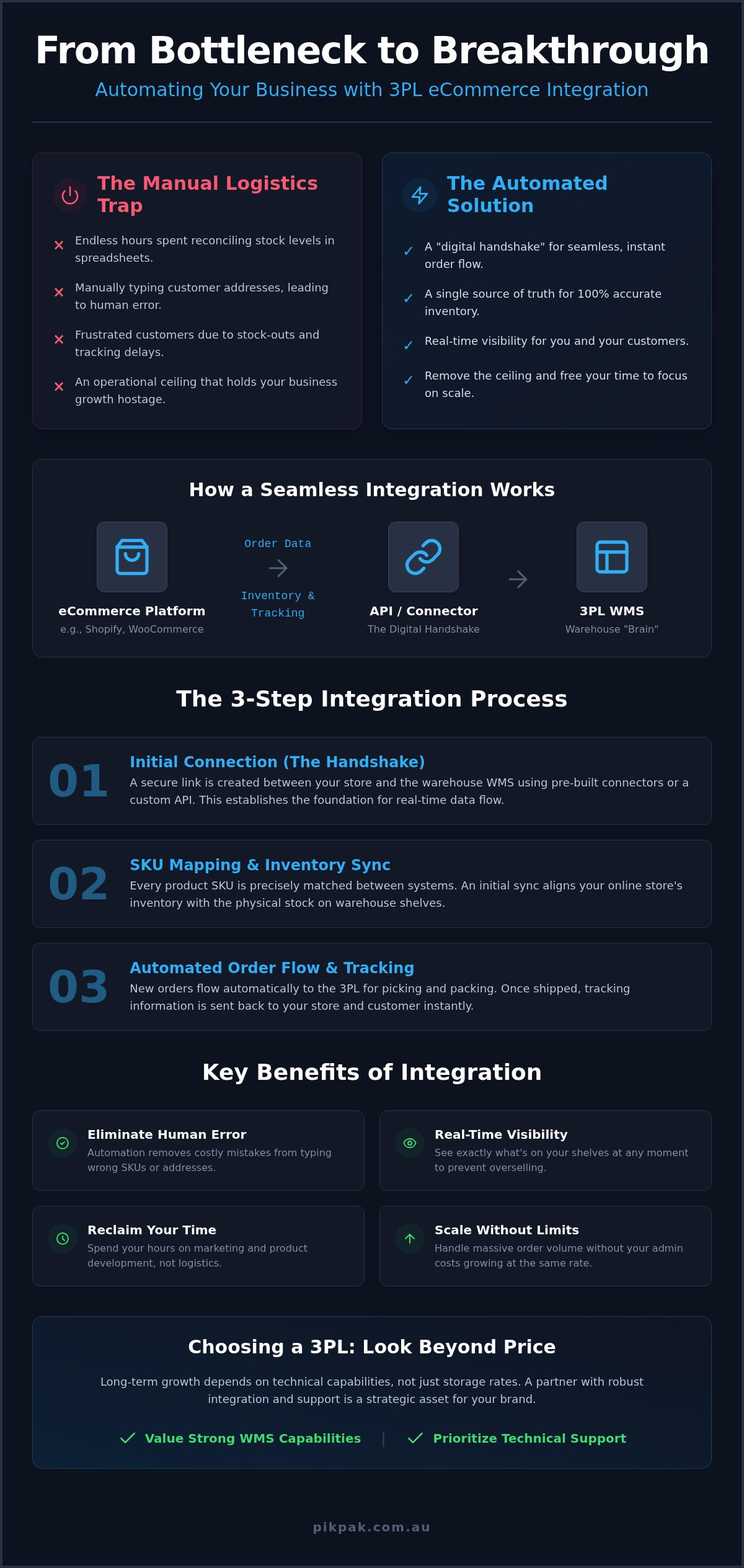
A successful connection relies on three primary pillars working together. First, your eCommerce platform, such as Shopify or WooCommerce, acts as the customer-facing interface. Second, the 3PL Warehouse Management System (WMS) serves as the “brain” of the operation, managing the physical movement of goods. Finally, an API or pre-built connector bridges these two systems. At Pik Pak, we provide WMS platform access that uses these connectors to automate the entire order flow, ensuring your data is never siloed or outdated.
Why Your Growing Business Can No Longer Ignore It
If you’re still manually sending CSV files to your provider, you’ve likely hit an operational ceiling. You can’t scale your order volume if your administrative headcount has to grow at the same rate. Integration removes this barrier by automating the order entry process. It also meets the high expectations of modern shoppers who demand instant tracking updates the moment their package leaves the dock.
- Eliminate Errors: Automation removes the risk of typing the wrong SKU or address.
- Real-time Visibility: See exactly what’s on your shelves at any moment.
- Reclaim Your Time: Spend your hours on marketing and product development, not logistics.
If you’re just starting to explore how these partnerships work, check out What is 3PL? Your Complete Guide for a foundational look at the industry. Transitioning to a fully integrated model isn’t just a technical upgrade; it’s a strategic move to future-proof your brand and ensure a professional experience for every customer.
How the 3PL Integration Process Works: Step-by-Step
Setting up your logistics shouldn’t feel like a complicated coding project. While the backend technology is sophisticated, the process for the business owner should be straightforward and logical. A pragmatic partner handles the heavy lifting, turning technical requirements into a “set and forget” system. The goal of a successful 3pl ecommerce integration is to create a seamless loop where data flows without your intervention. This allows you to focus on your brand while the machines talk to each other in the background.
Step 1: The Initial Connection (The Handshake)
The first step involves creating a secure link between your store and the warehouse. Most modern brands use pre-built connectors for platforms like Shopify or WooCommerce. These are essentially plug and play solutions that require minimal technical knowledge. If you have a custom built site, you might opt for a custom API integration instead. This phase establishes the connection to professional 3PL logistics services. You’ll grant the 3PL WMS limited, secure permissions to view orders and update stock levels. We also decide on data frequency; real-time updates are the gold standard for preventing overselling and maintaining customer trust.
Step 2: SKU Mapping and Inventory Sync
Precision is vital during this phase. Every product in your store must have a matching Stock Keeping Unit (SKU) in the warehouse system. If your store lists an item as “BLUE-TSHIRT-L” but the warehouse recognizes it as “TSHIRT-BLUE-L”, the systems won’t communicate correctly. We map these codes to ensure a perfect match across both platforms. This step also includes setting up “Master Data,” which covers the physical dimensions and weights of your products. Once the mapping is complete, we run the first inventory sync. This brings your digital store into perfect alignment with the physical stock sitting on the warehouse shelves.
Step 3: Order Flow and Tracking Automation
Once the systems are aligned, the true automation begins. When a customer places an order, the 3pl ecommerce integration pulls that data into the WMS instantly. The warehouse team receives a pick slip, prepares the package, and ships it. The “reverse flow” then kicks in. The WMS sends the tracking number back to your store, which automatically notifies the customer. This eliminates manual emails and repetitive status updates. Before going live, we always run a series of test orders to ensure every trigger works as expected. If you need assistance with this technical setup, our technology support team can guide you through every phase of the connection.
Key Benefits: Reclaiming Your Time and Scaling Your Brand
Smart logistics isn’t just about moving boxes. It’s about removing the operational ceiling that stops you from reaching the next level of revenue. When you implement a 3pl ecommerce integration, you’re doing more than just connecting software; you’re buying back your freedom. Instead of spending your Mondays reconciling weekend sales across Shopify and eBay, you can focus on your next marketing campaign. This automation allows you to scale your order volume without needing to hire a fleet of administrative staff.
One of the biggest drains on a founder’s time is the constant stream of “Where is my order?” emails. By automating the data flow, tracking numbers are pushed to customers instantly. This transparency builds trust and slashes customer service enquiries by providing the answers before the questions are even asked. You can also finally embrace an omnichannel strategy. Whether you sell on your own site, a marketplace, or through social media, every sale draws from a single, integrated inventory pool in the warehouse.
Real-Time Inventory Visibility
Overselling is a brand killer. It leads to disappointed customers and negative reviews that are hard to erase. With integrated Warehousing and Fulfilment Services, your digital stock levels reflect the physical reality in the warehouse. This is especially critical during seasonal spikes like Black Friday or Christmas. You won’t need to pause your store to do manual counts; the WMS handles the sync, so you can keep selling with confidence while the system manages the stock levels.
Enhanced Customer Experience
Speed is the new currency in eCommerce. A seamless integration shrinks the “click-to-ship” window significantly. Orders land in the warehouse moments after the customer hits buy, allowing for faster dispatch and shorter delivery times. Branded tracking notifications keep the customer engaged throughout the journey. Additionally, a streamlined returns process ensures that reverse logistics is just as easy as the initial delivery, turning a potential negative into a customer loyalty win.
Data-Driven Decision Making
You can’t manage what you don’t measure. The WMS provides detailed reports that go beyond just stock levels. You can identify which SKUs are your true profit drivers and which are just taking up shelf space. Monitoring courier performance and fulfilment speed helps you maintain a high standard of service for your customers. To understand the full scope of these processes, read our guide on What is Order Fulfilment? for a deep dive into the logistics lifecycle.
Common Challenges in 3PL Integration (and How to Avoid Them)
It’s natural to feel a bit of “integration anxiety.” Connecting two complex digital systems sounds like a recipe for a headache. However, every hurdle is just a solvable task when you have the right partner. The key to a smooth transition is preparation and transparency. By addressing potential friction points before you flip the switch, you ensure your 3pl ecommerce integration remains a growth engine rather than a source of stress.
The “Messy Data” Trap
The most common cause of integration failure isn’t the software; it’s the data. Duplicate SKUs, missing barcodes, or inconsistent naming conventions create chaos once they hit the warehouse floor. Before you begin the connection, perform a thorough audit of your product catalog. Ensure every product variation has a unique, clean identifier that matches across all platforms. SKU mapping is the critical link that ensures your store’s data and the warehouse system maintain absolute integrity. If your data is clean, the automation becomes effortless.
Technical Glitches and Sync Errors
Even the most robust systems occasionally face a sync failure. This might happen due to a major platform update or a temporary server blip. The danger isn’t the glitch itself; it’s not knowing it happened until a customer complains. Reliable systems use detailed error logs to track every data transfer. You should ensure your provider offers dedicated tech support to resolve these issues quickly. Security is also paramount. Always use encrypted API keys and limit access permissions to only what’s necessary for the 3pl ecommerce integration to function securely.
Managing Complex Orders (Kitting and Bundling)
Marketing bundles are fantastic for increasing average order value, but they can be tricky for logistics. A single SKU in your online store might represent three separate items that live in different areas of the warehouse. Your WMS must be smart enough to “explode” that bundle into its component parts for the picking team. The Pik Pak WMS handles kitting and assembly services with precision, ensuring the right items end up in the right box every time. You can see how we manage these operational nuances in our Pik Pak Service Priorities.
Don’t let technical fears hold your brand back from reaching its potential. Contact Pik Pak today to discuss how our tech-savvy team can simplify your integration and streamline your operations.
Choosing a 3PL with the Right Integration Capabilities
Many business owners make the mistake of choosing a logistics partner based solely on the lowest pallet storage rate. While cost is always a factor, a cheap storage rate won’t fix the lost revenue caused by technical downtime or manual shipping errors. A pragmatic choice involves evaluating a partner’s digital infrastructure as much as their warehouse space. Your 3pl ecommerce integration should be the foundation of your operations, providing the efficiency you need to scale without friction. Look for a partner that treats technology as a core service rather than an afterthought.
Questions to Ask Your Potential 3PL Partner
Before signing a contract, you need to know how the technology will behave under pressure. Ask direct questions to gauge their technical maturity and support levels. You don’t want to discover a limitation only after your first big sale event. Consider these specific queries:
- “Do you have a native connector for my specific platform, like Shopify or WooCommerce?”
- “How do you handle inventory discrepancies between my online store and your WMS?”
- “What kind of real-time reporting does your WMS provide for stock levels and courier performance?”
Native connectors are essential because they reduce the need for expensive custom development. Real-time reporting ensures you aren’t making critical business decisions based on data that is 24 hours old.
The Pik Pak Advantage: Technology Meets Support
At Pik Pak, we bridge the gap between complex backend systems and simple user actions. Our cloud-based WMS is designed to be simple, secure, and accessible from anywhere. We don’t just hand you an API key and leave you to struggle with the setup. Our team provides dedicated technology support and onboarding assistance to ensure your 3pl ecommerce integration is flawless from day one. We address the “human” side of tech, providing Australian-based experts who understand your business needs.
Our system is built to scale alongside your brand. Whether you are shipping your first 100 orders or managing a volume of 10,000 or more per month, our platform maintains the same level of precision. We focus on the logistics so you can refocus on your core objectives and business growth. This isn’t just about outsourcing a task; it’s about building a partnership that removes major operational hurdles.
Integration is the first strategic step toward delegating operational burdens and reclaiming your time. By choosing a partner that prioritizes technical efficiency and dedicated, multi-channel support, you set your brand up for long-term success. Ready to automate? Contact Pik Pak for an integration consultation today.
Scale Your Brand Without the Operational Friction
Automating your logistics is more than a technical upgrade; it’s a strategic move to remove the operational ceiling from your brand. By ensuring your online store and warehouse speak the same language, you eliminate manual errors and provide the real-time tracking your customers expect. A successful 3pl ecommerce integration transforms your supply chain from a source of stress into a scalable growth engine that works while you sleep. This digital connection ensures that your inventory levels remain accurate across every sales channel, protecting your reputation and your bottom line.
You deserve a partner that offers more than just shelf space. With Pik Pak, you gain real-time inventory visibility through our cloud-based WMS access, all backed by dedicated Australian-based tech support to keep your data flowing perfectly. We handle the technical “handshake” and the daily pick, pack, and ship process so you can focus entirely on marketing and product development. It’s time to stop managing bottlenecks and start leading your business toward its next major milestone.
Simplify your logistics with Pik Pak’s seamless eCommerce integration. You’ve built a brand with incredible potential; let’s give it the foundation it needs to grow effortlessly.
Frequently Asked Questions
Do I need a developer to integrate my store with a 3PL?
You don’t usually need a developer if you’re using a major platform like Shopify or WooCommerce. Most modern 3PLs provide pre-built connectors that act as plug and play solutions. These allow you to link your store in just a few clicks. However, if you have a custom built website or highly specific data requirements, a developer might be needed to build a custom API connection. A tech savvy partner manages the heavy lifting for you.
Which eCommerce platforms can integrate with a 3PL WMS?
Most 3PL Warehouse Management Systems are designed to work with the world’s leading eCommerce platforms. Common integrations include Shopify, WooCommerce, Magento, BigCommerce, and marketplaces like eBay or Amazon. At Pik Pak, our cloud based WMS offers pre-built connectors for these major players. This ensures your 3pl ecommerce integration is stable and secure. If you use a less common platform, we also provide API access to ensure your data still flows seamlessly.
Will I lose control of my inventory if I integrate with a 3PL?
You actually gain more control rather than losing it. Integration provides real-time visibility into your stock levels directly through a web-based platform. Instead of guessing what’s on your shelves or relying on weekly spreadsheets, you see the exact physical reality of your inventory at any moment. This single source of truth allows you to make better buying decisions and prevents the risk of overselling products that aren’t actually available for dispatch.
How much does 3PL eCommerce integration typically cost?
Costs vary depending on the complexity of your setup and the specific 3PL provider you choose. Some providers charge a one-time setup fee to map your SKUs and establish the initial connection, while others might include integration as part of their standard onboarding. You should also check if there are ongoing monthly fees for WMS platform access. It’s best to request a transparent quote that outlines all technical and operational costs before you commit.
Can a 3PL handle bundles and kitted products through an integration?
Yes, a sophisticated WMS can manage kitting and assembly services with ease. When a customer buys a bundle SKU in your store, the 3pl ecommerce integration tells the warehouse to pick multiple individual items to fulfill that single order. This process ensures your inventory levels for each component stay accurate. It removes the need for you to manually break down orders or manage complex stock counts for promotional sets and gift packs.
What happens to my data if the integration sync fails?
If a sync fails, modern systems use error logs to identify exactly what went wrong. Most integrations have built-in retry mechanisms to attempt the data transfer again once the connection is restored. You won’t lose your data; it simply waits in a queue. Having access to dedicated tech support is vital here. A reliable partner will monitor these syncs and help you troubleshoot any technical blips before they impact your customer’s experience.
How long does the typical 3PL integration process take?
A standard integration using pre-built connectors can often be completed within a few business days. This timeframe includes the initial connection, SKU mapping, and testing phases. If your business requires a custom API or has thousands of complex SKUs, the process might take a few weeks to ensure everything is mapped correctly. The goal is always to move at a pace that ensures total data accuracy before your first live order flows through the system.